
For the past several years, enterprise AI has been defined by one question:
How do we build better models?
Organizations invested heavily in GPUs, expanded compute capacity, and measured progress by model size, training time, and benchmark performance.
Those investments accelerated AI innovation. But they also encouraged a component-by-component view of infrastructure, where a GPU, server, network, and software stack are evaluated independently.
That approach worked when the primary challenge was training models.
The next phase of enterprise AI is different.
As AI moves from experimentation to production, organizations are discovering that building the model is only the beginning. The bigger challenge is operating AI at enterprise scale — serving inference, supporting AI agents, integrating with enterprise applications, protecting sensitive data, and sustaining performance as demand grows.
That requires infrastructure designed as a system, not a collection of parts.
The conversation around enterprise AI is shifting away from model performance alone. It is increasingly about how compute, memory, networking, cooling, security, and software work together to keep production AI running.
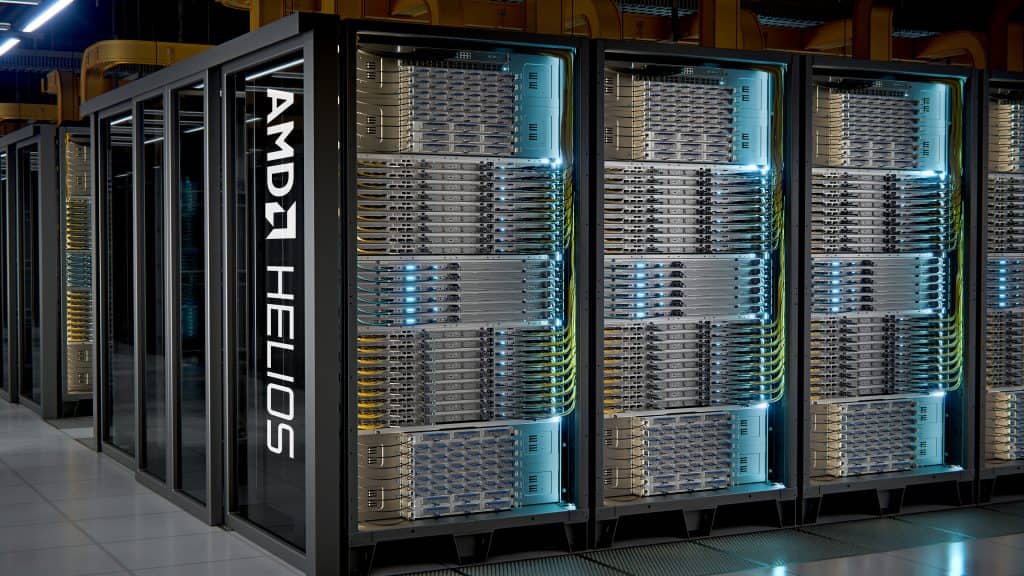
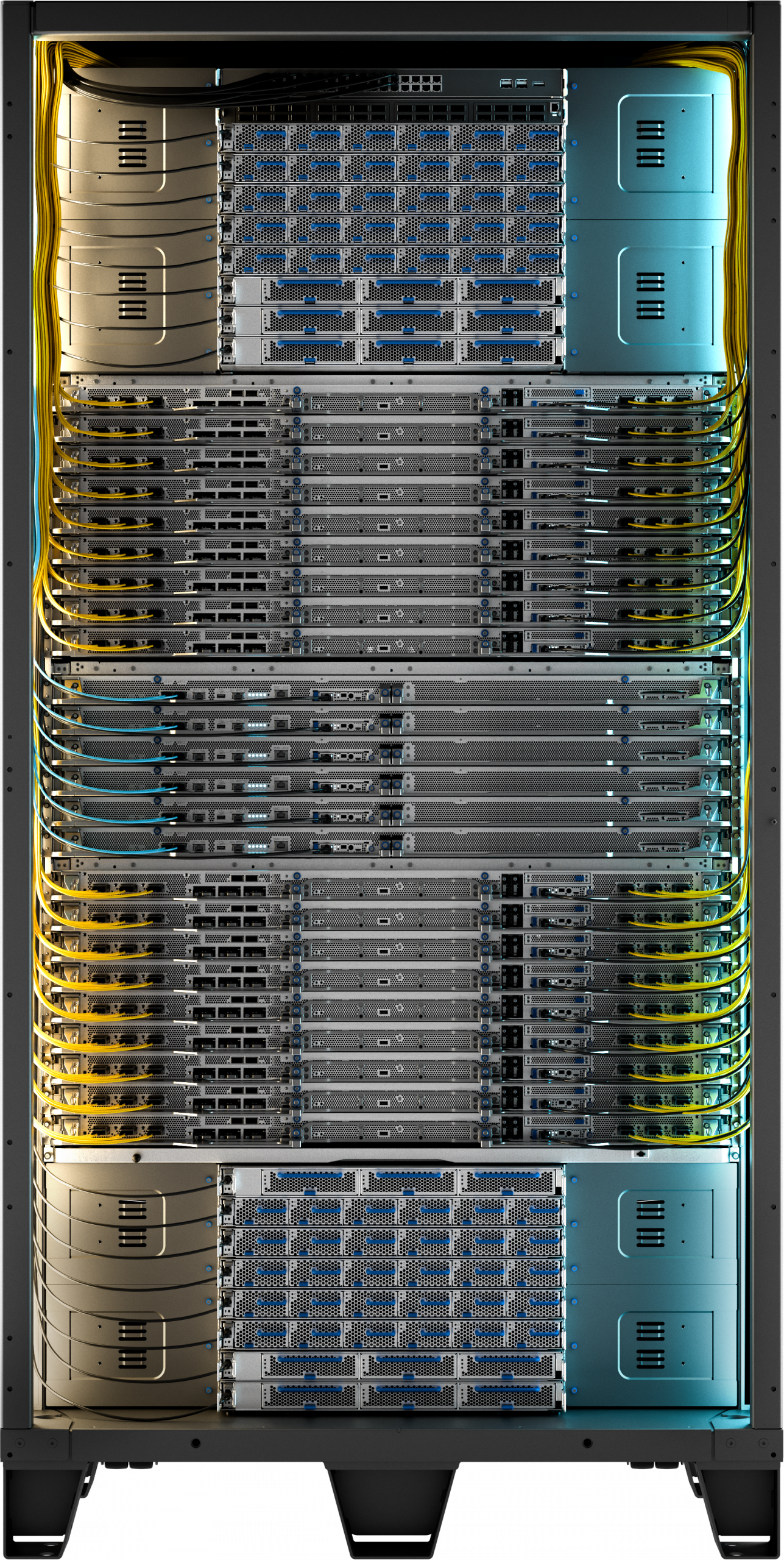
Oracle and AMD see Helios as a foundation for that new era. The AMD Helios rack-scale solution brings AMD Instinct MI455X GPUs, 6th Gen AMD EPYC CPUs, AMD Pensando networking, and AMD ROCm software together in a rack-level design. For customers, that means the platform can be considered as one coordinated AI system rather than assembled as disconnected layers.
The Infrastructure Built for Training Isn’t Enough
Training remains one of the most compute-intensive workloads in AI.
But once a model reaches production, the workload changes.
Every customer interaction.
Every AI-generated recommendation.
Every enterprise search.
Every intelligent assistant.
Every AI-powered application.
They all generate inference requests that must be processed continuously. They also create repeated exchanges among models, data stores, applications, and tools – placing new demands on memory, networking, and operations.
Unlike training, inference doesn’t happen once.
It happens every time someone uses AI.
For many organizations, inference is quickly becoming the largest and most persistent AI workload they operate. That changes how infrastructure is evaluated.
A production AI environment cannot be sized by GPU count alone. It must keep model weights and active context close to compute, move information quickly among GPUs, and connect that compute to the applications and data that make an AI response useful. Helios is designed around those interdependencies at rack scale.
The organizations that succeed in the next phase of AI won’t simply build powerful models. They will build systems that can deliver dependable AI output efficiently in production.
AI Agents Are Raising the Stakes for Infrastructure
As organizations enter the next era of AI agents, infrastructure requirements are evolving.
Unlike traditional AI applications, AI agents continuously interact with enterprise data, APIs, business applications, and other services. A single task can involve multiple model calls, retrieval steps, tool interactions, and long-running context.
That raises the value of a tightly integrated AI system. By accessing high-density CPU capacity in conjunction with a high-performance GPU platform like Helios, enterprises can build out a complete end-to-end AI solution that includes model training with all of the necessary data pre-processing and traffic management, inference, and orchestration of agents and any application workloads they require. The result is infrastructure built for the full path of an agentic workload, not only its model invocation.
As AI becomes more autonomous, infrastructure becomes more strategic.
Infrastructure Determines How Well AI Performs
Production AI depends on an entire technology stack operating in concert.
GPUs perform the parallel work behind model training and inference.
CPUs run the services around the model: application logic, APIs, data preparation, retrieval, analytics, and orchestration.
DPUs and network interfaces help handle the movement, isolation, and management of data between services and across infrastructure. Memory capacity and bandwidth keep models and context near compute, while power, liquid cooling, security, and operations determine whether high-density AI can run reliably over time.
Enterprise AI isn’t about choosing CPUs or GPUs.
It is about designing the CPU, GPU, DPU, networking, memory, and software layers to work together for the workload.
This applies to the rack-level design of Helios and to the complete end-to-end AI solution that includes high-density, cost-efficient CPU compute.
Flexibility Will Separate AI Leaders from Everyone Else
TNo two organizations are building AI the same way.
Some are deploying AI globally across public cloud environments.
Others must meet strict sovereignty, regulatory, or industry-specific requirements.
Many are integrating AI into decades of existing enterprise applications while extending new capabilities to factories, retail locations, hospitals, and the edge.
Infrastructure can no longer be optimized for one deployment model or one workload type.
It has to adapt as business requirements evolve.
That flexibility is becoming a competitive advantage.
Why Oracle and AMD
This is where the Oracle and AMD partnership becomes important.
Helios is a key pillar of the one Oracle and one AMD story. AMD supplies the CPU, GPU, DPU, networking, and software components as a coordinated rack-scale architecture; Oracle Cloud Infrastructure provides the enterprise cloud environment in which customers can apply that architecture to real AI workloads.
Oracle and AMD have collaborated to architect multiple generations of compute shapes, both virtual machines and bare metal instances, that can provide the CPU power to deploy and orchestrate AI agents.
The value is not that the technologies sit beside one another. It is that they are engineered to address the same operational problem: moving from isolated AI components to a system that can support large-scale inference, training, fine-tuning, and agentic applications.
Oracle’s distributed cloud architecture extends the choice of where those workloads run – across public cloud, sovereign cloud, dedicated regions, multicloud environments, and the edge- while helping organizations maintain a common operating model. Together, the Oracle and AMD approach gives customers a more integrated AI foundation and flexibility in how they deploy it.
As enterprise AI continues to evolve, infrastructure must evolve with it.
With Helios and high-performance, high-density compute shapes like E6 Acceleron, Oracle and AMD are bringing together the infrastructure layers that the next generation of enterprise AI requires.
Ready to Build the Next Generation of Enterprise AI?
Whether you’re modernizing enterprise applications, scaling AI inference, deploying AI agents, or preparing for the next generation of enterprise AI, Oracle and AMD offer an integrated Helios-based foundation designed to help turn AI from an experiment into a dependable production capability.