


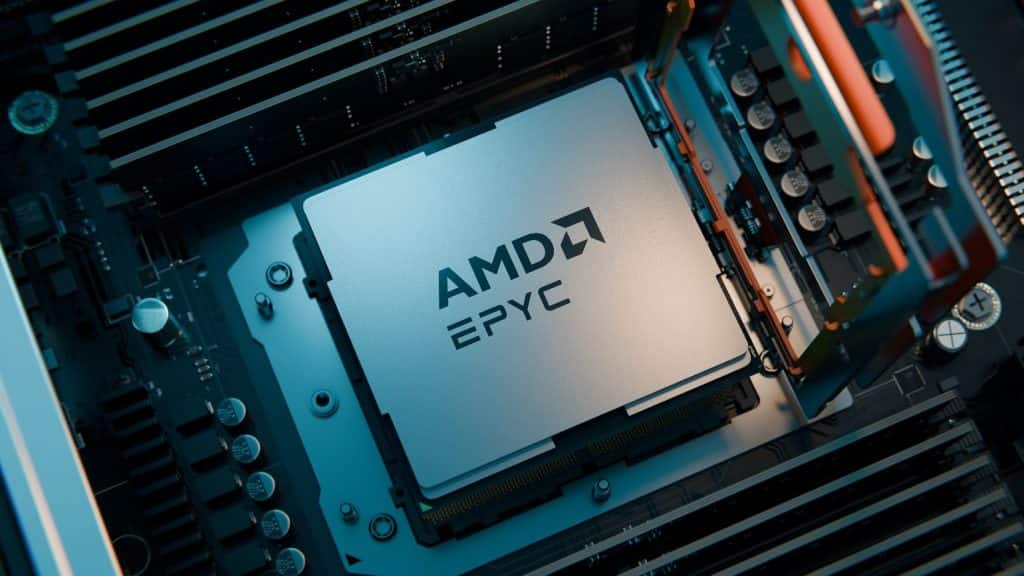
Today, we’re announcing two new Oracle Cloud Infrastructure (OCI) Compute E6 Acceleron instances, including E6 DenseIO Acceleron and E6 Standard Acceleron shapes, powered by the latest 5th Gen AMD EPYC™ “Turin” processors. Together, these new shapes deliver a major step forward in performance and efficiency for both storage-optimized and general-purpose workloads.
E6 DenseIO Acceleron’s 5th Gen AMD EPYC™ CPU cores deliver up to 17% higher instructions per clock (IPC) compared to previous-generation E5 DenseIO, while E6 Standard Acceleron provides 16% higher per-core CPU performance than existing E6 Standard instances. Built on the Oracle Acceleron architecture with a single Oracle Acceleron SmartNIC, both shapes also provide higher throughput, lower latency, and improved efficiency for modern cloud workloads.
Oracle Acceleron SmartNIC for modern workload performance
E6 Acceleron instances are built on Oracle Acceleron, OCI’s suite of network software and architecture designed to improve performance, enhance security, and simplify operations. At the core is Oracle Acceleron SmartNIC, which improves throughput per core and per instance while enabling strong isolation, line-rate encryption, and no downtime network patching. It also enables NVMe-based storage acceleration, delivering faster and more efficient data access without the cost and performance penalties of dual-NIC designs.
E6 DenseIO Acceleron: Designed for data-intensive workloads
OCI DenseIO instances are designed for applications that require high-performance local storage, low latency, and high I/O operations per second (IOPS). Common use cases include relational and NoSQL databases, real-time analytics platforms, distributed storage systems, and large-scale caching tiers. These workloads depend on fast data access and predictable performance. With OCI Compute E6 DenseIO Acceleron, customers can process larger datasets, support higher transaction rates, and scale more efficiently while maintaining consistent performance without compromising security.
E6 DenseIO Acceleron bare metal instances feature 192 cores, 2.3 TB of memory, and 81.6 TB of direct-attached NVMe storage, enabling demanding storage-optimized workloads to run at scale. Compared to previous-generation E5 DenseIO instances, E6 DenseIO Acceleron provides 1.5x more cores and memory, 33% higher memory bandwidth, and up to 2x networking performance.
Built on the “Zen 5” architecture, the 5th Gen AMD EPYC™ processors in E6 DenseIO Acceleron deliver up to 17% higher instructions per clock, along with higher base and boost frequencies. These architectural gains translate into higher compute throughput for both transaction-heavy and analytics workloads.
E6 DenseIO Acceleron is available in both bare metal and virtual machine (VM) configurations. Customers using previous-generation E5 DenseIO instances can take advantage of higher compute, memory, and networking performance to run larger and more complex workloads. For memory-intensive applications, a single bare metal instance provides up to 2.3 TB of memory.
E6 DenseIO Acceleron VM instances start at 8 OCPUs and 6.8 TB of NVMe storage and scale up to 48 OCPUs and 40.8 TB of NVMe storage. Each VM provides 6 GB of memory per thread, enabling flexible right-sizing for a wide range of workload requirements.
| Shape | OCPU | Memory | Attached Storage | Remote Storage | Network |
| Bare metal: BM.DenseIO.E6.Ax.192 | 192 cores | 2304 GB | 81.6 TB | Up to 1 PB of remote block storage | 200 G |
| Virtual machine: VM.DenseIO.E6.Ax.Flex | 8–48 cores | 96–576 GB | 6.8–40.8 TB | Up to 1 PB of remote block storage | Up to 48 Gbps |
OCI Compute E6 Standard Acceleron: Improved performance for general-purpose workloads
In addition to DenseIO, we’re also introducing E6 Standard Acceleron instances for a broad range of enterprise and general-purpose workloads. E6 Standard Acceleron delivers 16% higher per-core CPU performance compared to existing E6 Standard instances, helping improve performance for workloads that depend on strong single-threaded efficiency and consistent per-core throughput.
These improvements make E6 Standard Acceleron well suited for a wide range of workloads, including application servers, microservices, enterprise applications, and scale-out architectures. The new shape also aligns memory-to-core ratios more closely with real-world workload needs, helping customers optimize both performance and cost efficiency.
E6 Standard Acceleron is also available in both bare metal, with 192 cores and 1.5 TB of memory, and flexible virtual machine configurations. E6 Standard Acceleron VM instances support 1 to 94 OCPUs and up to 712 GB of memory, giving customers the flexibility to align compute and memory resources more closely with workload needs, from lightweight containerized applications to enterprise workloads that require higher per-core performance and larger memory footprints.
| Shape | OCPU | Memory | Attached Storage | Remote Storage | Network |
| Bare metal: BM.Standard.E6.Ax.192 | 192 cores | 1536 GB | 2 x 960 GB | Up to 1 PB of remote block storage | 200 G |
| Virtual machine: VM.Standard.E6.Ax.Flex | 1–94 cores | 1–64 GB per OCPU up to 712 GB | None | Up to 1 PB of remote block storage | 1-94 Gbps |
Modern infrastructure for modern workloads
E6 Acceleron instances are purpose-built to support the most demanding enterprise workloads, combining cutting-edge performance with the flexibility modern applications require:
- Broad OS support: Run your workloads on the latest operating systems, including Oracle Linux 8 & 9, Ubuntu 22 & 24, Windows Server 2019 & 2022, and Autonomous Linux.
- Flexible platform configuration: Fine-tune your environment with control over core counts, hyperthreading, NUMA settings, and more.
Getting started and availability
Whether you’re running storage-intensive databases, real-time analytics, enterprise applications, or scale-out cloud workloads, OCI E6 Acceleron instances deliver the performance, efficiency, and flexibility to help you innovate with confidence at scale.
E6 Standard Acceleron instances will begin rolling out across select regions today. E6 DenseIO Acceleron instances will be available in the coming weeks. To learn more, visit the OCI Compute page or contact your Oracle representative.
Learn more about the full portfolio of new Oracle Acceleron Instances: Introducing the Next Generation of OCI Compute Shapes