

Ganapathy (G2) Krishnamoorthy
Vice President, Database Services, Amazon Web Services (AWS)
In 2024, Oracle Chairman Larry Ellison and AWS CEO Matt Garman took the stage together at Oracle CloudWorld with a simple message for the customers both companies serve: moving to the cloud shouldn’t mean leaving your most important data behind. Garman said at the time that “the new service lets customers use the world’s most widely adopted cloud alongside enterprise software they rely on.” Oracle AI Database@AWS is how Oracle and AWS delivered on that vision.
Oracle AI Database@AWS reached general availability in July 2025, and in the year since we’ve worked backwards from what customers need most: a simple path to move mission-critical workloads to AWS without re-architecting, compromising performance, or giving up the capabilities they rely on. Today, hundreds of customers are running their business-critical workloads on Oracle AI Database@AWS.
Let’s start with completing the cloud journey
Many enterprises have moved their applications to AWS, but their Oracle databases that depend on Exadata or Real Application Clusters remain on premises: workloads that need a migration path without compromise. Oracle AI Database@AWS is the destination for those databases. It provides Oracle Exadata Database Service and Oracle Autonomous Database, natively inside AWS. As a result, customers can move their most demanding on-premises environments with little or no change, maintain full feature compatibility, and get the same performance they expect, with failover across AWS Availability Zones or Regions. No re-architecting. No compromise.
Once your Oracle databases are running in AWS, they are simpler to operate than the environments they replace
Oracle and AWS operate the offering together, with integrated management, support, and billing, so your teams work as if it were one cloud, not two. They can keep using familiar AWS tools and Oracle skills. The database’s autonomous capabilities automate much of the day-to-day work, reducing operational cost and effort, while usage counts toward both your AWS commitments and your Oracle license benefits. Security and compliance are easier to carry forward: controls, data-residency requirements, and governance practices can remain consistent across both clouds. Less to manage, less to spend managing it, and less to worry about.
The bigger opportunity comes when your Oracle data is unified across AWS and Oracle
With Oracle data sitting alongside the analytics and AI you run on AWS, you can put AI to work on your live business data, not copies you had to move out of on-premises systems. The Oracle AI Database capabilities like AI Vector Search enhance your applications intelligence, while zero-ETL integrations with AWS analytics let you unify your data for access to machine learning and agentic AI services such as Amazon Bedrock. This way you can build agentic AI applications and bring together structured and unstructured data across both clouds. That shortens the distance between a question and an answer, and between an idea and a working application.
And today, at AWS Summit in New York City, here’s What Oracle and AWS are announcing:
New services, available now and on the way.
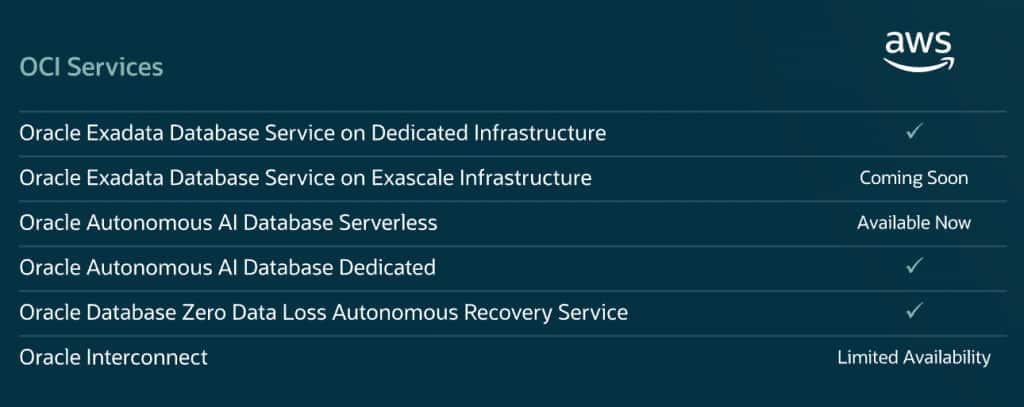
Autonomous AI Database Serverless, now Generally Available
This service enables you to efficiently run fully managed, optimized databases without having to provision or manage infrastructure. In addition to the transaction processing and general-purpose capabilities delivered by Autonomous AI Database, you also have the choice of using Autonomous AI Lakehouse or Autonomous AI JSON database for more focused workloads. You create a database in minutes and automatically scale compute and storage independently as your needs change. You pay for what you use, not what you think you might use in 6 months or a year. ADB-S is available through both public and private offers on AWS Marketplace, giving you flexible purchasing options that count toward your existing AWS commitments. For teams using AWS to spin up new applications or AI projects in AWS, that lowers both the cost and the effort of getting started, and it takes patching, tuning, and routine maintenance off your team’s plate and improves security. It also gives you a simple on-ramp to using the wealth of Oracle AI Database options and unique Exadata performance enhancements that come standard with Autonomous AI Database. Read the launch blog here.
Exadata Database Service on Exascale Infrastructure, coming soon
Running Exadata Database Service on Exascale infrastructure gives you the same full database control and Oracle Real Application Cluster (RAC) access for high availability that you expect from Exadata alongside cloud elasticity. Instead of provisioning for your peak on day one, you can start with a smaller footprint and scale up and down in fine increments as demand changes. That lowers the entry point for Exadata-class performance and helps lower your costs, opening up the same Exadata engine and availability to workloads that couldn’t be consolidated onto a larger, dedicated deployment.
We intend for Exadata Database Service on Exascale Infrastructure to be available in all Oracle AI Database@AWS regions by the end of 2026.
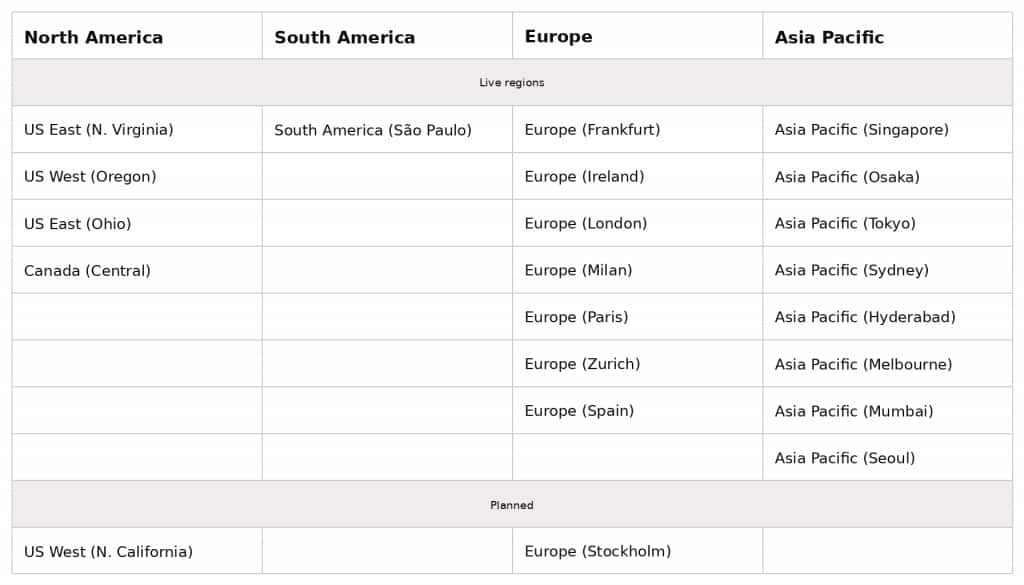
Available in 20 Regions worldwide
Oracle AI Database@AWS now reaches 20 AWS Regions across North America, Europe, Asia Pacific, and South America with two more planned. This is up from the two Regions when it launched. This means you can run the offering where your data and your users are, rather than compromising location to adopt it. It also makes in-country data residency and cross-Region disaster recovery practical in the places you operate.
Exadata Database Service achieves Oracle Maximum Availability Architecture (MAA) Platinum Tier
Oracle AI Database@AWS now supports the Platinum MAA tier of Oracle Maximum Availability Architecture, the highest level of application-transparent resilience that Oracle offers. For the mission-critical workloads you cannot afford to have go down, this means you can hit aggressive recovery targets using a validated and hardened reference architecture across multiple AWS Availability Zones or Regions rather than building and validating a customer configuration from scratch. You apply the same proven high availability best practices in Oracle AI Database@AWS that you rely on everywhere else. Read the MAA blog here.
A long-term strategic collaboration agreement (SCA)
Oracle and AWS have signed a long-term strategic collaboration agreement, a critical factor that you should consider when deciding whether to use Oracle AI Database@AWS. It commits both companies to keep investing for the long term, which means you can standardize on Oracle AI Database@AWS and plan your roadmap around the offering, knowing it will keep getting better.
Next Steps
If you run workloads using Oracle databases today: talk to us about moving those workloads to AWS, where they can sit next to the rest of your stack.
If you’re already building on Oracle AI Database@AWS: Oracle Autonomous AI Database Serverless is ready for you to use and additional services are planned over the next 12 months.
If you want to go deeper: find Oracle AI Database@AWS on the AWS Marketplace, or reach out to your Oracle or AWS representative.
A year in, the gap between the cloud you chose and the database you depend on is closed for the workloads that matter most. That’s something only Oracle and AWS can deliver together, and it’s what putting customers first looks like in practice. We’d love to hear what you build once your data and your cloud finally live in the same place.
None of this happens without people. To the customers who trusted us early and kept telling us what was working and what wasn’t: thank you. And to the teams at Oracle and AWS who did the hard work of building this and getting it right, Region by Region: thank you. We’re proud of what the past year produced, and grateful to everyone who made it possible.
Disclaimer
The preceding is intended to outline our general product direction. It is intended for information purposes only, and may not be incorporated into any contract. It is not a commitment to deliver any material, code, or functionality, and should not be relied upon in making purchasing decisions. The development, release, timing, and pricing of any features or functionality described for Oracle’s products may change and remains at the sole discretion of Oracle Corporation.
Ganapathy (G2) Krishnamoorthy
Vice President, Database Services, Amazon Web Services (AWS)