
Why API design matters for FinOps—and how OCI accelerates the rise of AI-driven automation
Introduction: The Next Phase of FinOps
As FinOps continues to evolve, organizations are moving beyond cost visibility into a new phase defined by real-time optimization and autonomous operations. At FinOps X, much of the discussion will focus on AI, automation, and operational efficiency. But beneath these trends lies a foundational question:
How quickly can organizations turn AI and automation into measurable financial outcomes?
The answer depends on more than models or tooling. It depends on something far more fundamental:
The design of the cloud APIs those systems rely on.
Because when automation scales—and when AI agents begin to actively manage infrastructure—API design becomes a critical enabler of speed, safety, and impact.
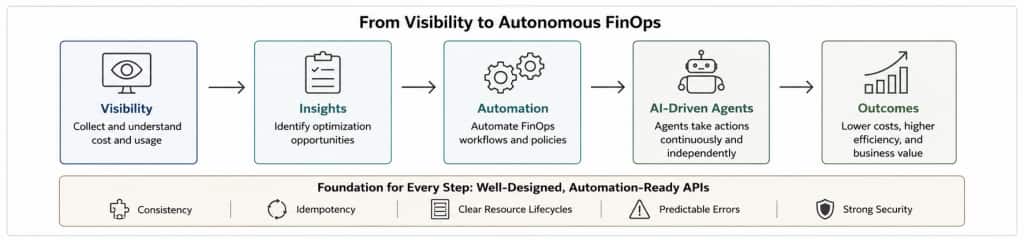
From Visibility to Autonomous FinOps
Traditional FinOps practices focused on dashboards, reporting, and human-driven optimization. Today, leading organizations are building systems that can act continuously and independently.
These systems can:
- Automatically right-size compute resources
- Shut down idle environments
- Optimize storage tiers in real time
- Enforce cost and usage policies continuously
Increasingly, these responsibilities are being delegated to AI-driven agents. These AI-driven agents may include LLM-based copilots, orchestration systems, or autonomous optimization services capable of taking operational actions.
But there is an important constraint:
AI agents are highly dependent on the quality, consistency, and safety of the APIs and operational systems they interact with.
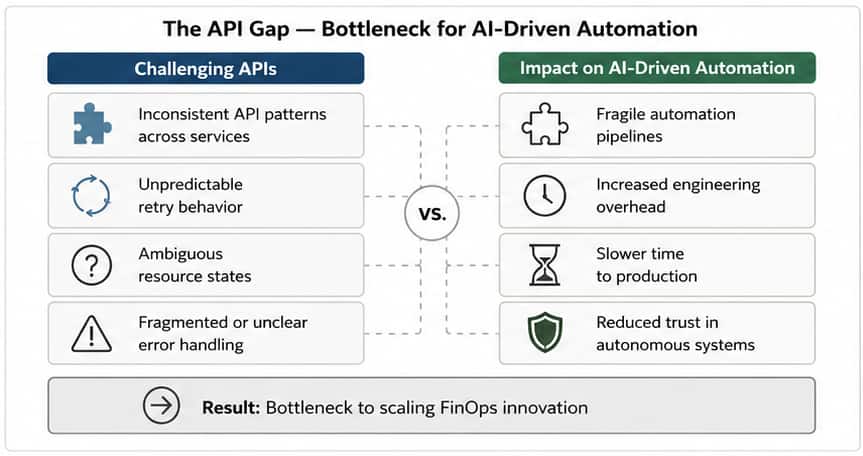
The Hidden Bottleneck: API Complexity
In many cloud environments, automation efforts encounter friction not because the goal is unclear, but because the underlying systems are difficult to operate programmatically.
Common challenges include:
- Unpredictable retry behavior
- Ambiguous resource states
- Fragmented or unclear error handling
For developers, these issues are manageable—though frustrating. For AI agents, they introduce systemic risk.
They result in:
- Fragile automation pipelines
- Increased engineering overhead
- Slower time to production
- Reduced trust in autonomous systems
In short, they become a bottleneck to scaling FinOps innovation.
OCI’s Approach: Designed for Automation from the Start
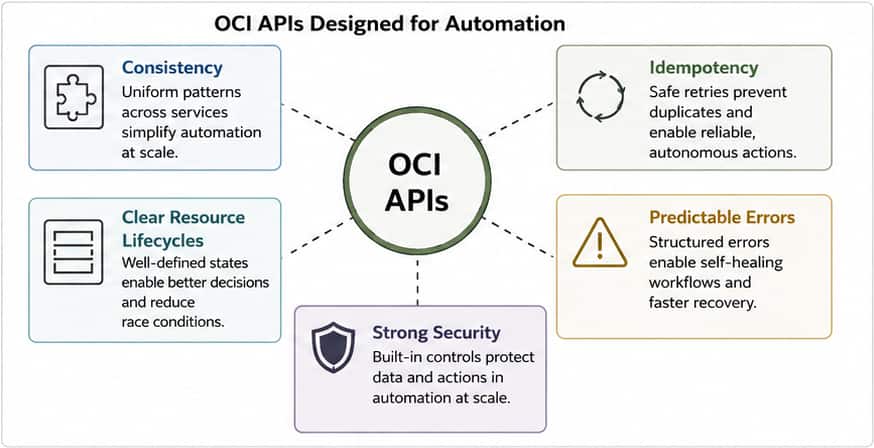
Oracle Cloud Infrastructure (OCI) API model is particularly well-suited for automation-heavy operational environments due to our strong emphasis on consistency, predictability, and automation-readiness. These design choices become especially powerful when applied to AI-driven FinOps.
Consistency Enables Scalable Automation
OCI APIs follow uniform patterns across services, including authentication models, request structures, and response formats.
This consistency matters because it reduces the cognitive and technical overhead required to build automation. Instead of creating bespoke logic for each service, teams can develop generalized automation workflows that operate across compute, storage, and networking.
Consistent APIs allow agents to reuse reasoning patterns, making their behavior more reliable and easier to scale. The result is faster development and fewer edge cases that require manual intervention.
OCI’s API consistency also becomes increasingly important in the context of Infrastructure as Code (IaC). As FinOps teams standardize on Terraform and declarative automation models, predictable infrastructure behavior directly impacts the reliability and scalability of optimization workflows.
OCI’s Terraform provider and Resource Manager help simplify this process by enabling teams to define infrastructure, governance, and cost controls as reusable code rather than manual operational tasks.
This reduces operational complexity while accelerating the rollout of FinOps best practices across large-scale environments.
Idempotency Reduces Autonomy Risk
One of the core challenges in automation—especially with AI agents—is ensuring that repeated actions do not create unintended consequences.
OCI addresses this through idempotent API design, often supported by retry tokens. This allows operations to be retried without duplicating resources or corrupting system state.
For FinOps teams, this capability is essential. Many optimization actions—such as scaling infrastructure or scheduling resource shutdowns—must be executed repeatedly and reliably. Idempotency reduces the risks posed by these autonomous actions even in the face of transient failures or retries.
Idempotency is a foundational requirement for safely scaling autonomous operations.
Clear Resource Lifecycles Enable Better Decisions
Automation systems—and especially AI agents—need to understand the current state of infrastructure in order to act effectively.
OCI provides clear and well-defined resource lifecycle states, such as provisioning, available, updating, and terminating. This clarity allows systems to make informed decisions about when to proceed, when to wait, and when to intervene.
In practice, this reduces race conditions and improves the reliability of multi-step workflows. Whether provisioning environments or executing cost optimization strategies, clear state visibility leads to more predictable outcomes.
Predictable Errors Enable Self-Healing Systems
Failures are inevitable in distributed systems. What matters is how those failures are handled.
OCI APIs provide structured and consistent error responses, making it easier for automation systems to distinguish between transient issues and critical failures.
This enables the development of self-healing workflows, where systems can automatically retry operations, escalate issues appropriately, or adjust behavior without human input.
For FinOps teams, this reduces operational overhead and shortens the time required to resolve incidents, directly contributing to efficiency and cost control.
Strong SDK Alignment Accelerates AI Integration
AI agents typically interact with infrastructure through structured tools or SDKs rather than raw APIs.
OCI’s SDKs are closely aligned with its APIs, reducing discrepancies and simplifying integration. This makes it easier to expose infrastructure capabilities as structured functions that AI systems can use reliably.
The result is faster development of:
- Internal FinOps copilots
- Automation platforms
- AI-driven operational tooling
This alignment helps organizations move from experimentation to production more quickly.
What This Means for FinOps Teams
Taken together, these design principles make OCI fundamentally easier for automation—and for AI—to operate.
In practical terms, this leads to:
- Faster time to value, as automation can be deployed more quickly
- Lower operational risk, due to safer retries and predictable behavior
- Greater scalability, as workflows can be reused across services
- Continuous optimization, enabled by systems that operate in real time
OCI’s APIs don’t just support automation—they make it easier to trust and scale.
Conclusion: Autonomous FinOps Requires Infrastructure That AI Can Understand
The FinOps journey is rapidly evolving. Organizations are moving from visibility and manual optimization toward fully autonomous systems.
These systems don’t just recommend actions—they take them.
In this context, the underlying infrastructure must be more than functional. It must be legible to machines.
That means:
- Predictable behavior
- Consistent interfaces
- Safe execution models
As AI becomes embedded in cloud operations, the platforms that succeed will be those that are easiest for machines—not just humans—to operate.
Clean, consistent, and automation-friendly APIs are no longer a secondary concern. They are a core enabler of autonomous cloud operations.
For FinOps teams looking to scale impact, accelerate time to value, and embrace AI-driven optimization:
API design is not just a technical detail. It is a strategic advantage.