
Healthcare organizations are under increasing pressure to modernize how patients access care. Despite changing insurance coverage models and costs, inbound calls for appointment scheduling, reminders, and confirmations, remain the highest volume interactions a health system manages, typically exceeding 40% of total call volume[1].
Many of these appointment workflows still rely on legacy infrastructure and on-premises systems originally designed for a different era. As patient expectations shift toward faster, consumer-grade[2], and artificial intelligence-first experiences, health systems are looking to the cloud to support scalability and operational efficiency without compromising security and compliance.
Oracle Cloud Infrastructure (OCI) provides a foundation purpose-built for regulated industries like healthcare, where security, compliance, performance, and cost efficiency matter most. OCI’s healthcare-first partner SpinSci deploys its patient access solutions on OCI to take advantage of these capabilities while helping healthcare organizations modernize their digital front door in a controlled, incremental way.
The infrastructure challenge behind patient access
Patient access platforms sit at the intersection of multiple systems of record. Scheduling systems, Electronic Health Record systems like Oracle Health’s, CRM tools, telephony platforms, and messaging services must all work together in real time. These workflows are highly transactional, and often “bursty” – exhibiting sharp spikes during mornings, lunch hours, and seasonal events like flu clinics and open enrollment.
Historically, health systems supported these workflows using on-premises infrastructure sized for peak demand. At the same time, patient access data, while transactional in nature, must be retained, audited, and protected as regulated health information. This approach leads to resources that sit underutilized most of the year and add significant operational overhead for IT teams.
A helpful way to view the scope of the patient access infrastructure problem is to look at how healthcare data itself has evolved. As healthcare systems digitized, the scale of unstructured data ballooned. By most industry estimates, roughly 80 percent of healthcare data now exists in unstructured form (such as medical images, free-text clinical notes, and voice recordings)[3] which places heavy demands on storage, indexing, and retrieval infrastructure.
This high-velocity, high-volume unstructured data turns patient access into more than a simple transactional service. The traditional model with on-site servers and storage arrays is not well suited to handle the continuous growth in data volumes while maintaining fast access and strong security controls. The result is a costly architecture that can impede real-time performance and require frequent maintenance, patching, and manual scaling to avoid service degradation precisely when patient access matters most.
Why Oracle Cloud Infrastructure is a fit for patient access workloads
Patient access represents a class of healthcare workloads that benefit from second-generation cloud design, such as OCI. OCI’s innovative architecture allows healthcare organizations to have complete freedom of deployment, using precisely the compute, storage, and network resources that they need at any given time without being constrained by pre-defined “T-shirt size” instances. Freedom of choice also extends to which CPU or GPU is best suited for each workload, where it is best to host data given OCI’s flexible deployment options, and a pricing model that does not tax customers on moving and using their own data through steep egress charges. All of this not only results in more efficiency but also increased affordability, in a security-first model. In addition, OCI already hosts the EHR with the largest global footprint[4], underscoring its suitability for cloud-based healthcare platforms.
How SpinSci supports OCI’s healthcare strategy
Patient access is often the first interaction a patient has with a health system. That interaction sets expectations for the rest of the care journey. In a recent study, 96% of healthcare executives said that they believe generated voice is “the main path to [contact center] success in the next 5 years,” yet 80% of patients prefer to speak to a human when calling their health system[5]. Oracle Cloud Infrastructure provides the underlying platform to support human experiences at scale, while SpinSci delivers the healthcare-specific workflows that sit on top of it.
A large health system in the Baltimore region was looking to modernize its contact center patient access operations while continuing to rely on Oracle Health as its EHR system of record. To support rising call volumes and improve agent efficiency, they deployed SpinSci Patient Assist as a cloud-hosted patient access platform running on Oracle Cloud Infrastructure.
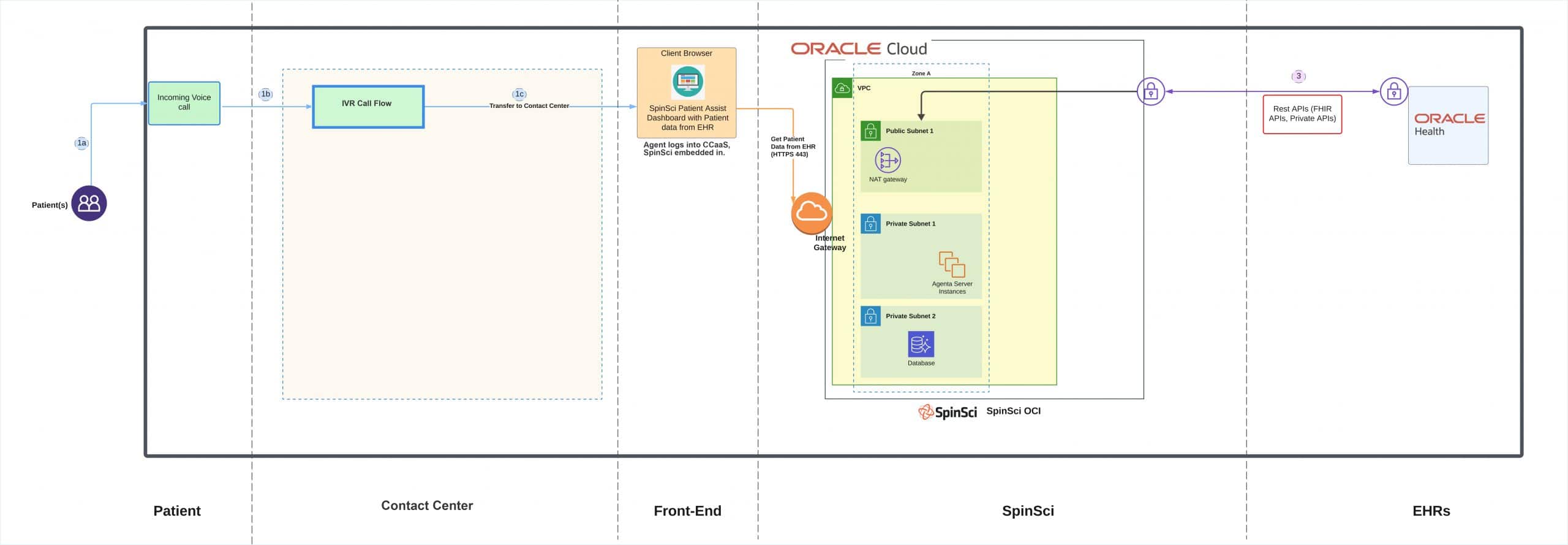
At this health system, SpinSci operates Patient Assist on OCI using secure, private connectivity back to the system’s Oracle Health environment and unstructured contact center data. OCI provides the scalable compute, networking, and security foundation needed to support real-time scheduling lookups and patient workflows without requiring the health system to expand on-premises infrastructure.
By running patient access workloads on OCI, the health system is now able to handle daily and seasonal demand spikes more efficiently while maintaining the performance, governance, and reliability required for patient-facing systems. The deployment illustrates how OCI can support mission-critical patient access workflows that integrate tightly with Oracle Health, with SpinSci delivering the healthcare-specific application layer on top.
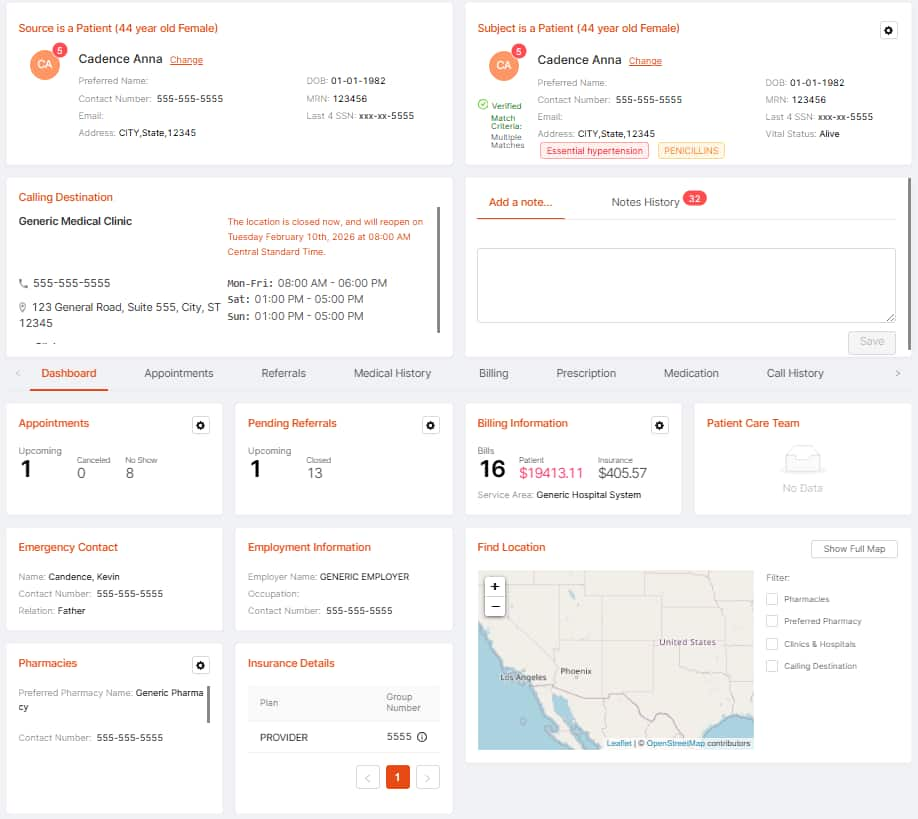
Seen in the image below, SpinSci’s patient access solutions are designed to run natively on Oracle Cloud Infrastructure while integrating with hospital environments that have considerable Oracle Health and unstructured data integration needs. By deploying on OCI, SpinSci aligns its architecture with Oracle’s healthcare-first cloud approach and leverages OCI services for computing, storage, networking, and observability.
A cloud foundation for the digital front door
For healthcare providers, the combination of OCI and SpinSci translates into a more manageable infrastructure model for patient access. Instead of maintaining dedicated on-premises environments for call flows, scheduling logic, and messaging services, organizations can rely on cloud-hosted platforms that scale with demand. Together, OCI and SpinSci can modernize patient access using cloud infrastructure together with healthcare-specific workflows.
To learn more about how Oracle Cloud Infrastructure supports healthcare workloads or how SpinSci deploys patient access solutions on OCI, contact an Oracle representative or a SpinSci representative. SpinSci is also proudly listed on Oracle Cloud marketplace here.
[1] Hyro: The State of Healthcare Call Centers 2023
[2] McKinsey & Company 2024 report: “Consumers rule: Driving healthcare growth with a consumer-led strategy”
[3] UPMC Health Care’s Unstructured Data Challenge
[4] KLAS names Oracle Global EMR Market Share leader for eighth straight year
[5] Smart Access, Stronger Systems: Patient Access Survey

Keegan Mahoney-Cates
Sales Associate, SpinSci
Keegan works at the intersection of healthcare and technology, helping health systems modernize access, communication, and the patient experience. At SpinSci, he partners with healthcare leaders on contact center transformation, clinical communications, and digital front door strategy to solve real operational challenges at scale. Outside of work, he enjoys watching all sports and playing volleyball.

Esteban Rubens
Healthcare Field CTO, OCI
Esteban has been in the tech industry for over 20 years, going from startups to Healthcare IT where he helps providers, payers, and life sciences customers solve problems with data. He is particularly focused on cloud, AI, Enterprise Imaging, and unstructured data. As Healthcare Field CTO at Oracle Cloud Infrastructure, he brings subject-matter expertise to technology conversations with the Quintuple Aim as a guiding light. He tries to avoid burnout by competing in powerlifting.