
Independent Software Vendors today are being squeezed from all sides. Customers expect richer functionality, faster release cycles, stronger SLAs, and global availability. Sales wants more flexible deployment options to win deals in new markets. Finance is looking for predictable margins and a cost base that can scale up and down with the business. Meanwhile, engineering teams are still spending a painful amount of time babysitting aging hardware, juggling colocation contracts, and firefighting issues in on-premises data centers.
At some point, every ISV runs into the same realization: continuing to run your own data centers—or long-term colocation footprints—is no longer a strategic advantage. It’s a distraction. A drag. A tax on your ability to innovate.
A data center exit to Oracle Cloud Infrastructure (OCI) is about more than “moving servers to the cloud.” For ISVs, it’s a chance to rewire the economics, security posture, and agility of the entire business: shifting from managing infrastructure to delivering value through software.
Oracle Runs Massive SaaS on OCI
One of the most important proof points for ISVs is simple: Oracle itself is one of the largest SaaS vendors in the world, and it runs that SaaS portfolio on OCI. ERP, HCM, CX, supply chain, and industry applications used by thousands of enterprises globally all run on the same cloud platform Oracle offers to ISVs.
That matters because it changes the conversation from theory to practice. You’re not just trusting a cloud provider’s marketing; you’re building on an environment that has already been proven at SaaS scale, with demanding requirements around multi-tenancy, compliance, and SLAs. For an ISV, OCI is effectively a “SaaS-for-SaaS” foundation: the underlying cloud layer that’s already running the kind of workloads you aspire to operate.
Built for Enterprises: Bring the Workload As-Is
OCI’s design philosophy started with enterprises and their real-world estates, not greenfield-only startups. That’s a crucial distinction for ISVs whose applications evolved over years and may not be perfectly cloud-native—yet.
OCI prides itself on being able to accept workloads as they are, minimizing the need for invasive rewrites just to “fit the cloud.” That includes complex, stateful, database-heavy applications; mixed Windows and Linux environments; VMware estates that need to move quickly without refactoring; and legacy components that are still mission-critical for customers.
For ISVs, that means DC exit becomes achievable in realistic phases rather than a multi-year, all-or-nothing engineering project.
Open Source, Choice, and No Lock-In for ISVs
Oracle has leaned heavily into open-source technologies and no-lock-in principles, giving ISVs more control over their destiny.
On OCI you’ll find first-class support for open-source stacks such as Linux, Kubernetes, Terraform, Java, Python, PostgreSQL, MySQL, Kafka-style streaming, and more, together with CNCF-aligned and open APIs. You can standardize on containers and infrastructure-as-code in ways that keep your architectures portable and your options open.
Security by Design: Zero Trust and Ransomware Protection
OCI is built around a Zero Trust philosophy: assume no implicit trust, verify everything, and minimize blast radius at every layer. Identity and access management is built on least-privilege principles; virtual cloud networks and security policies give you fine-grained isolation between tenants, environments, and workloads; and logging and observability are treated as core platform capabilities rather than optional add-ons.
On top of that, OCI’s storage, backup, and data protection services are designed with ransomware resilience in mind, including capabilities such as immutable backups, secure snapshots, and layered access controls that help protect your data and recovery processes even in the face of compromise. For ISVs handling sensitive customer data or operating in regulated industries, this is about more than just passing audits; it’s about operating on a platform that reflects modern threat realities.
Migration Tools and Hands-On Help for ISVs Exiting the Data Center
A big question for any ISV planning a DC exit is, “Who is actually going to help us move?” Oracle’s answer is a combination of built-in migration tools and hands-on engineering support that’s available to every customer, including ISVs.
Oracle Gives You Real Choice in How You Exit
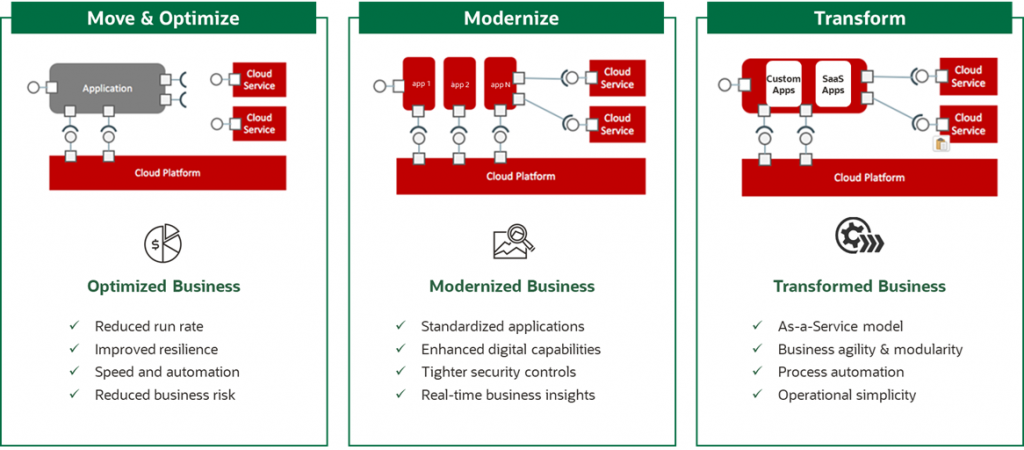
One of the most compelling aspects of using OCI for data center exit is that there is no single mandated path. Oracle gives you genuine choice in how you move, so you can align technology decisions with where your business is today and where you want it to go.
If your immediate priority is getting out of an expiring colocation contract or consolidating scattered environments, you can start with a pure lift-and-shift. Move existing VMs and workloads into OCI with minimal change, preserve architectures that work today, and buy yourself time to modernize thoughtfully instead of under deadline pressure.
If you want to improve manageability and operations while you move, you can adopt PaaS services as part of the migration. That might mean moving databases into managed services, standardizing on OCI’s observability stack, or using managed integration and messaging services. You still recognize the original application structure, but you offload more of the undifferentiated heavy lifting to the platform.
For parts of the portfolio where you see a clear opportunity to leap ahead, you can re-engineer or re-architect to cloud-native patterns from the start: containers, microservices, managed Kubernetes, and modern CI/CD pipelines that reshape how the application is built and shipped.
And for back-office and supporting systems, you may decide that building and running isn’t the best use of your time at all. In those cases, you can adopt Oracle’s SaaS platforms for backend applications and integrations—for example, using Oracle SaaS for finance, HR, CX, or supply chain, and connecting your ISV application into that ecosystem. You focus on the product that differentiates you, while letting Oracle’s SaaS handle the horizontal functions.
The key is that there is no one-size-fits-all answer. Different workloads and business domains can take different paths, and OCI supports that mixed reality. You choose where to lift and shift, where to adopt PaaS, where to go cloud native, and where to consume SaaS. Oracle gives you the toolbox; you decide the sequence and depth of transformation.
For an ISV, exiting the data center is not just an IT project. It’s a strategic pivot in how you build, deliver, and grow your software. Oracle Cloud Infrastructure offers a way to make that pivot without forcing a risky, all-or-nothing rewrite.
You’re building on the same cloud that runs one of the world’s largest SaaS portfolios. You gain the ability to bring your workloads as they are, modernize when you’re ready, embrace open source and portability to avoid lock-in, and strengthen your security posture with Zero Trust and ransomware-aware design. And you get genuine choice in how you exit: lift, transform, re-architect, or consume SaaS—whatever combination makes the most sense for your portfolio.
In short, you don’t have to be in the data center business to be in the software business. With OCI, you can step out of the data center, protect, and improve your margins, and accelerate the evolution of your product and platform on your own terms.
Check out how ISV’s like you are benefiting from adopting OCI on our ISV Partner Network page.