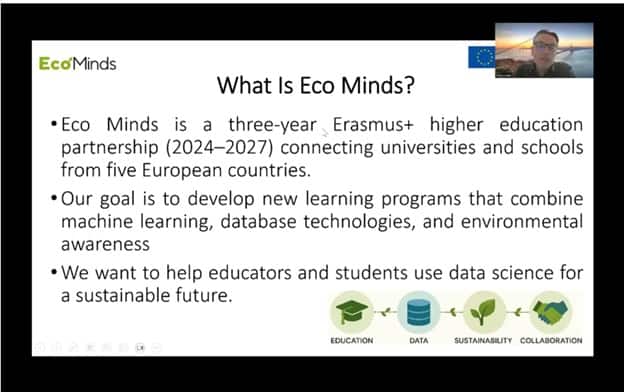
As the world faces unprecedented environmental challenges, integrating advanced technology and cross-border cooperation has never been more critical. The EcoMinds project, a three-year Erasmus+ collaboration, stands at the intersection of these priorities—bringing together five universities and one vocational school from Croatia, Italy, North Macedonia, Slovenia, and Ukraine to develop new learning opportunities that empower students and educators to use data science and machine learning to address real-world sustainability issues.
Supported by Oracle Academy and an NGO specializing in sustainable community development, and coordinated by Croatia’s Šibenik University of Applied Sciences, EcoMinds (Enhancing Environmental Data Collection through Machine Learning and Database Systems) is shaping the next generation of environmentally conscious innovators.
Free project courses and teaching resources available
The project’s core mission is to create, pilot, and openly share new university-level courses and teaching resources, all focused on using data-driven technology to solve sustainability and environmental problems. By grounding its approach in real use cases—such as shellfish farming, national park management, air pollution monitoring, and more—the consortium ensures direct relevance to local and regional stakeholders.
The EcoMinds project teams currently are developing two new, fully open-access bachelor-level courses: one focused on Machine Learning for Environmental Applicationsand the other on Database Design for Environmental Data Management. These courses are carefully crafted to match European Qualification Framework (EQF) standards, making them easy for other institutions to adapt or integrate as electives.
Alongside the main courses, the project also is creating a suite of open learning materials, detailed curricular guides, and specialized educator training—enabling a wide network of high school and university educators to deliver world-class content. Everything produced is licensed for free use and modification, reflecting a commitment to educational accessibility and sustainability.
Strength lies in diversity
The effectiveness and energy of EcoMinds flows from its diverse consortium, led by Šibenik University of Applied Sciences, Croatia, as project coordinator, focused on practical programs in computer science, business and logistics. University of Zadar, Croatia, is a historic institution excelling in humanities and increasingly investing in STEAM and IT, supporting course development and environmental data collection. LUISS Guido Carli University, Italy, is leading in business, law, AI, and sustainability, contributing to the project with its international partnerships and curricular innovation.
Saints Cyril and Methodius University of Skopje, North Macedonia, is the country’s largest public university, driving digital transformation, cloud computing, and machine learning. Igor Sikorsky Kyiv Polytechnic Institute, Ukraine, is highly regarded for its expertise in technical sciences and is pivotal in designing EcoMinds’ machine learning curriculum—contributing vital insights even under extraordinary circumstances.
And Vegova High School, Slovenia, is enabling EcoMinds to extend its reach to the secondary level, adapting university materials for younger students. Associate partners include Oracle Academy, which delivers industry-leading educational technology resources, and the Sustainable Community Development NGO ODRAZ, Croatia.
Students analyze real-time data
EcoMinds stands out by grounding learning in authentic, local case studies and datasets. For example, students analyze real-time environmental data collected from Croatian shellfish farms—a sector highly sensitive to temperature, salinity, and pollution changes. The project’s summer school in Zadar and Šibenik offered participants hands-on exposure to national parks, nature reserves, and cooperation with local businesses, illustrating the immediate value and urgency of environmentally focused data science and machine learning efforts.
Other partners monitor unique lake ecosystems in North Macedonia, coastal and urban challenges in Italy, and pollution data in Ukraine (and in particular pollution resulting from the full-scale invasion of Ukraine)—ensuring that students and educators from diverse backgrounds see the relevance of data-driven approaches to their own communities.
Comprehensive materials available for educators and students to use
All EcoMinds learning modules, curricular details, and lectures are being made available via a publicly accessible Moodle-based learning management system (LMS), hosted in the cloud established by the University Computing Centre of the University of Zagreb. Educators and students across Europe can simply register—or authenticate via their home institution, through eduGAIN —to access state-of-the-art materials. Successful learners can earn digital badges recognized for ECTS credits, with attestation and validation managed according to strict curricular standards.
Comprehensive resources—including curated lists of open-access books, detailed use case instructions, quizzes, and more—are available for download and integration with local curricula. This approach not only democratizes access to cutting-edge knowledge but also enables rapid adaptation to new challenges as they arise.
Recognizing the importance of early STEM exposure and cross-disciplinary skills, EcoMinds directly adapts university-level content for vocational and secondary school students. Whether through partnerships with Vegova High School in Slovenia or broad open licensing, EcoMinds nurtures a broad community of future environmental agents of change.
Courses meet European Qualification Framework for quality and scalability
A core strength of EcoMinds lies in its rigorous adherence to the European Qualification Framework. Each course is carefully validated through stakeholder surveys and feedback, guaranteeing portability, recognition, and instructional quality across the region. This makes EcoMinds not just a local or pilot project, but a scalable model for educational innovation in environmental technology.
As the project moves into its next phase, materials continue to be refined and piloted. This month, full course packs in English will be available online, and piloting in partner universities and schools will accelerate.
EcoMinds exemplifies the power of international, multidisciplinary collaboration in higher education. By harnessing machine learning, open data, and cross-sector partnerships, the project empowers students, educators, and communities to actively design solutions for sustainability. It’s a compelling demonstration of how academia, technology, and real-world needs can come together to shape a better future.
Access free materials today to learn and design sustainability solutions
The project dissemination webinar organized and hosted by Oracle Academy organized on November 20 can be reviewed here.
For more information and access to all project materials, visit ecominds.eu. The project web (ecominds.eu) is the gateway for anyone—educator, student, or policymaker—interested in adopting, adapting, or building on EcoMinds resources. Engage, explore, and join the movement towards a more sustainable, data-driven tomorrow.