Oracle Academy hosted more than 70 high school and university teachers eager to exchange experiences, learn about new technologies, and discuss the future of education on Oracle Academy Day, held in May 2026, in hotel Hyatt in Belgrade, Serbia. The event confirmed that interest in modern teaching approaches has never been greater, especially when it comes to artificial intelligence, databases, cloud technologies, and Java education.
What made this year’s conference particularly valuable was its highly interactive format. Participants were encouraged to ask questions throughout the day, which transformed the agenda into a dynamic conversation rather than a traditional sequence of presentations and panels. This open approach allowed the discussions to naturally evolve toward the topics teachers found most relevant and challenging in their everyday work.
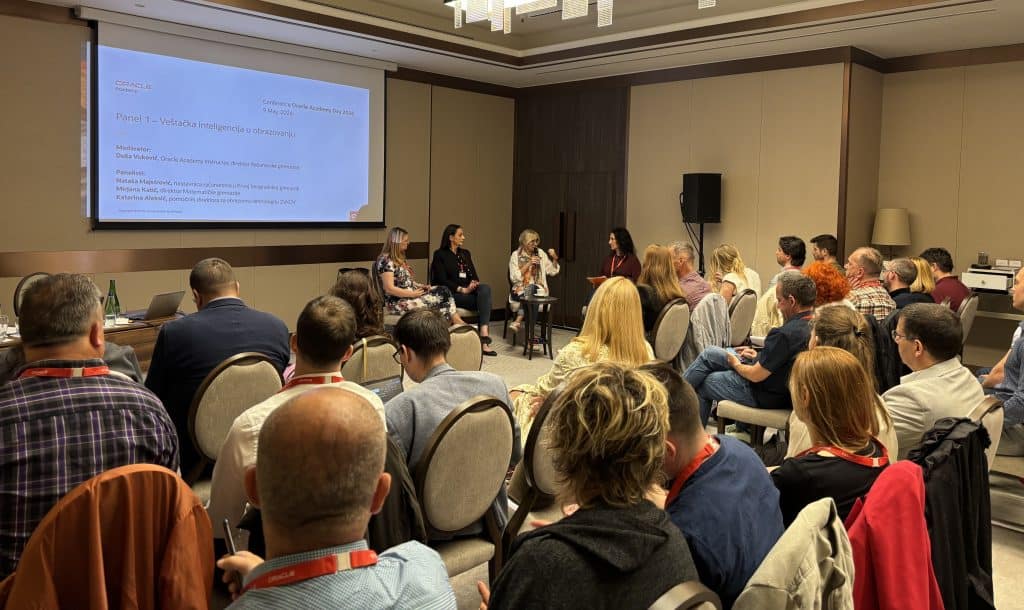
The first panel, “Artificial Intelligence in Education and Teaching,” was moderated by Duša Vuković, Principal of Grammar School for Computer Science (Računarska gimnazija), and long-term Oracle Academy Instructor. The panel brought together Mirjana Katić, Principal of the Mathematical Grammar School (Matematička gimnazija), Katarina Aleksić, Assistant Director for Educational Technology at ZVKOV–Institute for the Education Quality and Evaluation, and Nataša Majstrović, Teacher from the First Belgrade Gymnasium. Together, they explored how artificial intelligence is transforming teaching, assessment, and student learning, while also opening important questions related to ethics, critical thinking, and the role of teachers in the AI era.
One of the strongest conclusions from the AI panel was that technology itself cannot replace meaningful education. Panelists emphasized that teachers remain the key drivers of curiosity, creativity, and deeper understanding in the classroom. Regardless of how advanced digital tools become, meaningful learning still depends on curious students, engaged educators, and classrooms that encourage critical thinking and creativity. Discussions focused not only on how students use AI tools, but also on why it is important for them to understand the principles behind these technologies and develop critical thinking skills alongside technical competencies. Panelists emphasized that AI should not replace learning, but rather create opportunities for deeper understanding, more individualized teaching, and project-based work that prepares students for real-world challenges.
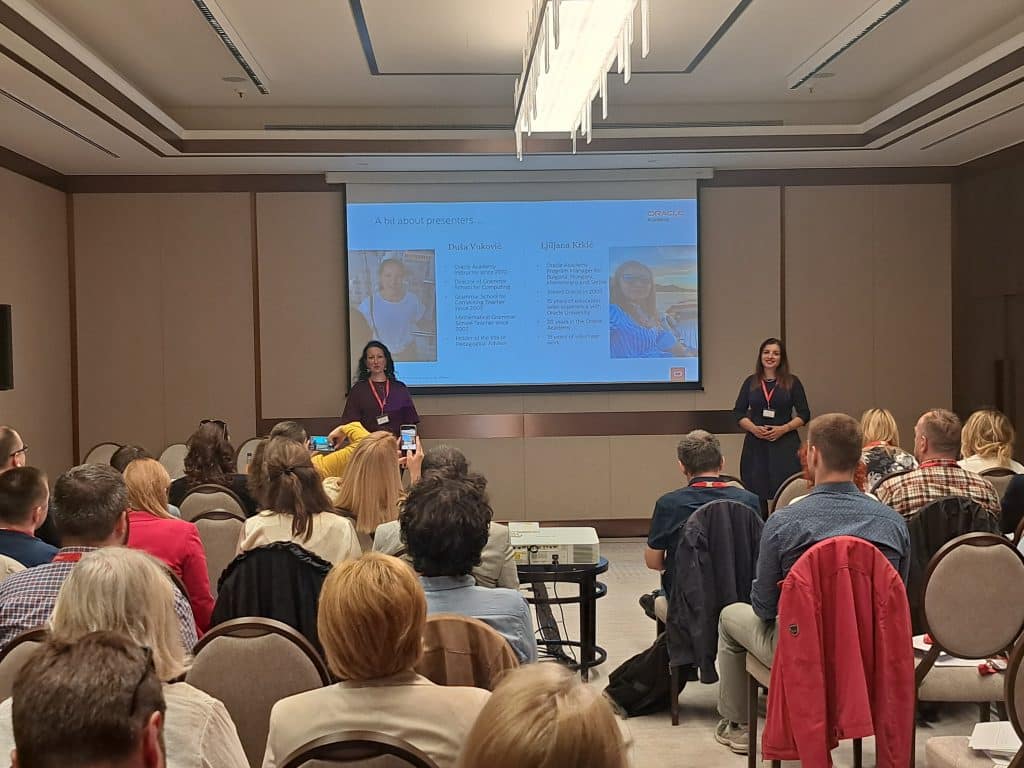
The second panel, moderated by Ljiljana Krkic, Oracle Academy Program Manager, focused on practical implementation of Oracle Academy curricula in schools. Teachers from several institutions shared concrete classroom experiences and demonstrated how Oracle Academy content is integrated into subjects such as databases, Java programming, and application development.
Among the panelists were Ivana Jovanović from the Mathematical Gymnasium in Belgrade, Jovica Čenić from Gymnasium Sveti Sava in Belgrade, Milorad Rumenić and Miodrag Vučinić from ESTŠ “Nikola Tesla” in Kraljevo, and Katarina Veljković from the First Kragujevac Gymnasium. Their experiences clearly showed that Oracle Academy program resources are no longer just extracurricular material, but are an integral part of regular teaching practice.
Particularly inspiring were the examples of project-based learning shared during the discussion. Students design complete database systems, create ERD diagrams, develop SQL queries, and build functional Oracle APEX applications connected to real-world scenarios such as libraries, hospitals, sports systems, tourist agencies, and e-commerce platforms. Several teachers highlighted that the moment when students see their database become a working application is often the turning point when theory suddenly becomes real-life meaningful and motivating.
Another recurring theme was the importance of balancing theory and practice. Many panelists emphasized that students learn best through hands-on work, experimentation, and problem solving in modern development environments.
The conference also featured a guest presentation by Marina Matijević, Head of the Department of Information and Communication Technologies, Ministry of Education, Science and Innovation, Montenegro, who shared Montenegro’s experience in building a digital education ecosystem. Participants learned how investments in infrastructure, digital platforms, and teacher development are supporting the digital transformation of schools. The presentation highlighted initiatives such as the Digital School platform, EdTech laboratories, and online learning resources, offering valuable examples of how technology can enhance teaching, learning, and collaboration in education.
Beyond the official agenda, Oracle Academy Day once again proved the importance of bringing educators together in one place. The most valuable moments often happened between sessions—through informal conversations, networking, and spontaneous idea sharing among colleagues facing similar teaching challenges.
By the end of the event, one message clearly stood out: students are most motivated when they work with modern tools, solve realistic problems, and understand how the knowledge they gain connects to real industry practices. The energy throughout the day showed that teachers are highly motivated to adapt their teaching to the realities of a rapidly changing technological world, while still preserving the human side of education. Oracle Academy Day 2026 therefore became much more than a conference: it became a space for inspiration, practical learning, and a shared vision of how education can evolve in the age of artificial intelligence.
View details about this conference from the viewpoints of Grammar School for Computer Science and Mathematical Grammar School on their respective websites: https://rg.edu.rs/rg-na-konferenciji-oracle-academy-day-2026/ and https://www.mg.edu.rs/sr/vesti/2026/05/mg-na-oracle-academy-day-2026#gsc.tab=0
Join Oracle Academy today and access all the benefits of membership.