
Sales Order Execution Has Become Increasingly Complex
Sales order execution sits at the center of customer experience, operational performance, and revenue realization. Even common issues such as inventory shortages, pricing discrepancies, or partial shipments can create delays that require coordination across sales, fulfillment, finance, and customer service teams.
Most organizations already have the necessary operational data inside their ERP and fulfillment systems, but the information is often fragmented across workflows and applications. As a result, account managers spend significant time gathering context and coordinating resolution efforts instead of focusing on customer outcomes.
This challenge becomes even more pronounced in environments with high order volumes, complex fulfillment networks, and increasingly demanding customer expectations. Operational teams are expected to respond quickly while balancing service levels, profitability, fulfillment constraints, and internal policy requirements. Even experienced teams can struggle when critical information is distributed across disconnected systems and workflows.
Bringing Agentic AI into Order Management
The Sales Order Command Center introduces an agentic AI experience within Oracle Fusion Applications Order Management that helps teams identify, prioritize, and resolve operational issues more efficiently.
Rather than functioning as a traditional dashboard, the application continuously evaluates signals across orders, inventory, pricing, fulfillment risk, and customer context to surface the actions that require immediate attention. Users begin with a prioritized view of operational exceptions, guided recommendations, and workflow actions that are designed to help move issues toward resolution.
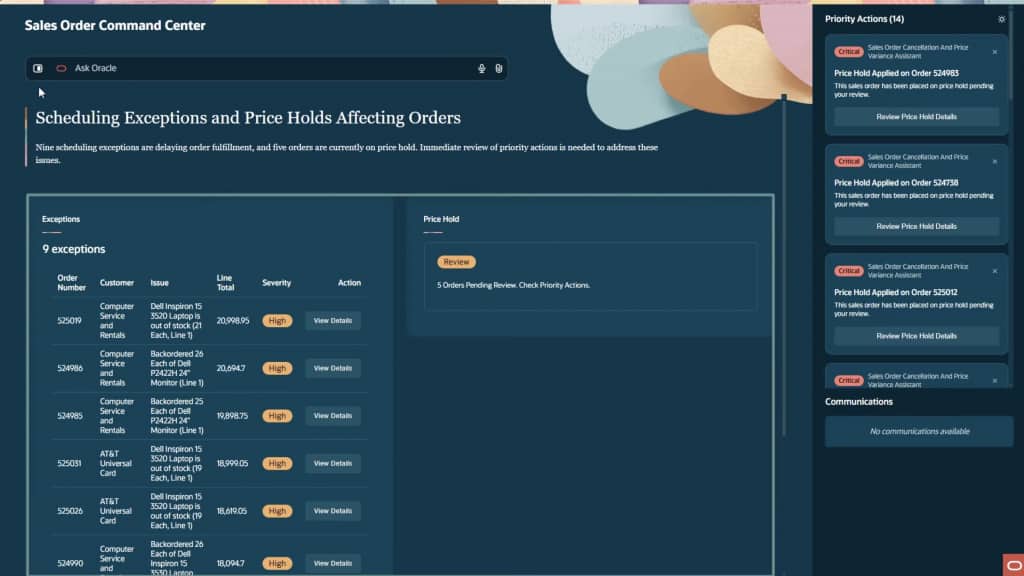
What makes the experience particularly effective is the way operational context is assembled automatically for the user. Instead of manually reviewing multiple systems to understand the source and impact of an issue, account managers can quickly evaluate customer implications, fulfillment constraints, revenue considerations, and recommended actions within a single workflow.
This changes the day-to-day operating experience for order management teams. Users spend less time gathering information and coordinating across teams, and more time resolving issues that directly affect fulfillment performance, customer satisfaction, and revenue continuity.
The application also introduces a more structured approach to prioritization. Rather than relying on static queues or manually triaging exceptions, users can focus first on the issues that carry the greatest operational or customer impact. That prioritization becomes increasingly valuable as organizations look for ways to improve responsiveness without continuously adding operational overhead.
Guided Resolution Instead of Manual Investigation
The most compelling aspect of the Sales Order Command Center is the way it combines operational context with workflow execution.
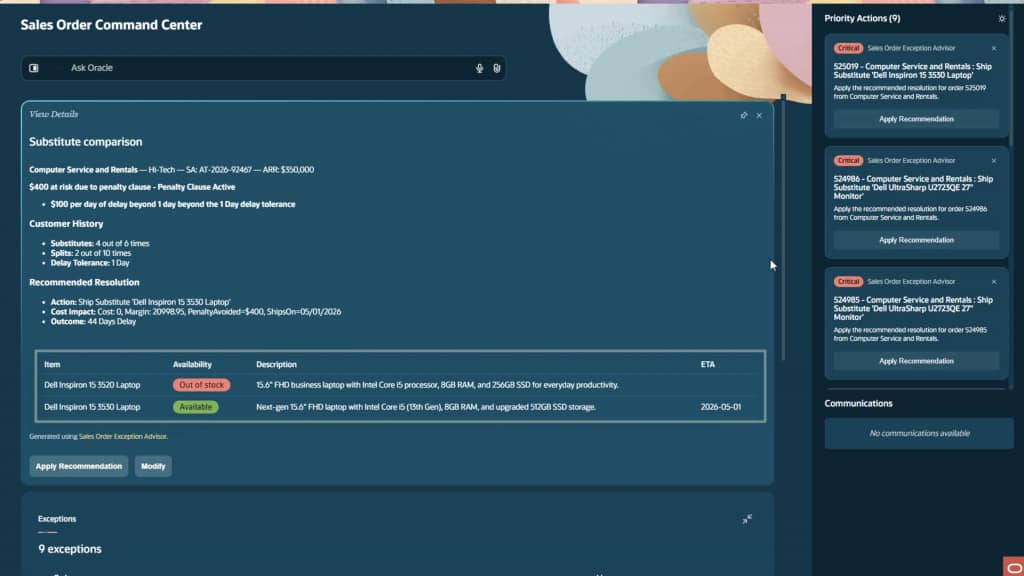
When an item becomes unavailable, the application can evaluate substitute products, customer priority, fulfillment constraints, and margin considerations before presenting a recommendation to the user. The account manager can review the reasoning behind the recommendation, understand the potential customer and revenue impact, and apply the recommendation directly within the workflow.
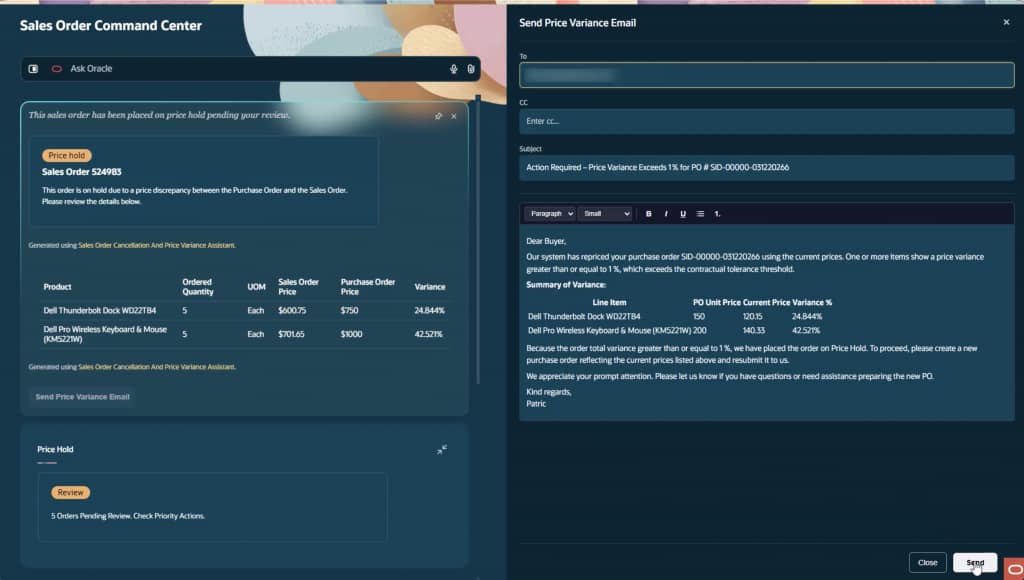
The same approach extends to pricing holds and order discrepancies. If a purchase order variance places an order at risk, the application can guide the user through the appropriate communication and resolution process using customer agreements, pricing policies, and order details as context.
Instead of requiring users to navigate multiple systems and coordinate manually across teams, the application helps operational issues move toward resolution much more efficiently while improving consistency across the order management process.
From a product perspective, this is where agentic AI becomes particularly relevant within enterprise applications. The value is not limited to automation alone. It comes from combining reasoning, recommendations, prioritization, and workflow execution into experiences that help users make decisions faster and operate with greater confidence.
What You Need to Know
The Sales Order Command Center reflects a broader shift happening across enterprise applications. Organizations are increasingly looking for systems that not only surface information, but also help users make decisions and execute work more effectively.
For Oracle Fusion Applications Order Management teams, this creates an opportunity to improve responsiveness, reduce operational friction, and protect customer relationships through a more intelligent approach to sales order execution.
As organizations continue investing in operational resilience and customer experience, applications that can intelligently guide users through complex workflows will become increasingly important. The Sales Order Command Center provides a practical example of how agentic AI can be applied to improve execution within real enterprise operations.