
We are excited to introduce a very new Agentic AI Application: the Design-to-Source Workspace for PLM, built to connect engineering and procurement so design decisions translate into sourcing outcomes faster, with better traceability and less rework. The objective is simple: reduce cost, cycle time, and compliance risk by connecting design and sourcing into one continuous process.
Design-to-Source as a system of outcomes
In many organizations, design-to-source is still sequential.
Engineering designs. Sourcing reacts. Teams go through multiple cycles to align decisions. In the Design-to-Source Workspace, that becomes one coordinated loop. The application reasons across cost, supply, and risk to drive better sourcing decisions as the design evolves.
This is what agentic applications are all about. They are goal-driven systems that reason, decide, and execute work inside the system of record, within enterprise governance and auditability. They move work forward continuously, not just when someone has time to push the next step.
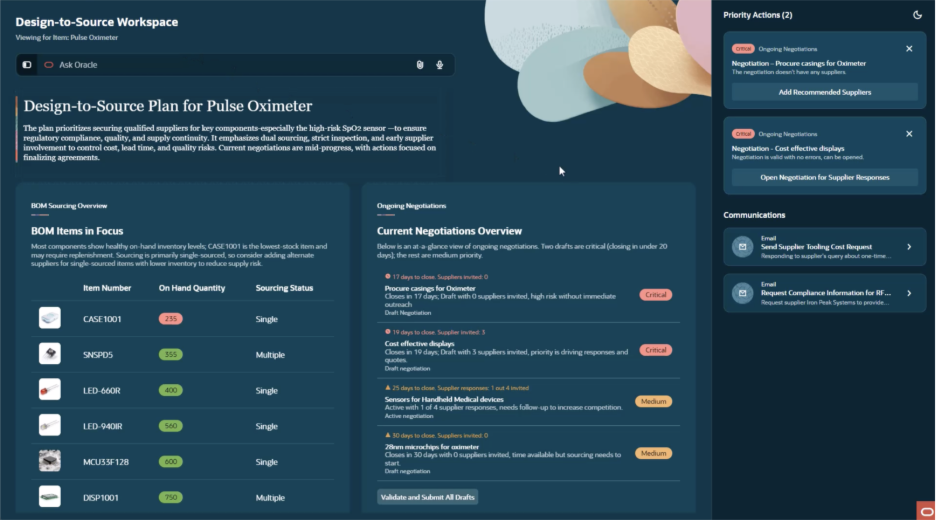
What the Design-to-Source Workspace does for a design team
Think of this workspace as a cross-functional partner that speaks both languages: engineering intent and sourcing execution.
It is an insight-driven cross functional agentic workspace that:
- Translates product specifications into qualified supplier options
- Simulates cost and lead-time tradeoffs
- Executes RFQs with compliant documentation
- Coordinates buyer and supplier communications in a way that stays connected to the design context
CAD to RFQ, without the manual translation step
One of the biggest drains on time is the manual bridge between CAD and sourcing tools. Designers finish a CAD update, then someone has to re-enter item details, interpret requirements, and stitch together documentation for RFQs. That introduces delays, errors, and traceability gaps.
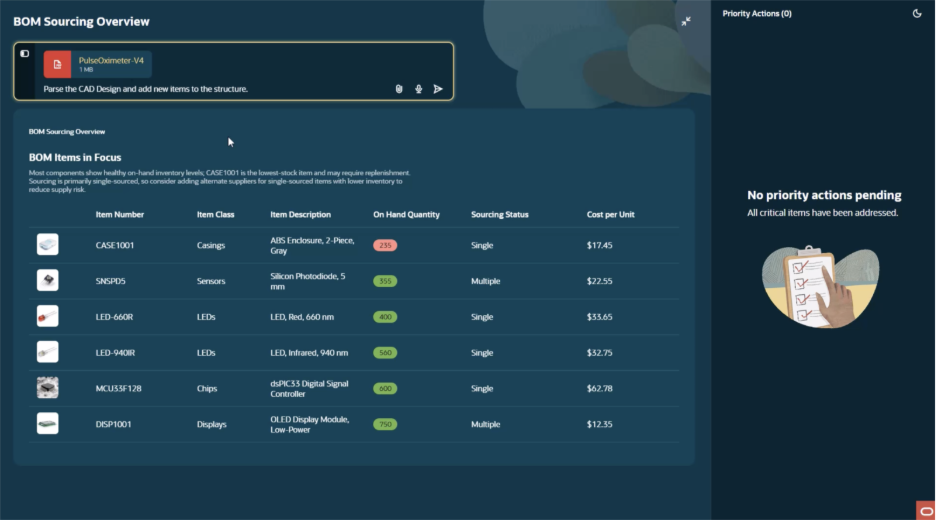
The Design-to-Source Workspace changes the workflow by enabling the AI agent to:
- Transform CAD design uploads into actionable sourcing items
- Automate item creation, supplier identification, risk assessment, and procurement workflows
- Automatically launch RFQs, while keeping the process traceable and compliant
Supplier evaluation that reflects real life, not just a spreadsheet
Supplier decisions are rarely about a single number. You are balancing cost, lead time, quality expectations, and risk, often under real constraints and changing conditions.
This workspace:
- Generates RFQs directly from design data
- Evaluates suppliers across cost, lead time, quality, and risk
- Continuously analyzes options and recommends the best path forward
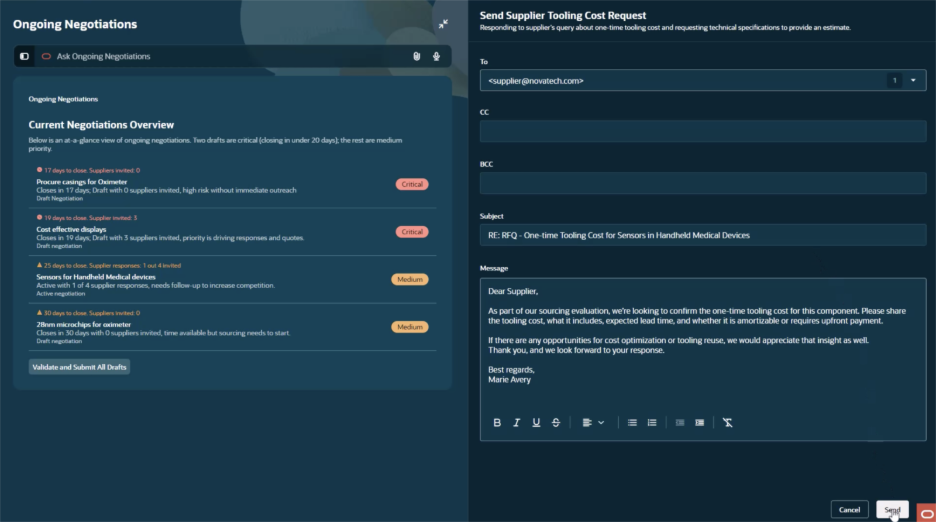
It also stays engaged through execution by monitoring negotiations, adjusting recommendations, and keeping decisions aligned as conditions change.
Why this matters: fewer handoffs, faster cycles, lower risk
The business problem is familiar: disconnected manual processes between design and sourcing cause delays, errors, and missed opportunities. Designers must manually specify item details after creating CAD files, which can lead to slow, error-prone RFQs and incomplete traceability. The fragmented workflow can also obscure compliance issues and sourcing risk.
By automating the extraction of CAD-based requirements and integrating them into sourcing, with AI-driven RFQ execution and risk management, the workspace eliminates handoffs and enables faster, safer, and more transparent sourcing.
Expected impact
The value proposition is designed to be measurable:
- 50% to 60% reduction in manual entry and back-and-forth between design and sourcing
- 30% to 40% faster creation and management of RFQs and sourcing projects
- Improved accuracy by minimizing data loss or errors through seamless transfer of design and requirement data
- 20% to 30% reduction in sourcing cycle time, enabling faster design-to-award timelines and accelerating time to market
- More time for high-value work, less time spent on tracking, coordination, and re-entry
The takeaway
This is the shift from disconnected functions to a continuous, outcome-driven process. Instead of managing handoffs and delays, teams move faster with decisions driven by real-time context.