
A bill of materials can look healthy in aggregate and still contain a component that prevents a product from moving forward. A favorable cost profile does not offset a compliance violation. Multiple available suppliers do not resolve an open quality issue. And a low overall risk score does not necessarily mean a product meets the criteria for design freeze.
For product teams, the challenge is connecting component-level findings to a specific release decision: What is blocking this product, what evidence supports that conclusion, and which actions offer the strongest path to readiness?
The BOM Risk and Grading Analyzer in Oracle’s Product Readiness Workspace helps teams answer those questions. Powered by Fusion Claw, Oracle’s enterprise agentic execution platform, it connects enterprise evidence, evaluates risk against company-specific release criteria, and helps teams move from assessment to approved execution.
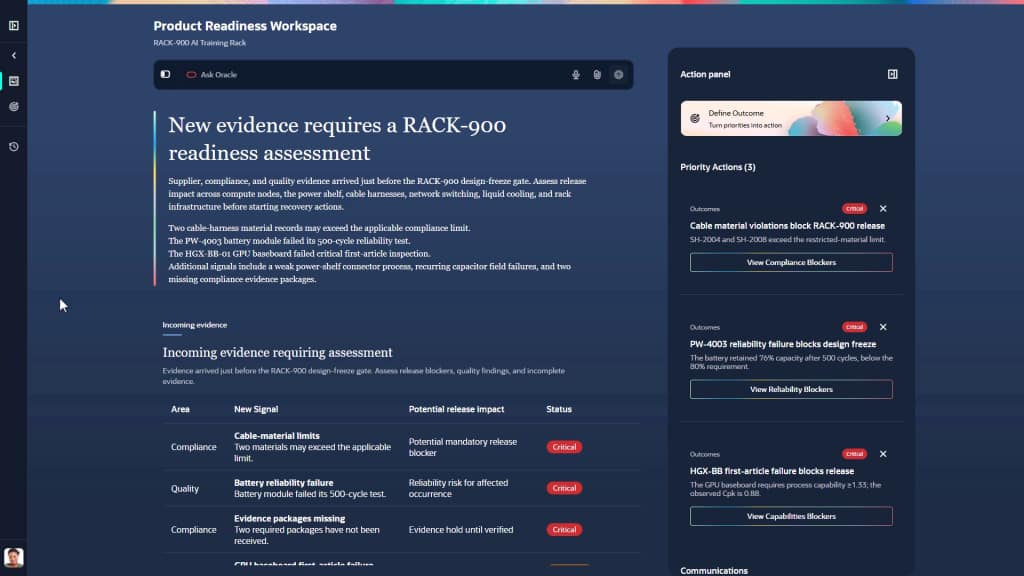
Start With the Outcome Being Evaluated
Product readiness is contextual. An assessment needs to account for the milestone being evaluated and the criteria that govern it.
In the demo, a product team member begins with an outcome-based request: “Evaluate the design-freeze risk for RACK-900.”
That request establishes the purpose of the analysis. Fusion Claw creates a plan, gathers relevant enterprise evidence, and evaluates the BOM across five dimensions: lifecycle, sourcing, compliance, quality, and cost.
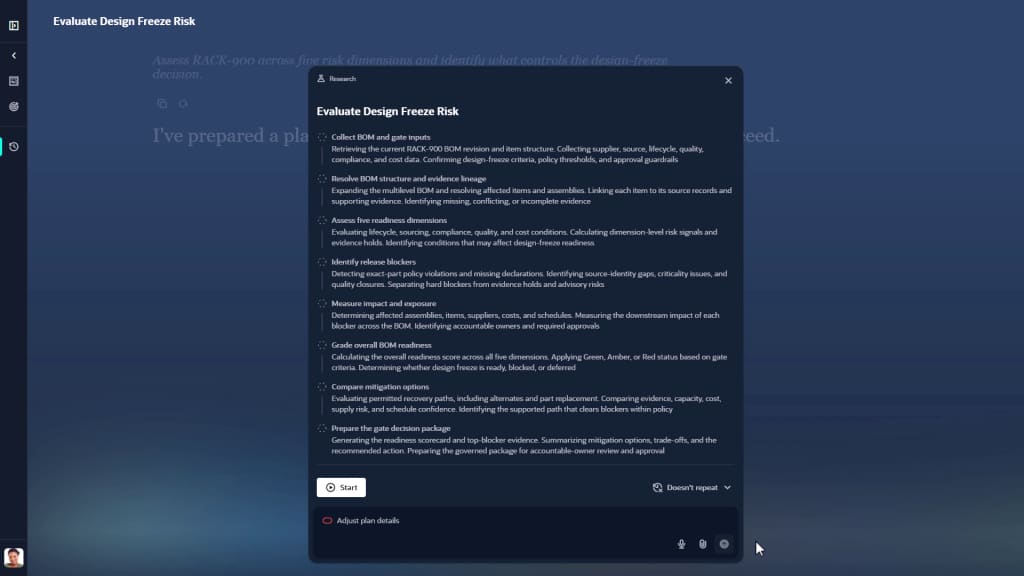
Evaluating these dimensions together helps teams understand how component risks affect the broader product decision. A sourcing recommendation, for example, may address availability while introducing different cost, quality, or compliance considerations. The analysis needs to account for those relationships when determining a path forward.
Distinguish Overall Risk From Release-Gating Conditions
The RACK-900 assessment returns an overall D grade and a determination that the product is not ready for release. The grade provides a useful summary, but the release decision requires more detail.
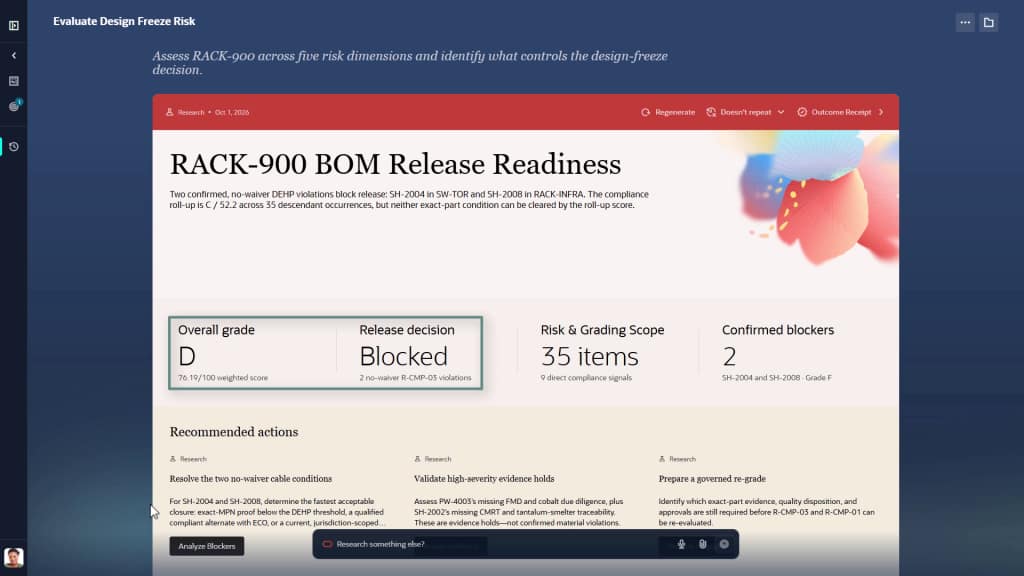
An aggregate grade and a release gate answer different questions. The grade summarizes the product’s risk profile across the evaluated dimensions. The release gate determines whether the product satisfies the conditions required to proceed.
That distinction matters because some conditions are noncompensatory: stronger performance elsewhere cannot offset a failed requirement. A mandatory compliance condition remains a blocker even when other components or risk dimensions perform well.
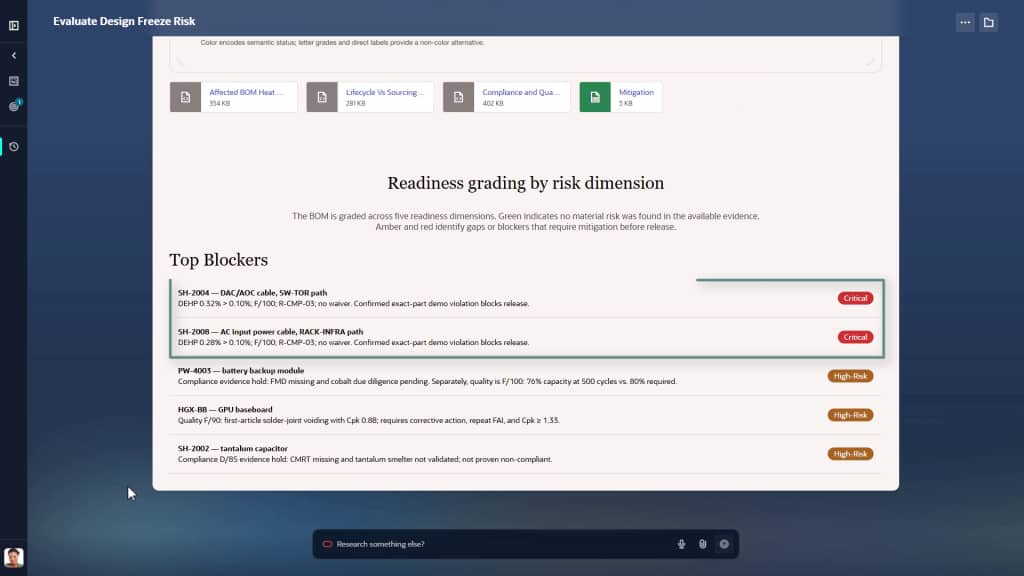
Fusion Claw applies company-specific release criteria and policies to identify the conditions that control readiness. In the demo, two cables violate compliance policies. Those violations are hard blockers that determine the release outcome.
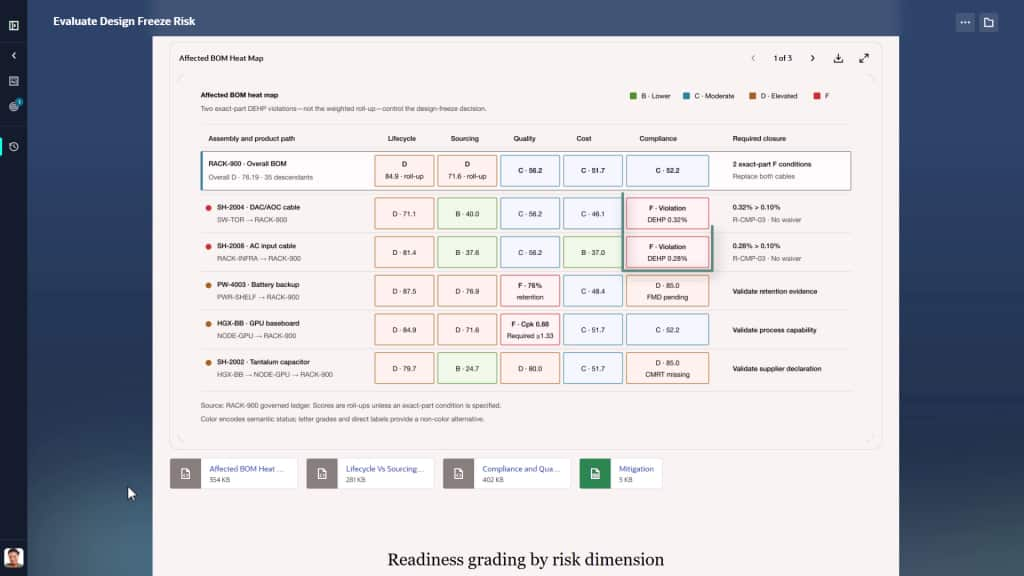
This approach preserves the significance of critical findings. Teams can see both the overall assessment and the specific conditions that prevent the product from advancing.
Make the Decision Explainable
A readiness determination needs to support review and action. Product teams must understand which findings drove the outcome, why those findings matter, and what evidence supports them.
The BOM Risk and Grading Analyzer makes the underlying evidence and reasoning available alongside the assessment. This gives reviewers a basis for examining the relationship between a component issue, an applicable release criterion, and the resulting readiness decision.
For RACK-900, the actionable finding is that two identified cables violate compliance policies and therefore control the release gate. That explanation directs attention to the conditions that must change before the product can move forward.
It also gives engineering, sourcing, quality, and compliance teams a shared basis for evaluating the next step.
Compare Mitigation Scenarios Across Interconnected Risks
Identifying blockers is the starting point for recovery. The next challenge is determining how to resolve them without creating unacceptable consequences elsewhere.
A component replacement can affect several dimensions simultaneously. An alternative source may change supply availability, cost, quality exposure, compliance status, or schedule. Evaluating one dimension in isolation can leave teams with a recommendation that addresses the immediate issue but weakens the broader release plan.
In the demo, the user asks Fusion Claw to analyze the blockers and model alternative mitigation scenarios. It compares the implications across supply, cost, quality, compliance, and schedule to recommend a resilient path forward.
The user then explores alternative sourcing recommendations. This connects the proposed mitigation to the original readiness objective: resolving the conditions that prevent the product from passing its release gate while considering the consequences of that resolution.
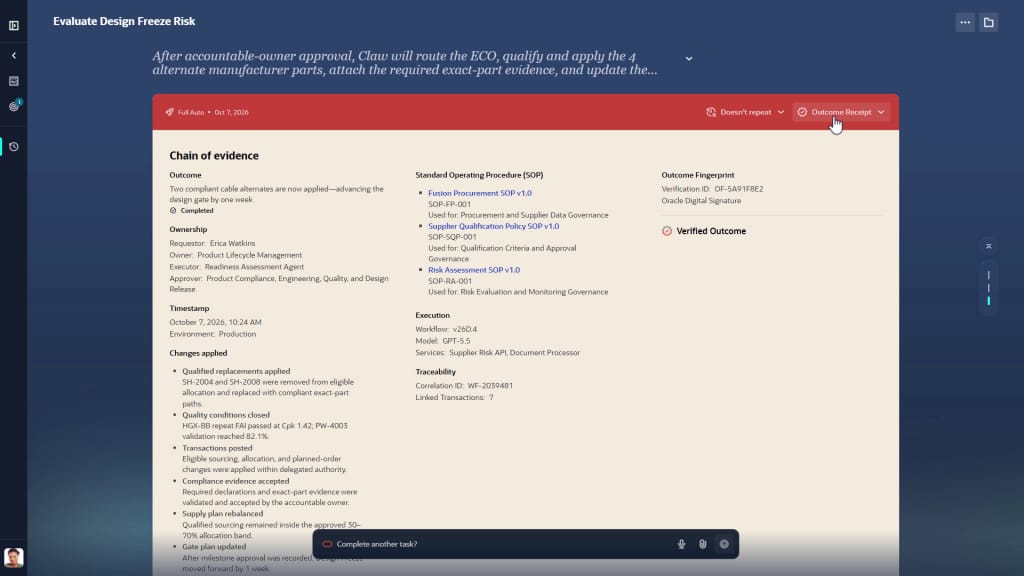
The scenario analysis supports human review of the available paths and their tradeoffs before execution begins.
Carry Approved Recommendations Into Execution
A recommendation only changes the release outcome when the required work is carried out.
After reviewing the alternative sourcing recommendations, the user selects “Carry to Execution.” Once approved, Fusion Claw coordinates the permitted actions across Fusion Applications.
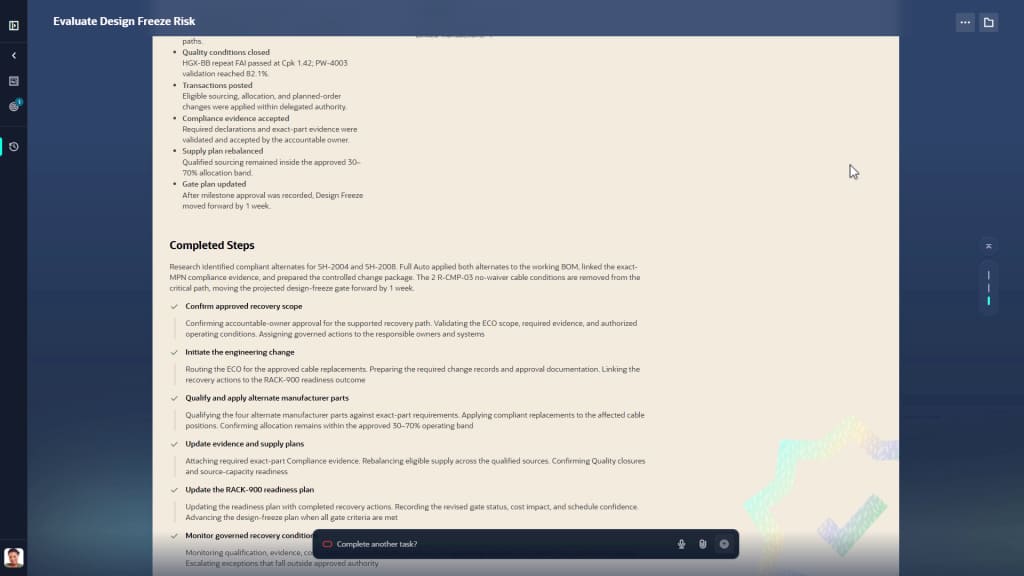
Corporate policies, approvals, and controls remain authoritative throughout this process. The recommendation establishes a proposed path; approval and permissions govern which actions can proceed.
This connection between analysis and execution helps teams carry the assessment’s context into the work required to resolve it. The identified blockers, supporting evidence, and selected mitigation remain part of the decision being acted on.
Monitor Readiness as Conditions Change
Readiness can change after an assessment or approval. New information may affect the assumptions behind a recommendation or alter the product’s ability to meet its release criteria.
Fusion Claw continues monitoring readiness, re-plans when conditions change, and escalates exceptions that require human judgment. This supports an ongoing evaluation of whether the chosen path still serves the requested outcome.
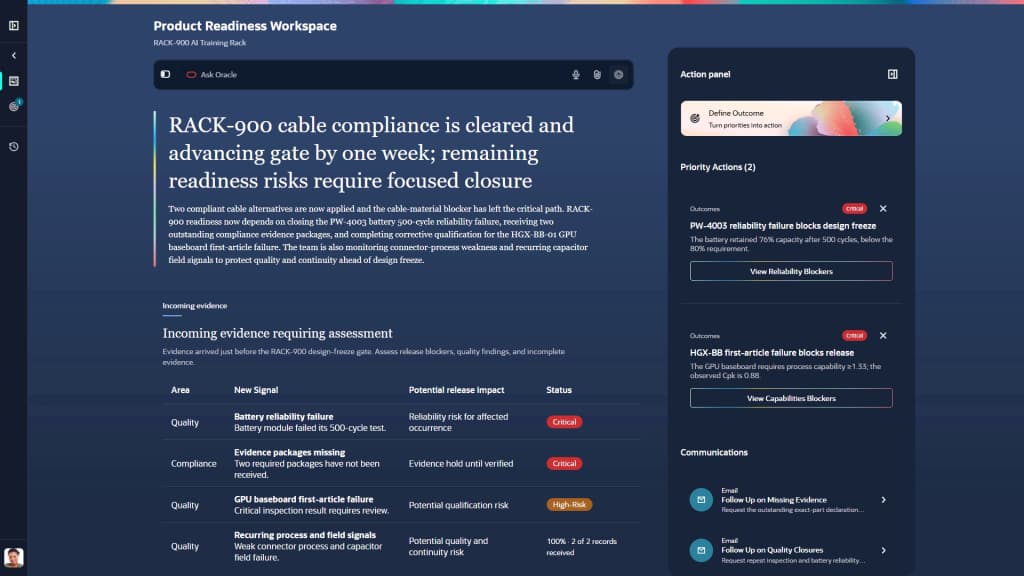
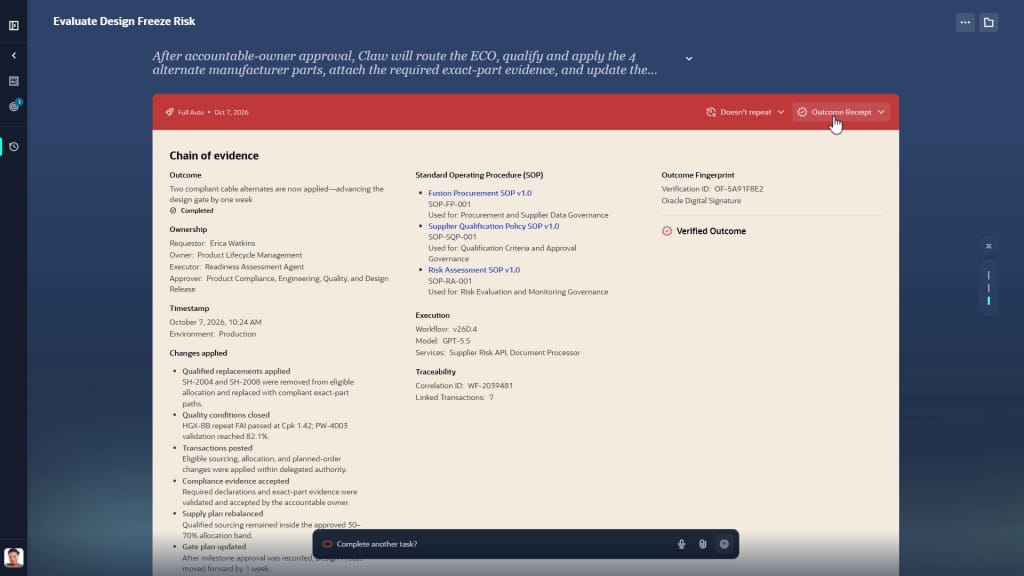
An Outcome Receipt preserves the evidence, decisions, approvals, and actions behind the result. That record helps teams review how the outcome was reached and understand the relationship between the original assessment and subsequent execution.
A Clearer Path From Product Risk to Readiness
The BOM Risk and Grading Analyzer brings together multidimensional risk assessment, policy-based release evaluation, mitigation scenario analysis, and approved execution in the Product Readiness Workspace.
For product teams, that means a clearer connection between the risks present in a BOM and the decisions required to move a product forward. They can identify the conditions that control readiness, examine the supporting evidence, compare recovery options, and coordinate action while maintaining corporate oversight.
Watch the demo to see how the BOM Risk and Grading Analyzer evaluates RACK-900, identifies its release blockers, and carries an approved mitigation path into execution.