
France’s e-invoicing mandate adds new requirements across the full invoice lifecycle. Finance teams must be able to create customer invoices in approved electronic formats, receive supplier invoices without manual re-entry, exchange invoice and payment status updates, and adapt as local compliance rules or business needs evolve.
Readiness typically goes beyond ERP setup alone. It also depends on connectivity with approved e-invoicing platforms that support tax authority reporting, country-specific validations, and required message exchanges.
PeopleSoft helps organizations manage the ERP side of this process with eInvoicing capabilities across Billing, Receivables, and Accounts Payable, supporting both customer and supplier invoice flow
A Flexible Product-and-Partner Model
The PeopleSoft eInvoicing solution combines product capabilities with service-provider connectivity.
Within PeopleSoft, the Data Export Import Utility, or DEIU, supports the extraction and import of invoice data in standard XML formats. Delivered maps provide baseline content that organizations can copy and extend, making it easier to add information or accommodate new requirements without starting from scratch.
A service provider complements these capabilities by managing communication with tax authorities and supporting local or customer-specific requirements. This division of responsibilities allows PeopleSoft to manage invoice processing while the service provider manages the external exchange.
Generating Electronic Customer Invoices from Billing
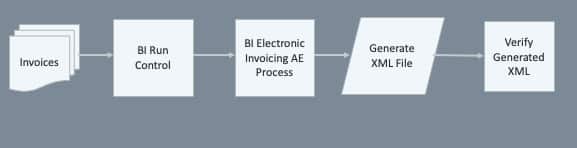
For outbound customer invoices, PeopleSoft Billing uses DEIU maps to extract invoice data. For France, a delivered UBL 2.1 map provides the baseline content.
Oracle recommends copying the delivered map and modifying the copy to meet the organization’s regulatory and business requirements. This preserves the delivered definition while providing the flexibility to add fields or adjust the mapping when requirements change.
After the map is associated with an electronic invoice form, customers can be enabled for electronic invoicing through their Bill To options. The appropriate electronic invoice form then defaults during standard bill entry.
Users can finalize the invoice through the existing Billing process and run Create Electronic Invoice File to produce XML files for selected business units and customers.
This provides a repeatable way to generate structured customer invoice data without separating eInvoicing from the Billing processes users already know.
Bringing Supplier Invoices into Accounts Payable
Inbound supplier invoices follow a similar model in reverse.
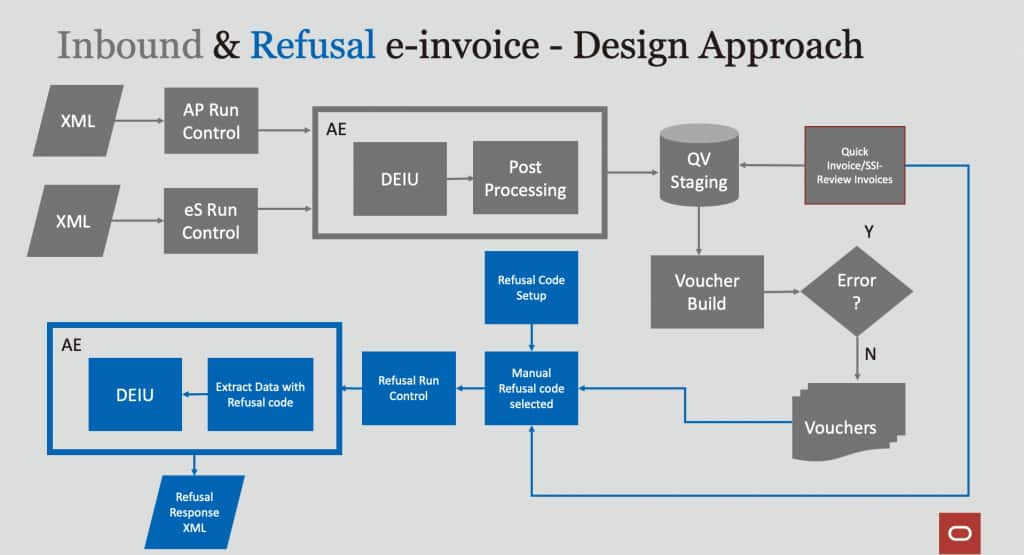
Users provide the required processing parameters through the AP Inbound E-Invoice page. DEIU then loads the incoming XML invoice data into Quick Invoice staging. Post-processing can enrich the invoice data—for example, by performing a supplier ID lookup—before Voucher Build creates the voucher.
When an invoice requires attention, teams can use familiar PeopleSoft pages rather than moving to a separate correction experience. Accounts Payable users can review and correct invoices through Quick Invoice, while eSupplier users can work through Self-Service Review Invoice.
By connecting electronic invoice import to existing staging, review, and voucher creation processes, PeopleSoft helps reduce manual data entry while keeping established financial controls in place.
Reporting Payment and Invoice Status
Electronic invoicing does not always end when an invoice is sent or received. Some mandates also require status information as the transaction progresses.
For France, PeopleSoft Receivables can generate CDAR-formatted XML for payment status reporting. The AR_FRA_CDAR process creates files for each business unit and customer and selects invoices whose VAT declaration point is Payment.
The output includes payment and VAT-related information required for reporting. Payment identifiers and reporting indicators also help prevent information that has already been reported from being selected again.
PeopleSoft Accounts Payable, delivered in Image 57, also provides UBL-based output for voucher creation error updates. These responses can help communicate invoice processing failures back through the eInvoicing network so the exception can be investigated and corrected.
Why This Matters
PeopleSoft eInvoicing capabilities help organizations:
- Generate outbound customer invoice XML from Billing
- Import supplier invoice XML into Accounts Payable staging
- Adapt delivered DEIU maps for regulatory and business requirements
- Continue using familiar Billing, Quick Invoice, and Voucher Build processes
- Produce status information for payments and invoice processing errors
- Work with service providers for tax-authority connectivity and local requirements
The result is a practical framework for managing electronic invoice data without separating it from the core financial processes teams use every day.
As eInvoicing requirements evolve, flexibility becomes as important as format support. By combining standards-based XML, configurable mappings, existing PeopleSoft processing, and service-provider connectivity, PeopleSoft gives organizations a foundation they can adapt as mandates and business needs change.