
Organizations rely on experienced PeopleSoft technical resources to maintain, enhance, and modernize critical applications. Yet those skills can be difficult to find, and experienced developers are often balancing a growing list of priorities. In PeopleTools 8.63, AI Assistant in PeopleSoft Application Designer helps organizations make better use of the expertise they already have while making PeopleSoft development more approachable for others.
AI Assistance Where Developers Work
AI Assistant introduces a new LLM-enabled chat window directly in Application Designer. Developers can ask questions without leaving their familiar development environment, using metadata from supported PeopleTools objects as context as well as uploaded files such as bug replication instructions, requirements documents, and more.
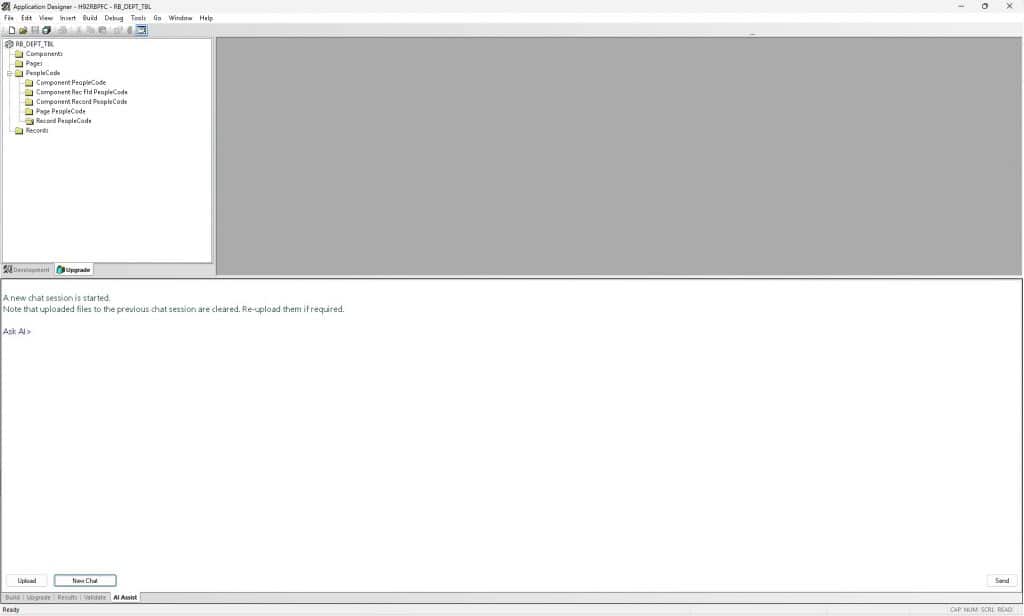
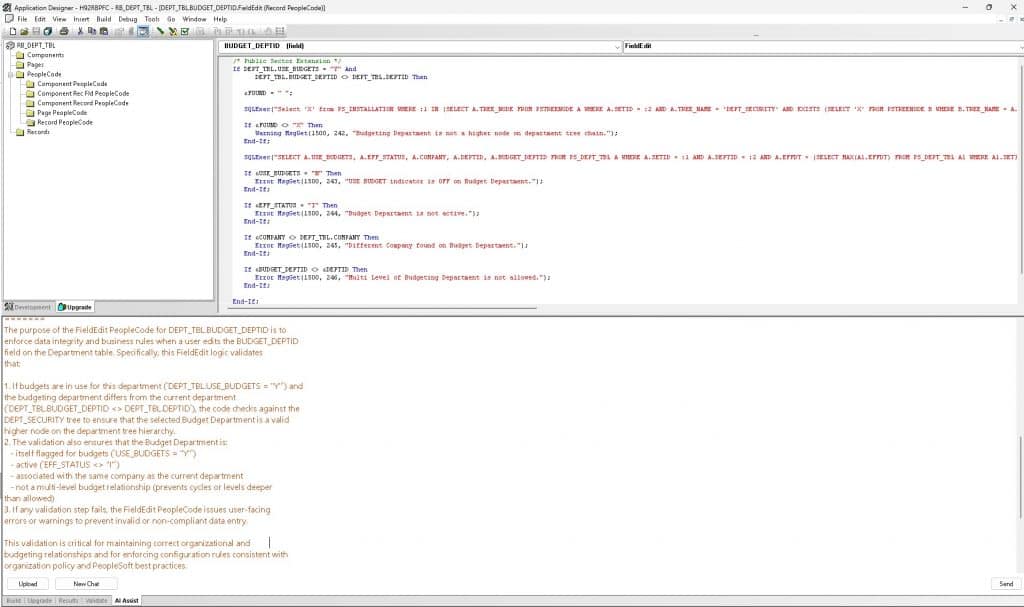
The new chat window experience in Application Designer can assist with activities such as generating documentation, explaining existing designs, and offering code suggestions. Developers remain in control, reviewing the information and deciding how it should be applied. As an example, if you have created an Application Designer project you could ask a question about a PeopleCode object in the project:
“What is the purpose of the FieldEdit PeopleCode for DEPT_TBL.BUDGET_DEPTID?
Your LLM, Your Choice
Every organization has different requirements for AI, including security, deployment, governance, cost, and model capabilities. AI Assistant is designed with a pluggable approach, allowing customers to configure the supported LLM that best fit their environment.
Customers are not locked into a single LLM. This flexibility helps organizations align AI Assistant with their existing technology strategy and adapt as models and business requirements evolve. The design supports integration through AI Agents such as Aider and Cline with customers managing the appropriate client and model configuration.
Helping Teams Address the PeopleSoft Skills Gap
AI Assistant is not a replacement for experienced PeopleSoft developers. It is a force multiplier for them. Senior technical resources can spend less time explaining familiar object structures, documenting customizations, or answering repetitive questions. Newer developers can get help understanding metadata and navigating unfamiliar designs, reducing the time required to become productive.
Consider a developer assigned to maintain an unfamiliar customization. Instead of beginning with a blank page, the developer can ask AI Assistant to explain objects and generate a first draft of the documentation. An experienced team member can then review and refine the result.
Why AI Assistant Matters
By bringing AI driven assistance into the developer workflow, organizations can improve productivity, accelerate onboarding, strengthen documentation, and extend the reach of experienced PeopleSoft resources. At the same time, the flexible LLM architecture gives customers control over how AI fits into their technology landscape.
Closing Thoughts
AI Assistant in PeopleSoft Application Designer is part of PeopleTools 8.63. The shortage of PeopleSoft technical resources will not be solved by one feature alone. But AI Assistant can help organizations scale knowledge, support the next generation of developers, and give experienced professionals more room to focus on the work where their expertise matters most, without limiting customers to one AI model or provider.