
Over the past year, we have had the opportunity to share Oracle Enterprise Manager’s AI vision at Oracle AI World and several Oracle user group conferences. Across those discussions, message has come through clearly: modern database operations are becoming too complex for traditional monitoring alone.
Today’s database environments span Exadata fleets, RAC clusters, Autonomous Databases, multicloud deployments, and Kubernetes-based platforms. At the same time, the volume of operational telemetry continues to grow, making it increasingly difficult to identify the true root cause of performance issues before they impact the business.
Oracle Enterprise Manager is evolving to address these challenges by combining Oracle’s deep operational intelligence with Generative AI and Agentic AI. The goal is not to replace deterministic database analysis, but to make it easier to access, interpret, and act on operational intelligence.
In this post, we start with the future enhancements for database performance management, then briefly summarize the released AI assistant and MCP capabilities in Enterprise Manager that are already available.
Safe Harbor statement: Features described as planned enhancements are intended to outline Oracle’s general product direction. They are provided for information purposes only and should not be relied upon in making purchasing decisions. The development, release timing, and functionality of these features remain at Oracle’s sole discretion.
AWR.ai: Simplifying AWR analysis
(Planned enhancement)
Automatic Workload Repository (AWR) is one of Oracle Database’s most valuable performance resources, but it can also be difficult to use effectively. The AWR stores detailed historical performance information, and meaningful analysis often requires familiarity with many views, snapshot comparisons, and Oracle-specific performance concepts.
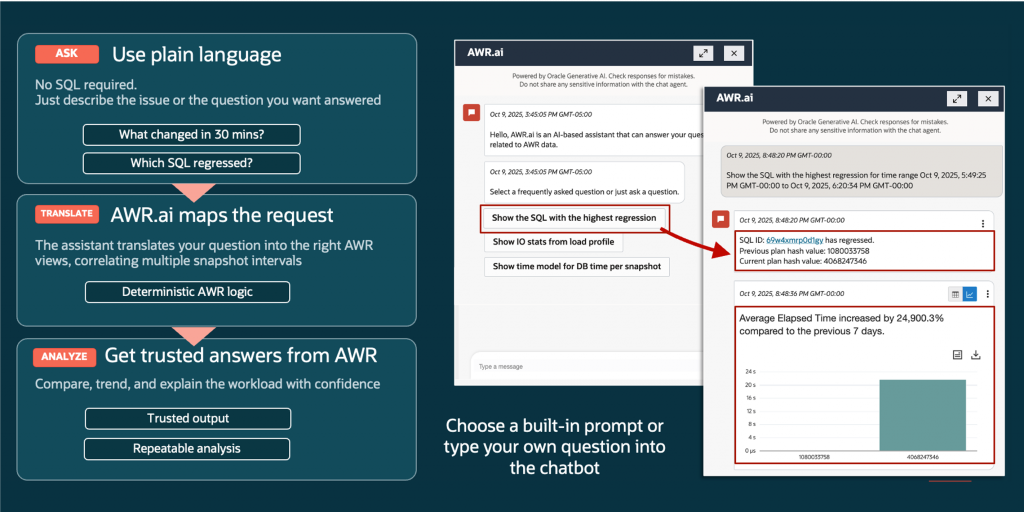
AWR.ai is being developed to simplify that experience. Instead of writing SQL or manually correlating AWR reports, administrators will be able to ask questions such as:
- What changed during the last 30 minutes?
- Which SQL statements regressed?
- Show the top wait events.
- Compare workload across snapshot intervals.
Behind the scenes, AWR.ai maps each request to deterministic AWR analysis rather than relying solely on an LLM to interpret performance data. This approach combines conversational AI with Oracle’s proven workload analysis logic, helping produce accurate, repeatable, and trustworthy results. Planned capabilities include:
- Built-in prompts for common AWR investigations
- User-defined prompts
- Historical workload comparisons
- Trending and drill-down analysis
- Integration with Enterprise Manager Performance Hub
SQLPerf.ai: Turning SQL Monitor execution evidence into tuning guidance
(Planned enhancement)
Once a workload issue has been identified, the next challenge is understanding why a SQL statement performs poorly and determining the appropriate tuning strategy.
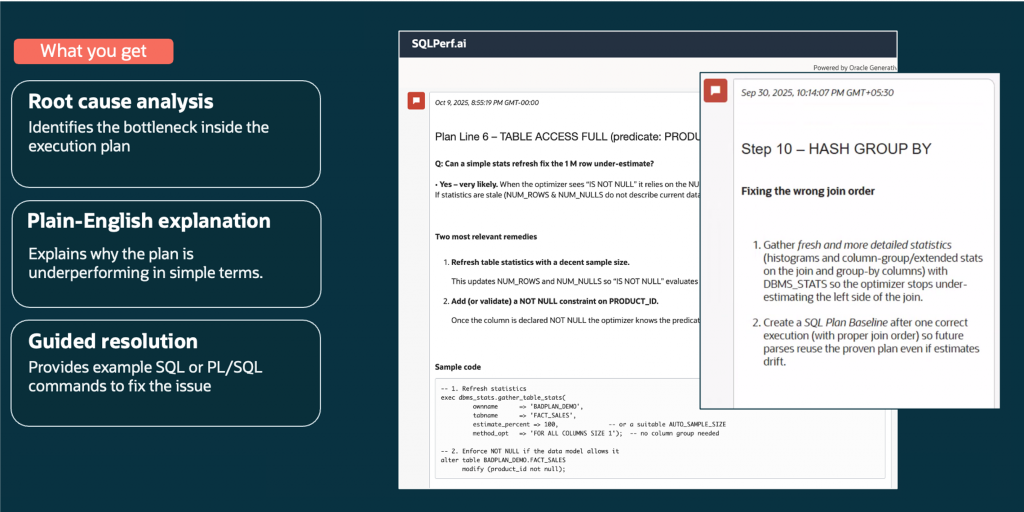
SQLPerf.ai is designed to transform SQL Monitor execution evidence into actionable tuning guidance. SQLPerf.ai begins with deterministic analysis of SQL Monitor execution data to understand where execution time is spent and why a SQL statement is underperforming. Once the bottleneck has been identified, AI provides a natural-language explanation of the findings along with practical remediation guidance. SQLPerf.ai is designed to identify common SQL performance issues such as:
- Inefficient nested loops
- Poor filtering
- Stale statistics
- Missing histograms
- Incorrect join ordering
- Missing column groups
- Lack of partition pruning
- Parallel query skew
The objective is not simply to explain execution plans, but to help administrators move efficiently from diagnosis to remediation. As part of the planned workflow, SQLPerf.ai is expected to integrate with SQL Tuning Advisor (STA), allowing DBAs to continue using Oracle’s recommended SQL tuning framework while significantly reducing the time required to identify the appropriate tuning strategy.
Oracle AI Database Assistant and MCP Server
Oracle AI Database Assistant, formerly known as Ask EM, is available beginning with Enterprise Manager 24ai RU10.
The assistant provides a conversational interface that allows administrators to retrieve Enterprise Manager information using natural language instead of navigating multiple pages throughout the console. Administrators can ask questions such as:
- Show me the databases with the highest I/O throughput during the last 24 hours.
- Which databases currently have critical alerts?
- Show CPU utilization across my managed targets.
Oracle AI Database Assistant retrieves Enterprise Manager telemetry and presents the results using interactive widgets, tables, and visualizations. Users can drill into the data, filter results, and continue their investigation without leaving the workflow.
Key capabilities include natural language interaction, interactive Enterprise Manager widgets, AI-powered operational insights, Oracle-managed OCI Generative AI or Bring Your Own LLM (OpenAI-compatible endpoints and Ollama), and zero data exfiltration that keeps Enterprise Manager operational data within the customer’s environment.
Because the assistant operates within Enterprise Manager, it can leverage existing targets, metrics, security, credentials, and operational context while respecting enterprise governance and access controls.
Enterprise Manager 24ai RU12 introduces support for Model Context Protocol (MCP) Server. MCP Server enables Enterprise Manager to securely expose operational context to MCP-compatible AI clients while maintaining Enterprise Manager as the authoritative platform for authentication, authorization, auditing, credentials, and governance.
This architecture allows organizations to benefit from modern AI models while ensuring that operational context and administrative controls remain securely managed within Enterprise Manager For more details on Oracle AI Database Assistant and MCP Server, please see blog: Oracle Enterprise Manager MCP Server: Connecting AI Agents to Enterprise Manager Data
A platform built for Oracle context
Generative AI excels at understanding natural language, but enterprise database management requires more than conversation. Performance diagnostics depend on deterministic analysis, Oracle-specific domain knowledge, and secure access to operational telemetry.
Enterprise Manager already contains that operational context – including AWR, SQL Monitoring, Exadata metrics, Data Guard information, targets, jobs, policies, credentials, and security controls.
Oracle’s AI strategy builds on this foundation by combining deterministic Oracle analysis with AI-generated explanations and recommendations. It helps administrators work more efficiently while maintaining the accuracy and reliability expected in enterprise environments.
Watch the complete presentation
This article summarizes the AI capabilities and planned enhancements that we have shared with customers at Oracle AI World and Oracle user group conferences.
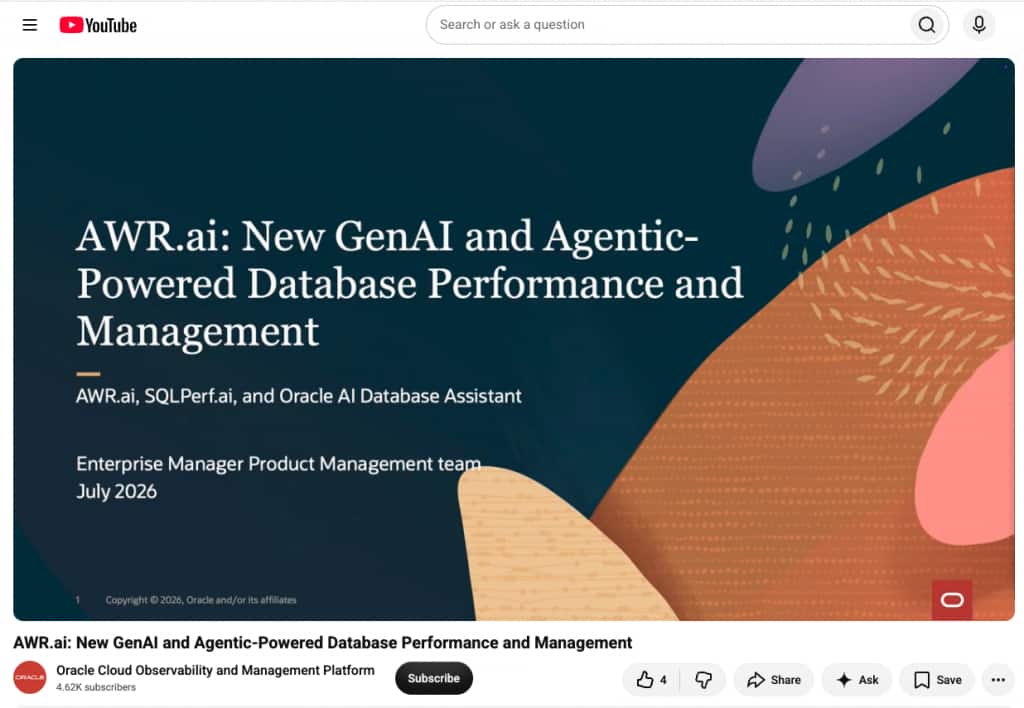
To see these capabilities in more detail, including supporting demonstrations of Oracle AI Database Assistant, AWR.ai, and SQLPerf.ai, watch the complete presentation here: AWR.ai: New GenAI and Agentic-Powered Database Performance and Management
Conclusion
Enterprise database environments continue to grow in complexity, and AI has an important role to play in helping administrators manage that complexity.
Oracle AI Database Assistant, available today in Enterprise Manager 24ai RU10, makes Enterprise Manager more conversational and easier to use. MCP Server, available in Enterprise Manager 24ai RU12, extends that foundation by enabling secure, context-aware integration with MCP-compatible AI clients. Planned enhancements such as AWR.ai and SQLPerf.ai build on that foundation by simplifying performance analysis, streamlining SQL tuning, and enabling more intelligent operational workflows.
Together, these capabilities represent Oracle’s vision for evolving Enterprise Manager beyond traditional monitoring into an AI-powered operational intelligence platform for Oracle database environments.