
MySQL is taking a significant step forward by rethinking how foreign key constraints and cascades are managed. Starting with MySQL 9.6, foreign key checks and cascade operations will be handled directly by the SQL engine rather than the InnoDB storage engine. This improvement addresses long-standing challenges with change tracking, binary log replication, and data consistency, making MySQL more robust for heterogeneous environments, Change Data Capture (CDC) pipelines, and analytical workloads.
How Foreign Keys Previously Worked within InnoDB
Historically, MySQL enforced foreign key constraints and cascades at the storage engine layer, specifically within InnoDB. Here’s how it worked:
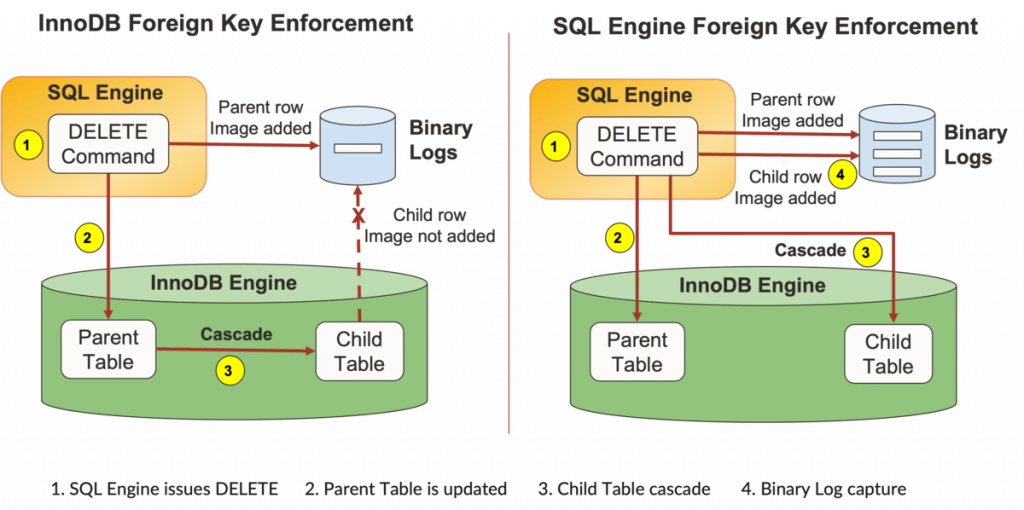
Foreign Key Cascades: When a statement like DELETE or UPDATE was executed on a parent table, InnoDB checked the foreign key constraints. If cascading actions (such as ON DELETE CASCADE) were defined, InnoDB handled updating or deleting the corresponding rows in the child table.
Internal InnoDB Execution: All cascaded operations were executed internally by InnoDB. The SQL engine initiated only the parent operation; every dependent action on child tables was managed by InnoDB.
Importantly, these child-row changes were invisible to the SQL layer. As a result, cascades performed within InnoDB did not appear in the MySQL binary log under row-based replication (RBR).
Operational Impact: Because these changes were hidden from the SQL engine and binary logs, downstream systems, such as CDC pipelines and analytics platforms could miss them. This could lead to inconsistent data, unreliable analytics, and replication issues.
Limitations of InnoDB-Based Foreign Keys
As MySQL deployments grew in scale and complexity, this legacy approach revealed the following limitations:
- Hidden Data Changes: Cascading parent-child changes performed inside InnoDB were invisible to the SQL layer and weren’t captured at a higher level.
- Incomplete System Logs: Child row changes were often missing from binary logs, making replication and audits incomplete.
- Data Capture Gaps: Data tools and downstream systems relying on binary logs or a complete change history couldn’t always track every foreign key related update or delete.
- Replication Risks: In complex replication setups, these silent changes could cause data divergence between the primary server and replicas, leading to operational challenges.
The New Model: SQL Engine-Managed Foreign Key Enforcement
To address these issues, MySQL now enforces foreign keys and manages cascades in the SQL engine itself. With this change, all foreign key operations on both parent and child tables are fully visible to the SQL layer.
Key Advantages:
- Complete Logging: Every change, including cascades, is now visible, auditable, and fully recorded in the binary logs.
- Reliable Replication: No more hidden data changes; replication is now more trustworthy and accurate.
- Better Analytics: Data capture and analytics tools now get a complete, real-time view of all data changes.
- Foundation for Innovation: This architecture makes it easier to extend foreign key support across storage engines and future replication and observability features.
Note: For storage engines other than InnoDB that support foreign keys, enforcement and cascade actions continue to be managed at the respective storage engine.
Performance Comparison
We understand that performance is a top priority for MySQL users considering a shift in foreign key enforcement from InnoDB to the SQL engine. Extensive benchmarking across common transactional workloads confirms that SQL engine based foreign key enforcement and cascade performs nearly identically to the InnoDB approach. The cost of foreign key checks and cascades remains effectively unchanged, resulting in no observable regression in throughput or latency.This makes the new implementation safe to adopt even in high-throughput and mission critical deployments.
Backward Compatibility
The SQL Engine foreign key enforcement and cascade is designed for full backward compatibility, preserving the semantics and behavior of InnoDB foreign key enforcement. While the overall user experience remains unchanged, there are a few deliberate improvements and minor behavioural differences worth noting:
- Error Messages: While error codes continue to match previous releases, the specific error message text (including foreign key names) may differ due to the order in which checks are performed.
- Auto-Increment Gaps: If a foreign key constraint fails, any attempted insert increments the auto-increment counter, which may result in value gaps, matching standard MySQL behavior.
- Statistics Updated for Cascaded Rows: Row-level statistics (such as
delete_rows) are updated to include rows affected by cascading foreign keyf operations. This ensures system statistics accurately reflect all data changes performed by foreign key enforcement. - Stricter Collation Validation: If a foreign key cascade would cross incompatible collations, an explicit error is raised preventing silent data issues and improving data integrity for users.
Safe Adoption with a Built-In Fallback
For controlled adoption, MySQL introduces a read-only startup variable, innodb_native_foreign_keys. This provides a smooth upgrade path and minimizes unexpected changes during version transitions. By default, this variable is set to FALSE, making SQL Engine based foreign key enforcement the default behavior. During staging or early production rollout, you may set this variable to TRUE to temporarily revert to InnoDB’s native foreign key handling. This provides a clear operational fallback while validating the new SQL Engine behavior.
Note: This system variable is intended to help ease migration and will be removed in a future release as the MySQL community fully adopts SQL Engine based foreign keys.
Summary: Why This Change Matters
By moving foreign key enforcement to the SQL engine, MySQL closes a long-standing architectural gap. This improvement ensures that data changes are always visible, logged, and replicated, making MySQL a stronger platform for modern, distributed, and compliant data environments.
Overall, for MySQL users, this means better data consistency, more reliable replication, and fewer surprises in analytics and compliance workflows without sacrificing performance.
What’s Next on the Roadmap
- Broader support for triggers on cascaded changes.
- Foreign key enforcement for additional storage engines.