
Why ransomware resilience starts with protecting a clean, recoverable copy of business data
The measure of security is what you can recover
Ransomware resilience is often discussed as a contest at the perimeter: stop the intrusion, block the payload, contain the attacker. Those controls matter. But a determined adversary may still get in, and the damage can reach beyond production systems. Attackers increasingly pursue administrator credentials and backup repositories because disabling recovery can give them greater leverage over the business. The advent of agentic AI now enables adversaries to perform large-scale attacks to quickly identify privileged accounts and backup systems using much less effort.
The scale of the problem keeps rising. A recently released HyperFRAME Research brief “Moving from Defense to Resilience: AI-Era Data Protection Against Ransomware Attacks” cites a 2026 Ransomware Report that tracked 7,551 publicly disclosed victims from April 2025 through March 2026, a 24.9% increase over the prior period. Disclosures reached a fourth consecutive annual high. These numbers do not predict the fate of any one organization; they do show why recovery readiness belongs in the enterprise risk conversation.
The strategic shift is from asking “How do we keep attackers out?” to also asking, “If they reach our data and credentials, can we restore trustworthy operations quickly?” That turns backup from a periodic IT task into a business control. The goal is not simply to possess backup files. It is to know that a clean copy exists, that an attacker cannot erase it, and that the organization can use it under pressure.
Oracle’s Zero Data Loss Recovery Appliance (ZDLRA) and Autonomous Recovery Service (ZRCV) offer a comprehensive suite of database protection capabilities for on-premises and cloud environments in establishing a secure, resilient recovery vault for the enterprise.
Build a vault to stop an adversary that gets inside
A recovery vault needs four safeguards working together: isolation, immutability, continuous integrity checks, and separation of duties.
Each addresses a different failure mode:
- Isolation limits reachability.
- Immutability protects retained copies from alteration or deletion.
- Ongoing validation helps reveal corruption before an emergency restore.
- Separate identities and responsibilities make a stolen production credential less useful against recovery assets.
The air gap architecture is a key consideration for isolation – the below illustrates how these safeguards have evolved from manually transferring data across physical locations to an end-to-end managed virtual air gap.
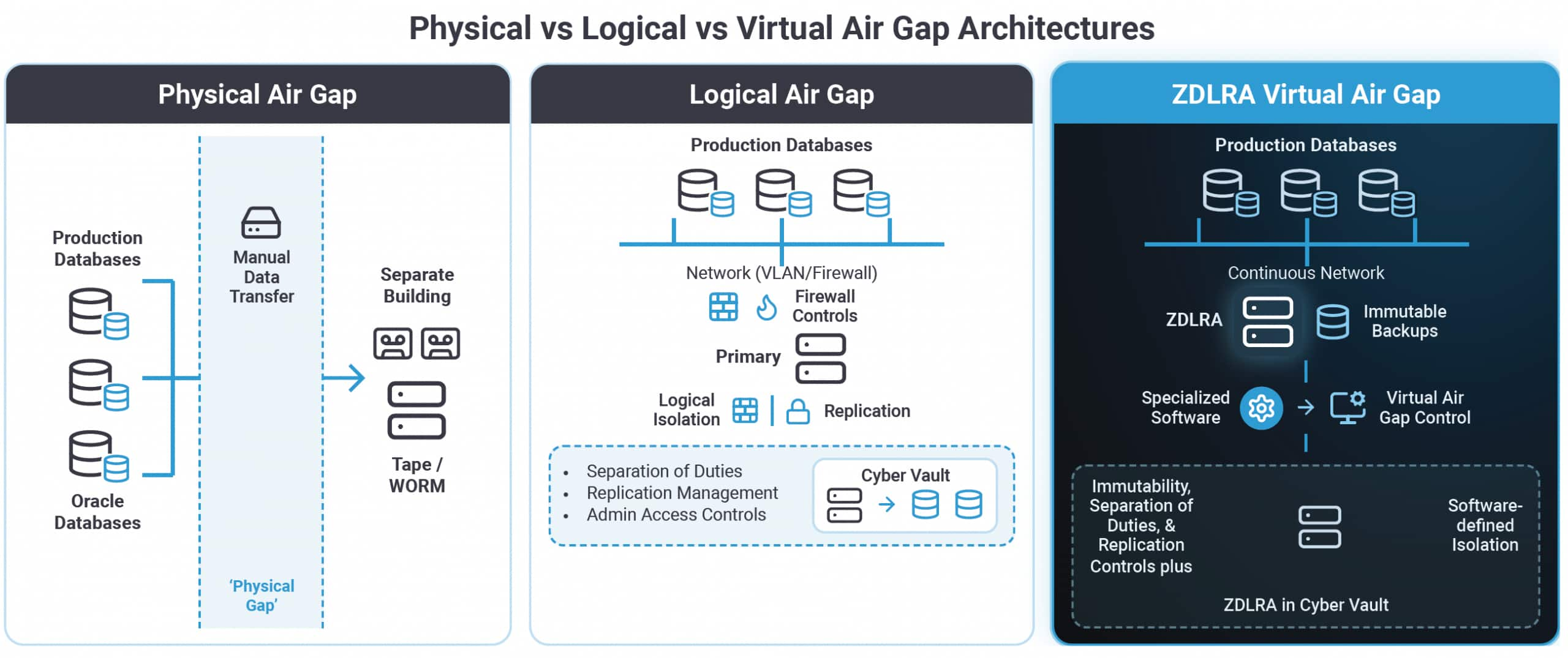
Physical vs Logical vs Virtual Air Gap Architectures (Credit: HyperFRAME Research)
A virtual air gap aims to make the recovery environment unavailable to ordinary network access similar to physical air gap, while opening a controlled path for replication into the vault when needed and closing it again afterward. With the ZDLRA Virtual Air Gap, replication is enabled at a database-level and works in conjunction with user-specified vault access periods. And, ZDLRA’s innovative incremental forever backup and replication model means that data in the vault can be synchronized with production much faster than traditional full backup-based approaches.
Prove the backup can become a working database
Isolation and immutability controls are essential, but they do not prove that stored data is healthy. A backup job can complete successfully while the data it copied is already damaged. Silent corruption may accumulate across multiple backup cycles, leaving teams with a long history of unusable recovery points just when they need them most.
For database workloads, recovery assurance should include application-aware validation. Oracle’s Zero Data Loss Recovery solutions – Recovery Appliance for on-premises and Recovery Service for OCI & Multicloud databases – validate database blocks as they arrive and continue to inspect stored data, so potential corruption can be flagged before a restore is attempted. This goes beyond answering the question “Did the backup finish?” to validating that the backup data is structurally sound and can be restored to bring the complete database back into service.
Furthermore, Oracle’s solutions provide real-time transaction protection to reduce the recovery point objective to the last committed transaction, allowing recovery to within a sub-second of the current time. In the event production environment is compromised, you can know that all transactional data up to that moment has been validated and made available for recovery to a separate, clean environment. These databases can be opened for business operations, while production systems are investigated by forensics teams.
Make recovery independent of compromised access
A recovery environment should not inherit every role from production. Separate administrative identities, strict role boundaries, multi-factor authorization, and carefully controlled access windows help reduce the chance that one compromised account can both disrupt operations and destroy recovery options. Minimizing exposed services and unnecessary privileged agents can further limit paths for lateral movement.
The same principle applies to governance. Executives need evidence that recovery objectives are achievable, not just a dashboard showing successful backup jobs. Live recovery-point reporting, audit trails, and rehearsed continuity plans can translate technical controls into clear answers: what data is protected, how current the protected copy is, who can access it, and how long restoration is expected to take.
Three steps to move from defense to resilience
To embark on the journey transforming defensive measures to proven resilience, start with these three steps:
- Start by auditing recovery, not only backup completion. Test whether protected data can be validated and restored to a usable state and identify how far back a clean recovery point can be achieved.
- Decouple recovery administration from production identity. Review privileged access, separation of duties, and the process for opening and closing vault connectivity.
- Prioritize outcomes: define acceptable data loss and downtime, then exercise a recovery plan that demonstrates those targets under realistic conditions.
No architecture makes an organization immune to ransomware. A well-designed recovery vault changes the consequences when defenses are breached. By keeping trusted data isolated, immutable, independently administered, and continuously checked, organizations can make recovery a deliberate capability instead of a last-minute hope.
For more information on these critical building blocks for cyber resiliency, read the complete HyperFRAME research brief.
Discover and learn more at Oracle AI World
To learn more about Oracle’s Zero Data Loss Recovery solutions and how they can transform enterprise resiliency, join us at Oracle AI World from October 25-28.
Register for an exclusive customer roundtable “Ransomware Resiliency in the AI Era: Architecting Zero Data Loss Strategies” on Monday October 26. Bring your questions, share operational practices, and learn from peers protecting critical data across on-premises, cloud, and multicloud environments. Learn how Oracle Zero Data Loss Recovery solutions can keep your business running in the face of ransomware and cyber threats.
Attend these learning and hands-on sessions to hear from product experts about Oracle’s latest data protection innovations:
Recover with Confidence: Modern Data Protection for Cyber Resilience [LRN6053]
Monday, October 26, 8:15 – 9:00 AM PT
Explore how Recovery Manager (RMAN), Zero Data Loss Recovery Appliance (ZDLRA), and Recovery Service (ZRCV) help deliver resilient, scalable data protection for on-premises/OCI/Multicloud.
Prove You Can Recover Under Attack: Hands-On with Recovery Service [HOL6005]
Tuesday, October 27, 10:00 – 11:30 AM PT
Learn how Recovery Service helps protect mission-critical Oracle Databases and keep recovery options ready when an attack, outage, or operational mistake puts data at risk.
Stop by the Oracle Demogrounds Booth #6 (MAA solutions) in the exhibit hall to meet the product team and see the latest demonstrations of Oracle’s data protection & recovery solutions in action.
We look forward to seeing you at Oracle AI World!