
AI is raising the value of the data behind the model and the cost of losing it.
For years, many organizations treated backup as a scheduled operational activity: create periodic copies, retain them for a prescribed period, and hope they are usable if an incident occurs. That approach is increasingly out of step with how AI-enabled businesses operate. AI applications are accelerating the volume, velocity, and business importance of database transactions. They are also making data platforms more interconnected and more attractive targets for cyberattacks.
The real question is no longer whether last night’s backup completed. It is whether we can recover the database to a known-good point with minimal or no data loss without adding meaningful overhead to the systems supporting AI-driven business processes.
That is a different backup requirement and it calls for a different recovery posture.
AI Increases the Speed and Stakes of Database Change
AI workloads may include model training and inference, but their business value is often created in the systems around them: customer interactions, orders, payments, inventory updates, product telemetry, approvals, and the feedback signals used to improve models. These operations are frequently recorded in transactional databases.
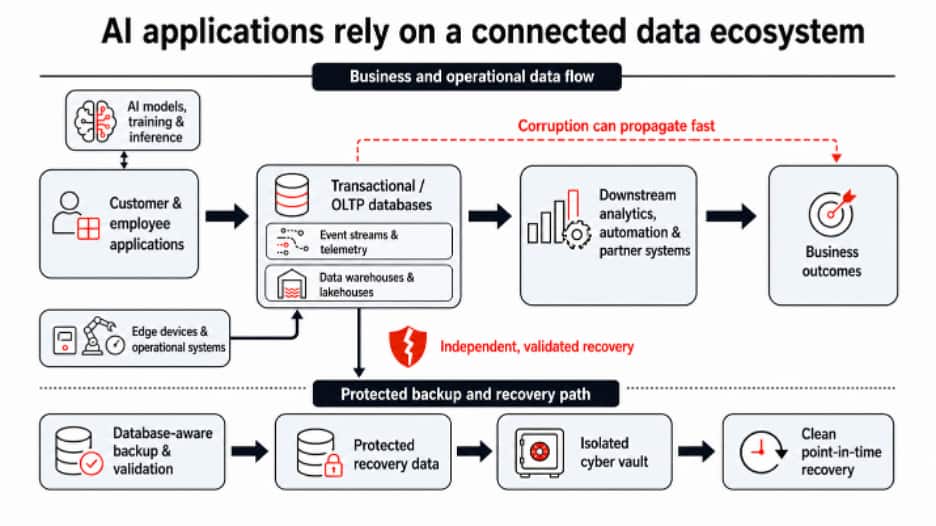
As AI increases personalization, automation, and decision speed, those databases can experience:
- More frequent transactions and updates
- More services and pipelines depending on the same data
- Less tolerance for downtime or stale information
- Faster propagation of bad data, accidental changes, or malicious activity
An RPO measured in hours can be difficult to justify when thousands of high-value transactions may occur in seconds. And an RTO is not meaningful if the restored data is incomplete, corrupt, or cannot be trusted.
In other words, AI does not just create more data. It compresses the time available to protect, validate, and recover the data that matters.
The old backup window is becoming a production constraint
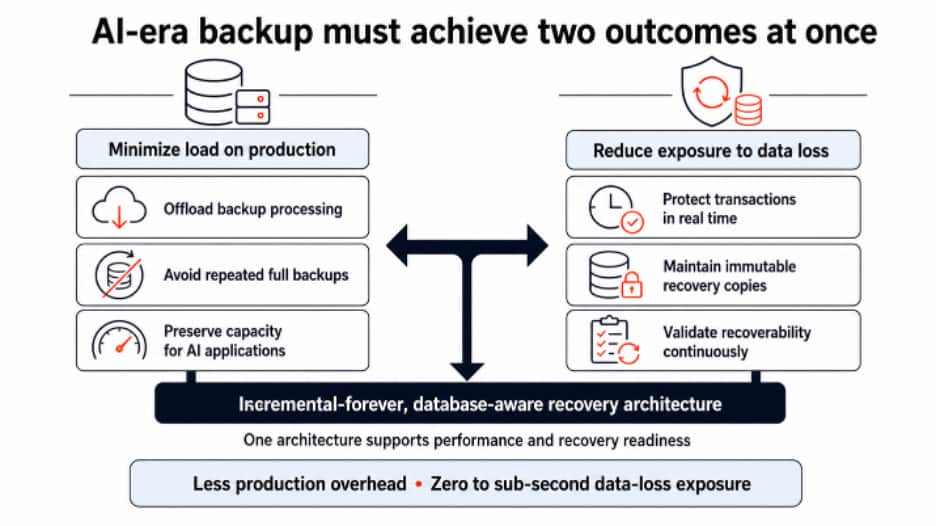
Traditional backup designs commonly rely on periodic full backups supplemented by incrementals. For large, busy databases, full backups can consume significant CPU, memory, I/O, and network capacity. At the same time, AI-adjacent applications are asking production databases to do more… not less.
This creates an uncomfortable trade-off: allocate resources to backup operations or preserve resources for customer-facing and AI-enabled services. Neither choice is attractive when the backup strategy itself also leaves a gap between scheduled copies. Storage snapshots can be useful for fast local copies, but they do not by themselves meet these recovery requirements. They may share the production storage failure domain, do not provide database-aware validation, and can preserve corruption that has already reached the source. For critical databases, snapshots should complement(not replace) an independent, validated recovery strategy.
A modern approach should minimize the load imposed on production while reducing exposure to data loss. This is why incremental-forever architectures and offloaded validation matter. They shift backup work away from production systems and remove the repeated full-backup burden, while still building a recoverable recovery point over time.
For Oracle databases, Zero Data Loss Recovery Appliance uses database-aware recovery technology and an incremental-forever approach to offload backup validation and reduce production overhead. Oracle Database Zero Data Loss Autonomous Recovery Service extends this model as an Oracle-managed cloud service.
Backup copies alone are not a recovery strategy
An AI-driven enterprise must assume that an incident may be both fast-moving and sophisticated. A ransomware attack may target production data, backup credentials, retention policies, or backup copies themselves. A pipeline defect or harmful automated action can also introduce logical corruption that is replicated across dependent systems.
That changes the standard from “we have copies” to “we have a recoverable, protected, and verified copy at the right point in time.”
Three capabilities become especially important:
1. Zero data loss protection – Critical database transactions should be protected as they occur, rather than only at the next backup interval. This narrows the potential data-loss window and gives recovery teams a more precise point-in-time recovery option.
2. Immutability, isolation, and cyber-vault readiness – A backup that an attacker can delete, alter, or prematurely expire is not a dependable last line of defense. Immutable retention and separation from the production environment help preserve recovery options during a cyber event. For the most critical workloads, an air-gapped cyber vault provides an additional, independently controlled recovery location.
3. Continuous validation – A backup job that reports success is not proof that recovery will succeed. Database-aware validation helps identify anomalies and confirms that the data and files needed for recovery are available both before and after a crisis.
These are not aspirational features. They are the controls that turn backup data into a credible recovery capability.
AI raises the bar for cyber recovery
AI can help defenders identify threats and automate response. Conversely, it can also be leveraged by cyber organizations to accelerate the scale and speed of attacks. More importantly, AI platforms concentrate valuable datasets, intellectual property, and high-impact business processes. That makes recoverability a board-level resilience issue, not just a DBA task.
Consider an incident that compromises a database used for customer offers, fraud decisions, or supply-chain planning. Restoring last night’s backup may return the system to service, but it can also discard a full day of valid business activity. Replaying or reconciling those lost transactions takes time, introduces risk, and can delay every downstream process.
The better objective is to recover to the moment immediately before compromise, using validated backups and transaction protection to minimize data loss. Oracle’s zero data loss recovery solutions are designed to protect database transactions in real time, continuously validate backups, and support point-in-time recovery. Recovery Appliance provides this capability on premises and can support an air-gapped cyber-vault architecture; Autonomous Recovery Service provides it as a fully managed cloud recovery service for supported OCI, Oracle Multicloud, and on-premises protection scenarios.
The bottom line
AI is changing the economics of downtime and data loss. The more rapidly an organization acts on data, the less acceptable it is to protect that data on a slow, periodic schedule. Backup must evolve from a set of copies to an always-on recovery discipline.
For customers running Oracle databases, Zero Data Loss Recovery Appliance and Zero Data Loss Autonomous Recovery Service provide two deployment models for that discipline: purpose-built, on-premises recovery infrastructure and a fully managed cloud recovery service. Both are designed to help organizations protect transactions in real time, validate recovery readiness, and recover from outages or cyberattacks with zero to sub-second data-loss exposure.
In the AI era, resilience is not measured by whether a backup exists. It is measured by how confidently and how completely you can recover the business. That means knowing that recovery data is isolated from the production blast radius, validated continuously, and ready to restore to a clean point in time when an incident occurs.
For organizations that depend on Oracle databases to run AI-enabled processes, the practical goal is clear: turn backup from a periodic operational task into a tested, always-on recovery capability that protects the business at the speed it operates.