
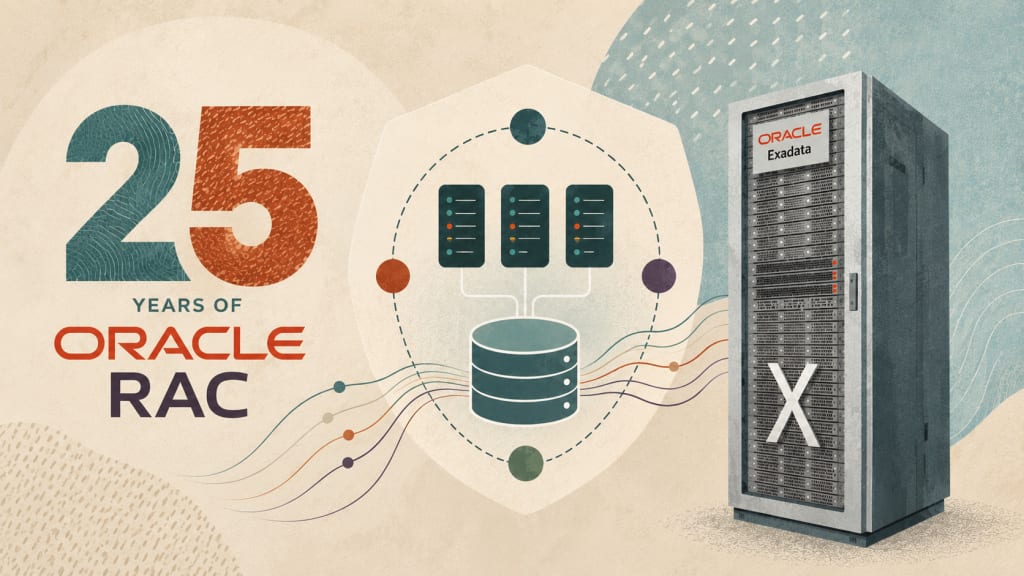
The Oracle Real Application Clusters (RAC) story begins in 2001 with a deceptively simple ambition: keep the Oracle Database available, keep applications running, and enable customers to scale without redesigning their business applications. That goal remains as relevant today as it was then. Mission-critical systems only grow more demanding over time, accumulating more users, more transactions, more data, more maintenance requirements, and an ever-lower tolerance for downtime.
Oracle RAC distinguished itself by making high availability and scalability fundamental capabilities of the underlying database architecture. Through innovations such as Cache Fusion, Oracle Automatic Storage Management (ASM), and Application Continuity (AC), Oracle RAC enables multiple database instances running on independent servers to function as a single clustered database. Applications connect to a single logical database service while Oracle RAC provides scalability, continuous availability, and rolling maintenance without requiring application changes.
Oracle RAC is one of Oracle’s defining technologies. Its 25-year history is a testament to continuous innovation, with each milestone release introducing new capabilities and building on the innovations of its predecessors.
- Oracle Database 9i RAC – the first Oracle RAC release with the Internet (i) designation
- Oracle Database 10g – the first release with Oracle Clusterware as the basis for RAC, introducing the Grid (g) era
- Oracle Database 11g, especially Rel. 2 – a landmark release with a unified Oracle Clusterware and Oracle Automatic Storage Management (ASM) under Oracle Grid Infrastructure, and one of the longest-supported Oracle Database releases
- Oracle Database 12c – the first release to introduce the new Cloud (c) designation and Application Continuity – A Database Feature for Developers
- Oracle Database 19c – the first long-term support release with the new Cloud (c) designation, and another milestone release for Oracle RAC, marking the introduction of a New Generation Oracle RAC
- Oracle AI Database 23ai – the first Oracle Database release with the Artificial Intelligence (AI) designation, including Oracle RAC support for Oracle AI Vector Search
- Oracle AI Database 26ai – the next long-term support release and Oracle’s first official AI Database, enhances its capabilities to transparently scale Enterprise AI workloads with Oracle RAC
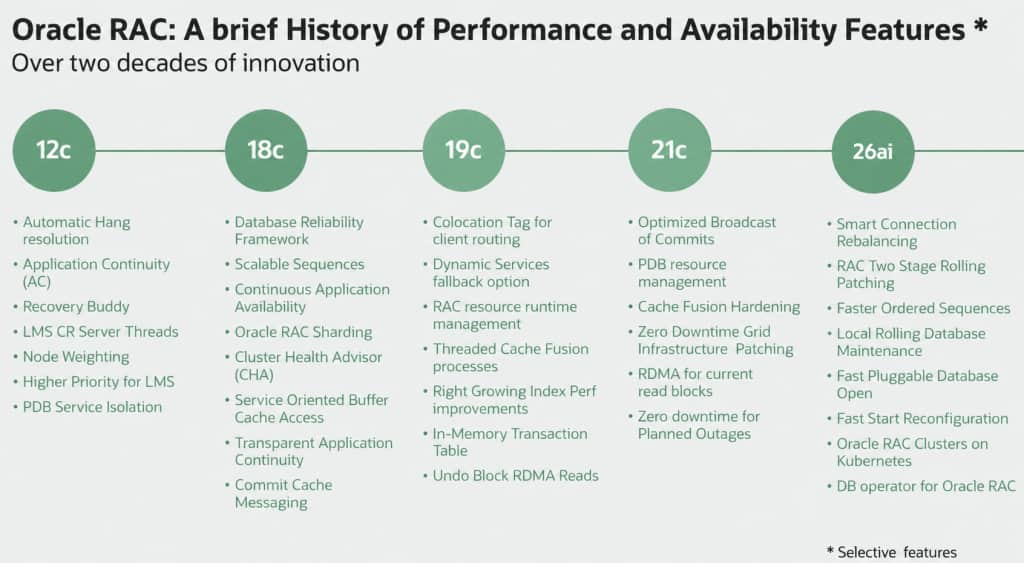
Today, customers around the world rely on Oracle RAC to run their most mission-critical applications. It is deployed across industries including banking, capital markets, telecommunications, retail, government, and utilities, where downtime is measured in business impact rather than seconds. Its continued adoption reflects the enduring value of an architecture that enables organizations to scale, maintain continuous availability, and simplify operations without requiring application redesign.
Oracle RAC and Exadata: Engineered to Scale
The second chapter in the Oracle RAC story begins with Oracle Exadata. As an engineered system, Exadata combines hardware and software innovations to deliver exceptional database performance, scalability, and availability. Applications running on Oracle RAC on Exadata benefit from the platform’s low-latency Remote Direct Memory Access (RDMA) interconnect, where RDMA operations complete within 14 microseconds. These capabilities have made Oracle RAC on Exadata to efficiently run demanding OLTP, analytics, reporting, batch processing, database consolidation, and mixed workloads.
Oracle RAC automatically leverages Exadata’s scale-out architecture, low-latency interconnect, RDMA-based optimizations, faster failure detection, and database-aware infrastructure. Organizations can deploy Oracle RAC on Exadata in on-premises data centers or benefit from the same technology through Exadata Cloud@Customer, Exadata Database Service, and Autonomous AI Database. Oracle RAC also serves as part of the underlying database infrastructure for Oracle SaaS, with the same proven architecture delivered through increasingly automated deployment and operations.
Oracle RAC in the Multicloud Era
Enterprises can take advantage of the capabilities of Oracle RAC while keeping applications where they already run. Oracle RAC on Exadata is available in enterprise data centers, on Oracle Cloud Infrastructure (OCI), through Exadata Cloud@Customer, and in multicloud environments with Amazon Web Services (AWS), Microsoft Azure, and Google Cloud (GCP). Oracle AI Database@Azure, Oracle AI Database@Google Cloud, and Oracle AI Database@AWS extend Oracle managed database services and Exadata infrastructure into hyperscaler cloud environments, enabling customers to deploy Oracle RAC closer to their applications, data, and cloud-native services.
The Road Ahead is Agentic
Looking ahead, Oracle RAC’s role will become even more important as enterprise workloads continue to converge. Traditional distinctions between transaction processing, analytics, JSON, AI Vector Search, SaaS, batch processing, graph, and mixed workloads will continue to blur as organizations consolidate diverse applications onto unified data platforms. At the same time, operational expectations will continue to increase, requiring high throughput, low latency, continuous availability, and online maintenance.
The road ahead for Oracle RAC is therefore not only about building bigger clusters. It is about delivering greater automation, minimizing brownouts, strengthening integration with Exadata and Autonomous Database, and providing consistent availability across on-premises deployments, Oracle Cloud Infrastructure (OCI), Cloud@Customer, Dedicated Regions, and multicloud environments.
Twenty-five years after its introduction, the core promise of Oracle RAC remains unchanged: applications should not have to choose between availability and scalability, or between performance and operational simplicity. That principle has guided Oracle RAC from the beginning, and it continues to shape its evolution as organizations modernize their data infrastructures across on-premises, cloud, and the multicloud.
As enterprise applications evolve toward Agentic AI, the demands on the database continue to increase. AI agents require continuous access to trusted enterprise data, predictable performance, and the ability to scale seamlessly as workloads grow. Oracle RAC extends its long-standing strengths in high availability and scalability to meet these new requirements, providing a resilient foundation for the next generation of intelligent applications.