
Announcing
Human in the Loop is now available as a native capability of Oracle Integration.
What is Human in the Loop?
Human in the Loop (HITL) is the deliberate placement of human oversight at specific decision points within an otherwise autonomous workflow; where the cost of an AI error exceeds the cost of a human intervention. It is a design philosophy that keeps humans meaningfully in control of agentic AI systems; not to micromanage their every step, but rather to provide oversight where it matters most.
Why it Matters in Agentic AI
Enterprises recognise the value agentic AI can bring and many are eager to adopt it. What gives them pause is not doubt about its capability. It is the question of whether they can govern its actions. And without governance, capability alone is not enough to justify deployment.
This concern is understandable. Agentic systems are designed to act autonomously, at speed, and at scale. That is exactly what makes them valuable, but it is also what raises the stakes when something goes wrong. When an agent makes a consequential decision and gets it wrong, the question of who is responsible — the developer, the organisation, or the system itself; rarely has a clean answer. This ambiguity is not a technical problem – it is a trust problem and it is the single biggest barrier standing between agentic AI and meaningful enterprise adoption.
Human in the Loop is designed to close that gap. By placing human oversight at the moments that carry the most consequence, every significant decision becomes traceable — logged with who reviewed it, when, and why. The agent is no longer an autonomous actor operating beyond reach; it becomes a governed participant in a workflow where accountability is clear and the audit trail is intact. The result is an auditable record that satisfies compliance teams, reassures leadership, and gives organisations the assurance needed to stand behind the actions the system took.
Over time, something more valuable than accountability emerges: trust. When stakeholders can see, consistently and verifiably, that an agentic system operates within its intended boundaries — and that humans with the right authority step in when it doesn’t — confidence accumulates. That confidence is ultimately what determines how fast an organisation is willing to scale AI adoption.
Therefore, HITL should not be viewed as a constraint on what agentic systems can do, nor a brake on the speed at which they can deliver. Instead, HITL should be thought of as the governance layer that makes it safe – and therefore sustainable – for them to operate at all.
Organisations that can demonstrate this credibly will scale agentic AI with conviction. Those that cannot will find their pilots stalling indefinitely, regardless of how capable the underlying technology is.
HITL in practice
Not every step in an agentic workflow carries the same risk. Some actions are consequential enough to require approval before they happen. Others need a checkpoint to catch errors before they spiral and some situations fall so far outside what the agent was designed to handle that only a human can decide what comes next. These are the moments where HITL earns its place.
Control Gate: Before an agent executes a high-stakes action, a human reviews and approves it first. The agent does the work; the human owns the decision. A travel management agent has received a trip request, checked policy compliance, compared options, and assembled a full itinerary within budget. Everything is in order but before any booking is confirmed, the request lands with a manager for sign-off. They review, approve, and the agent completes the booking. The employee has confirmation within minutes, and the manager retained full visibility over the spend without doing any of the legwork.
Circuit Breaker: Unlike traditional software, agentic systems are probabilistic meaning that the same input does not always produce the same output. In a multi-step workflow, that variability means a small error at one step doesn’t stay small; it gets carried forward and compounded. Without a mechanism to validate outputs before they are acted upon, the workflow has no way to catch drift before it causes damage. A circuit breaker provides that mechanism. It intercepts the agent at a defined checkpoint, holds the output for review, and prevents anything downstream from proceeding until a human has confirmed it. Consider a payroll agent processing end-of-month calculations that begins producing figures that are slightly off consistently rounding in the same direction across every record. A small discrepancy, but multiplied across thousands of employees it becomes material. The circuit breaker detects the drift and pauses the run before a single figure is committed. A human reviews it, identifies the source of the error, and either corrects it or instructs the agent to reprocess. Nothing moves forward until the outputs are validated.
Exception Management: Agentic systems are designed to operate within a defined set of instructions — but the real world doesn’t stay within boundaries. When an agent encounters something outside its parameters, the worst thing it can do is guess. The right response is to escalate, surfacing the situation to a human with the context needed to make a sound judgement, then resuming once a decision has been made. Consider a customer service agent working through a refund request. The order looks routine until the agent detects that a partial refund has already been processed through a separate channel. It has no instruction for this, so it doesn’t proceed. Instead it pauses, assembles the full picture (the original order, the prior refund, and the outstanding request) and places it in front of a human in a single view. The human reviews it, determines the customer is owed the remaining balance, and instructs the agent to process the payment and close the case. The agent never guessed. It never overstepped. It did exactly what a well-governed system should do: recognised the boundary of its authority and handed off to the person best placed to decide.
Human in the Loop in Oracle Integration
The promise of Agentic AI is speed and scale, but the barrier to adoption is trust. We built Human-in-the-Loop capabilities in Oracle Integration to ensure that as your agents gain the agency to act, your organization can retain the power to control and govern their execution. This commitment is reflected in our three strategic pillars:
Trust-Centric Autonomy: To confidently accelerate agentic initiatives, organizations need the assurance that human oversight is an integrated core component, not an afterthought. Through Human in the Loop, we provide the governance layer that allows customers to bridge the gap from experimental prototypes to mission-critical production deployments.
Standardized Oversight: Whether an agent is built within Oracle Integration or on an external agentic platform, customers require a standardized way to govern their digital workforce. With HITL we ensure that our governance capabilities are accessible to the entire AI ecosystem via industry-standard interfaces, providing a universal safety net regardless of where the agent lives.
Unified Lifecycle Management: True governance requires a Single Pane of Glass. Through OIC Projects, we provide a unified environment where development, real-time observability, and lifecycle management converge. This integrated approach results in faster development cycles, reduced operational overhead, and a definitive audit trail for all agentic activity.
What is HITL in OIC exactly?
Human in the Loop is designed to allow organisations to introduce human oversight in agentic AI automations. Developers creating Oracle Integration agents can design approval workflows that enforce company policies and expose them as tools that their agent can leverage at key decision points.
Project Context
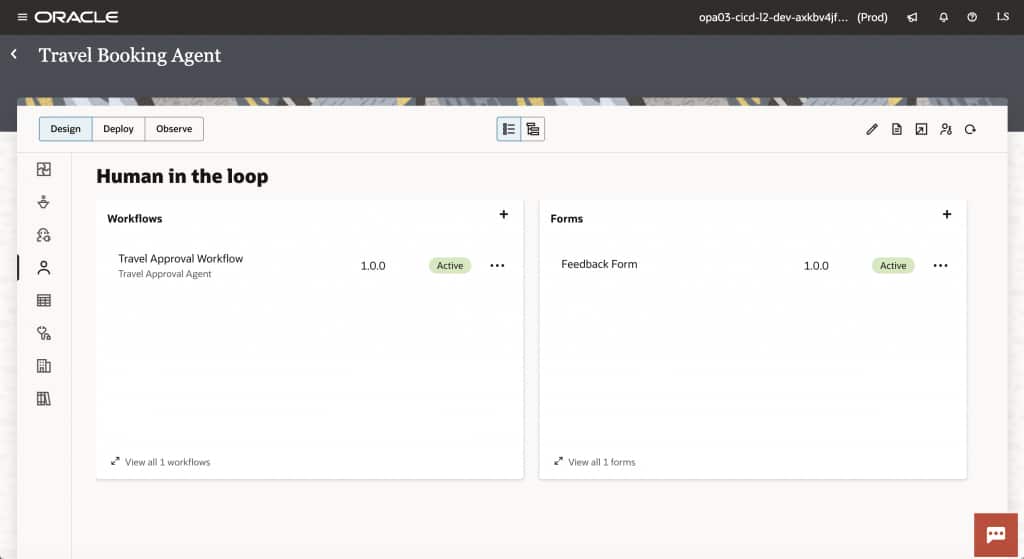
Human in the Loop workflows are built and managed within solution-focused Projects, in the same context and under the same governance as other automation technologies needed to build agentic solutions.
Predictable Workflows
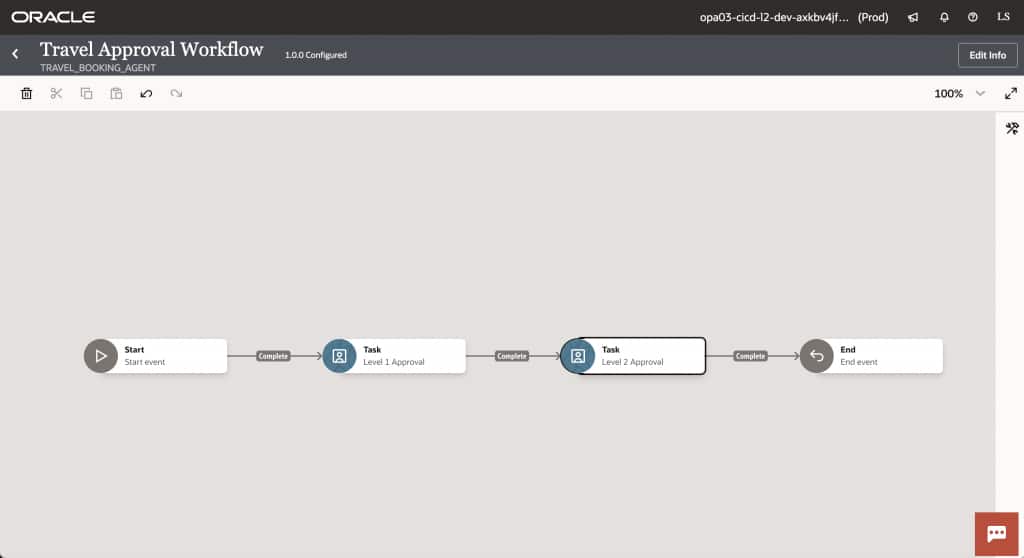
Agentic systems are probabilistic by nature — but the governance that oversees them cannot be. When a high-stakes decision requires human approval, the steps taken to review, escalate, and resolve it must execute the same way every time, regardless of how the agent arrived at that point.
To address this, Oracle Integration provides a dedicated canvas for modelling approval workflows. Business users can design and maintain the exact sequence of steps that should occur whenever an agent invokes HITL; defining who reviews what, in what order, and under what conditions. When the agent triggers an intervention, it hands off to a structured, deterministic workflow that the business controls. The result is a clean separation between what the agent decides and how the organisation responds.
Exposing HITL as a Tool
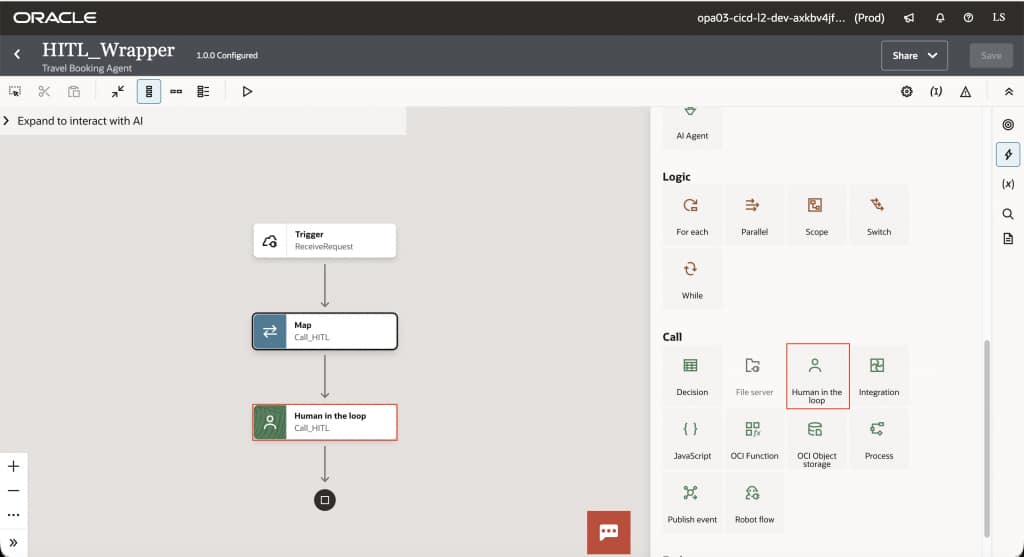
Tools are how agents take action and interact with the world beyond their own reasoning. In OIC, integrations are exposed as tools; giving agents the ability to access external applications and data. HITL follows exactly the same pattern, which means there is no new paradigm for developers to learn and no separate framework to maintain. Human oversight is just another capability the agent can invoke.
OIC provides a native Human in the Loop action that, when invoked, initiates a structured approval workflow. The agent pauses, the workflow executes, and once a human has reviewed and responded, the agent is notified of the outcome and determines its next step accordingly.
Tool Recipes
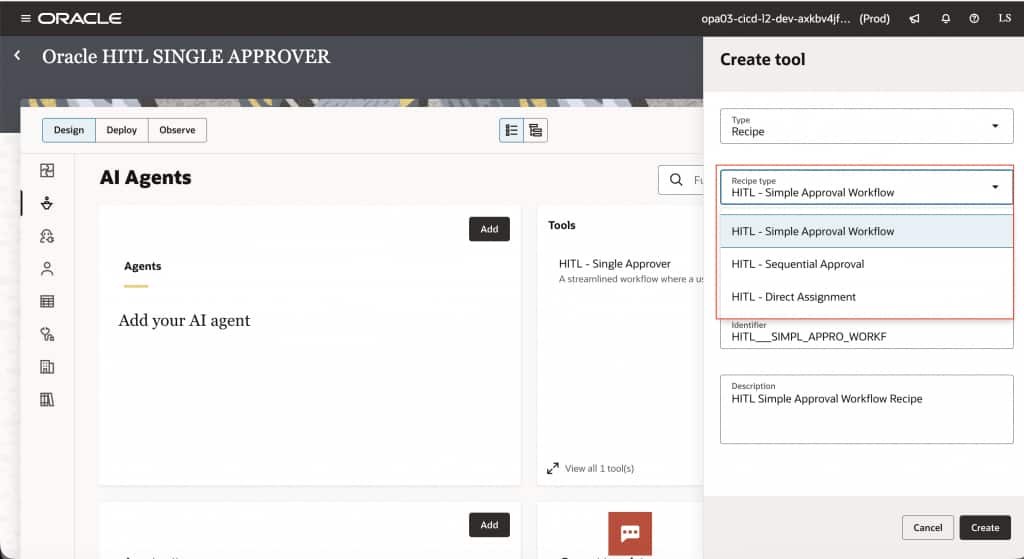
The fastest way to implement HITL is to not to build it from scratch. Tool Recipes are Oracle-provided templates that deploy a fully working Human in the Loop implementation in seconds — the tool, the approval workflow, the form, and the supporting integration.
Oracle provides a set of recipes out of the box, each covering a common approval pattern that enterprises encounter in practice and because every recipe is fully editable, teams can start with a working foundation and adapt it as their approval requirements evolve.
Observability
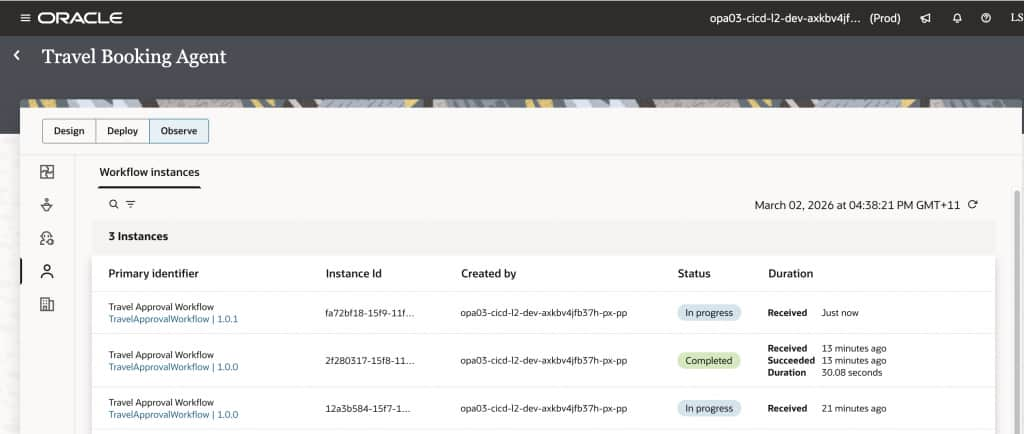
Deploying HITL in production means knowing, at any moment, exactly where every approval stands. Oracle Integration provides unified observability directly within projects – giving developers and administrators a view of every workflow instance, its current status, and a full activity stream of each step taken along the way.
This allows organizations to easily understand who has approved, who has yet to act, and where a workflow is at any point in time. When something stalls or fails, the information needed to diagnose and resolve it is readily available.
Interacting with End Users
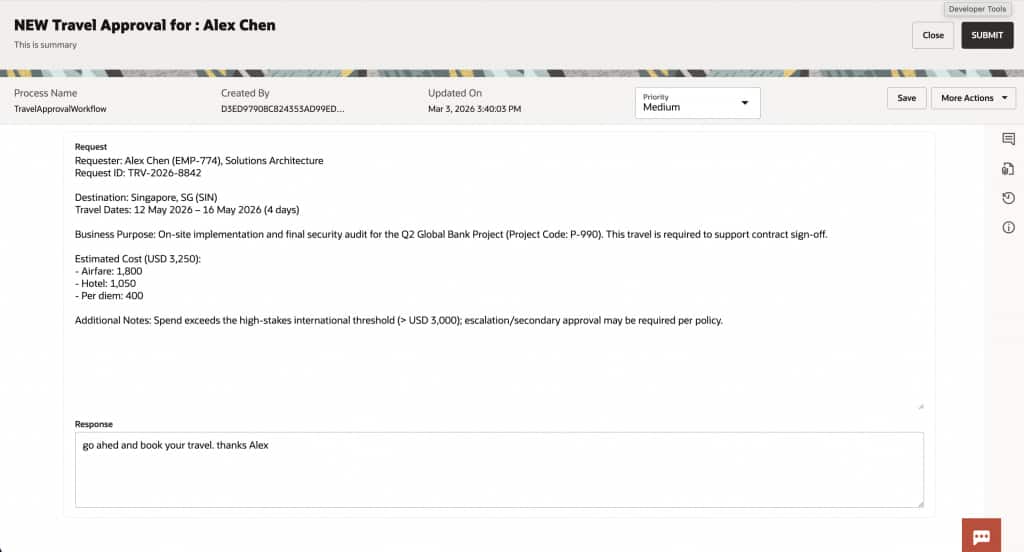
When an agent invokes HITL, the task lands in a dedicated workspace — a centralised environment where end users manage every task assigned to them by agents. Users can act on tasks directly, reassign them to colleagues, and collaborate through comments. For periods of absence, out of office routing ensures tasks are automatically redirected to the right person, so approvals keep moving regardless of availability.
End user interactions can take two forms. Structured responses such as approve or reject keep high-volume decisions fast and consistent. Unstructured responses allow users to reply in natural language, giving them the flexibility to provide context, ask questions, or direct the agent’s next step in their own words. The agent receives the response and continues accordingly.
The forms that present this information are fully configurable. Teams can tailor the layout, fields, and content to match their specific business requirements and apply company branding to ensure the experience feels native to their organisation.
Managing Deployment and Dependancies
Deploying an agentic solution is not a once off act — it is a lifecycle. As agents evolve, their supporting components: agents, tools, integrations, workflows and forms need to move through environments consistently, reliably, and without manually stitching things together each time.
Oracle Integration manages this through project deployments. Every component that makes up a HITL-enabled agentic solution is packaged and versioned together as a single deployable unit. A project deployment represents a snapshot of all component versions that need to be present in the target environment whether that is testing, staging, or production. Teams can promote with confidence, roll back cleanly if something goes wrong, and maintain a clear version history of exactly what is running in each environment.
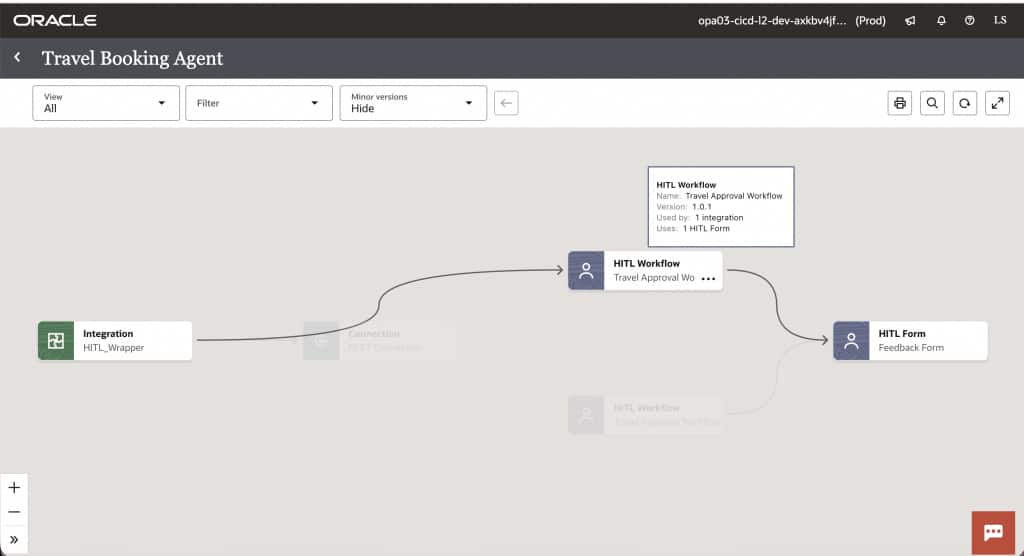
Before making changes, understanding the blast radius matters. Modifying a workflow or form that is shared across multiple agents or integrations can have unintended downstream consequences and without visibility into those dependencies, those consequences are invisible until something breaks. Oracle Integration addresses this by providing project resource dependency visualisation, enabling developers and architects to clearly understand how assets are related, impacted, and consumed across a project.
Human in the Loop vs Process Automation
Human in the Loop and traditional Process Automation both involve human actors — but they are designed for fundamentally different purposes.
Process Automation is built for traditional business automation. It follows a fixed path designed in advance, where human tasks are explicitly modelled into the process at design time. Human involvement is predictable, the sequence is known, and the workflow orchestrates both system and human actions along a well-defined route. In Oracle Integration, Process Automation is intentionally separate from agentic AI.
HITL is a different mechanism entirely. It exists because AI agents are autonomous — they pursue goals across multiple steps, make their own decisions, and can encounter situations no one anticipated at design time. Human involvement in this context is not modelled in advance; it is triggered dynamically, either at predefined checkpoints before critical actions, or by the agent itself when it recognises it needs guidance. And unlike a human completing a task in a workflow, human input in an agentic context actively shapes what the agent does next — redirecting its approach, resolving ambiguity, or correcting a misunderstanding before it compounds.
How it works in Practice
How to video coming soon!
Get Started Today!
Are you ready to try Human in the Loop in Oracle Integration?
Contact Oracle to setup a demo
Learn more about Human in the Loop in Oracle Integration 3