
Migrating databases and applications from on-premises to a cloud environment can seem risky. However, it is a crucial step you can take to modernize your IT systems and realize the operational and economic benefits delivered by the cloud. You can migrate to Oracle Cloud while remaining secure – perhaps even more secure than on-premises thanks to proactive security through:
- Defense in depth
- Separation of duties enforced by technology
- Least privileged access
- Audit logs for your SIEM
But business requirements often drive additional complexities. Not every service is available in every cloud, requiring solutions in a multicloud environment. Keep reading to learn how Multicloud Solutions help you meet your business and security goals for your mission critical and sensitive data.
What is Multicloud?
Multicloud Solutions deliver Oracle Exadata Database Service (as well as other database services) on Dedicated Infrastructure running on OCI in Amazon Web Services, Microsoft Azure, and Google Cloud data centers. Oracle does this in three steps:
- Install Oracle Exadata hardware as OCI resources collocated with the cloud service provider’s data center
- Connect the Exadata hardware to an OCI region for remote service delivery with an OCI controlled network
- Connect your cloud service provider networks to your Exadata service with private connectivity dedicated to you
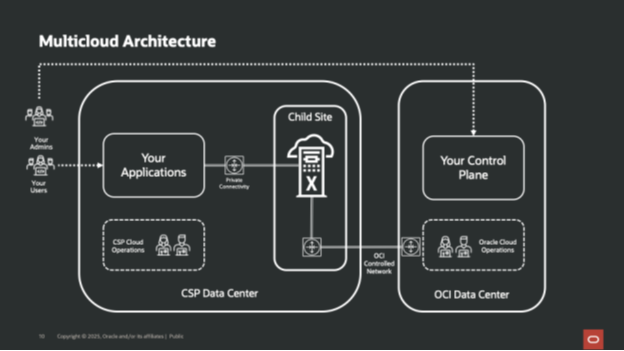
With Oracle’s Multicloud Solutions, you get all the performance, availability, and security benefits of Oracle AI Database and Oracle Exadata delivered to your applications in your choice of cloud provider.
How we did it. Why we did it.
Oracle’s mission is to make cloud security stronger than ever. We did this by listening to customers like you and industry customers like Verizon. We integrated cloud technology and database services to solve the top security problems. We did it because Oracle customers run the mission critical infrastructure that runs our systems, and our clients depend on the trust they have in that infrastructure. Check a LinkedIn post for real-world examples.
According to the 2024 Data Breach Investigations Report:*
- 68% of breaches involve people—technology-enforced separation keeps actions accountable
- 31% involve stolen credentials—just-in-time credentials and network controls cut theft risk
- 1/3 involve ransomware—least-privilege access limits reach
- 28% involve errors—automated setups reduce mistakes
- 15% involve third parties—you control and audit Oracle’s access
Source*2024 Data Breach Investigations Report and Executive Summary
Keep Your Data Secure with Multicloud Solutions
Multicloud puts security front and center. Separation of duties means no single entity controls everything:
- You control your data and keys.
- Oracle manages cloud infrastructure and servers.
- Your cloud provider controls physical building access.
Oracle software provides every user with the minimum access they need and logs every action for transparency. For example:
- Your team runs your apps and networks.
- Oracle manages and monitors the infrastructure.
- The cloud provider operates the data center and escorts Oracle staff when needed.
The hardware maintenance process is a great example. When storage fails, it’s logged—including the hardrive’s serial number. Oracle and your provider swap the drive, lock the old one, and destroy it. Every step is tracked; alarms sound if anything goes wrong. Three teams watch, so you always know what’s happening.
Start Secure with Multicloud Solutions
Multicloud Solutions start you on secure footing in three steps: identity management, network security, and database service deployment.
First, you connect your Oracle cloud tenancy and databases to your company’s Identity Provider and integrate OCI Audit to your security information event management (SIEM) system. This enables you to control user access using your Identity and Access Management (IAM) policy, and provides easy access to eventn logs showing what applications and data users and staff accessed and queried.
Second, secure your network with Oracle Cloud Infrastructure (OCI) to control which systems, ports, protocols, and credentials are allowed. Key controls include:
- Zero-trust Packet Routing: Describe your security goals in plain terms; OCI creates the network implementation and security rules for you.
- Private Service Access: Choose which credentials can be used from your networks and block access to outside resources.
- IAM Deny: Restrict what networks can use your credentials, keeping them from being used elsewhere.
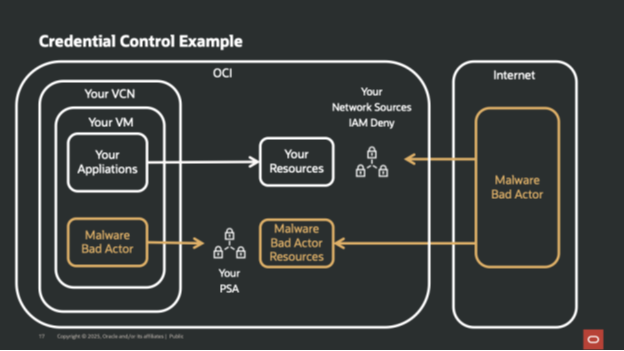
These controls help you make sure only your applications and staff can access your data—no one else. This also prevents co-mingling business and personal accounts.
Third, deploy your Oracle AI Database services. All Oracle databases and VMs come with:
- Automatic data encryption in flight and at rest, with keys you control.
You can add your compatible identity and access management tools to your Oracle databases and VMs. With identity, network, and data controls working together, you start every cloud deployment with strong, auditable security.
Stay Secure with Multicloud Solutions
Security isn’t static. Oracle’s approach centers on staying secure, not just starting secure. Multicloud Solutions provide three unique features:
Multicloud starts with a unified security control center: Oracle Data Safe which provides risk dashboards, user activity monitoring, sensitive data discovery, and automated data masking. With you in control of the software that does the work, you can accurately scale security intentions.
Next, your services need protection from your admins and AI Agents. Multicloud provides explicit approval workflow control for service lifecycle management with API, Delegate, and Operator Access Control. These security controls add to traditional identity and access management by focusing on what can be done to specific resources. These controls protect resources by implementing temporary, least privileged access for specific lifecycle management operations and comprehensive auditing. Activity is captured in human and machine-readable audits, making compliance and investigations straightforward. Check out the API, Delegate, and Operator Access Control demo videos to see how it all works. Configure Oracle Database Vault to enforce data security controls within Oracle Database to limit privileged user access to application data, reducing insider and external threats while meeting compliance requirements like separation of duties. Try Database Vault on LiveLabs to learn how to limit data access by DBA and privileged users, restrict database command execution, and prevent a multitenant common user from accessing objects in associated pluggable databases.
Finally, Oracle Exadata Live Update automates security patching with minimal disruption, ensuring your Oracle databases are always up to date. With continuous monitoring, automated workflows, and rigorous access controls, Oracle’s cloud database services help your team stay ahead of threats—and prove it to auditors, too.
Multicloud Solutions give you defense in depth from controls provided by your CSP, OCI, Exadata, Oracle Linux, and Oracle AI Database.
Final Thoughts
Cloud doesn’t just match on-premises database security—it can raise the bar. Oracle’s architecture, integrated controls, and automated workflows make it possible to achieve and prove uncompromising security, even in today’s multicloud world.
Call to Action:
Protect what matters most. Discover if cloud security really can outdo your data center. Contact your Oracle representative to schedule your review today. Want to learn more about specific features? Check our documentation or contact Oracle experts or explore Oracle Data Safe and Exadata security here. For practical configuration guidance, reach out to your Oracle rep or visit our support channels.