
Key takeaways
- Fusion Agentic Applications for SCM bring relevant data, reasoning, context, recommendations, and actions into supply chain workflows.
- Ten new demos show agentic applications across supply chain processes, including product lifecycle management, strategic sourcing, logistics, order management, cost accounting, maintenance, and process manufacturing.
- The demos show teams of specialized agents working together toward specific business outcomes, while people stay focused on the decisions and exceptions that matter most.
Oracle recently introduced Fusion Agentic Applications, a new class of enterprise applications powered by teams of specialized AI agents. A set of short demos shows what Fusion Agentic Applications look like in Oracle Fusion Cloud SCM. You’ll see how they bring together data, reasoning, context, recommendations, and actions in a single workspace, helping supply chain teams improve visibility, respond to disruptions, and reduce manual effort.
This article highlights three SCM examples across product readiness, warehouse operations, and process manufacturing. To get even more detail, please visit the Oracle Cloud Applications Readiness—Supply Chain & Manufacturing 26B page.
Product lifecycle management and procurement
Successful product launches depend on many moving parts working in concert: complete item data, accurate bills of materials, supplier readiness, required compliance documentation, and clear handoffs between teams. When information doesn’t flow smoothly, small issues can become big launch risks.
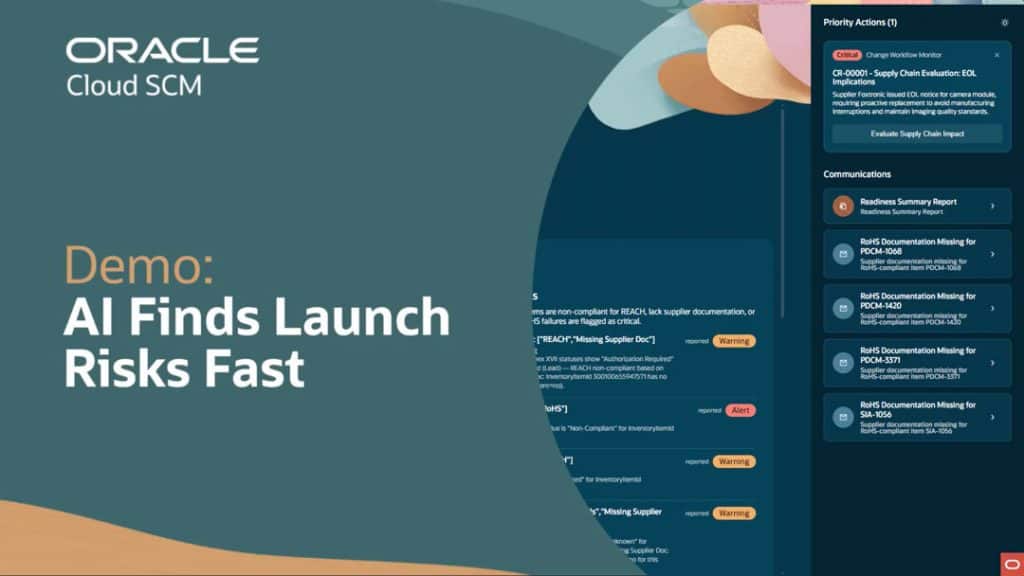
The Product Readiness Workspace demo shows how a Fusion Agentic Application can help product launch teams detect and address potential risks. In this demo, a product manager reviews readiness, investigates exceptions tied to the bill of materials, and relies on AI agents to understand what is blocking progress. The agentic app surfaces issues such as missing compliance documentation and incomplete item details, then helps draft supplier communications to move toward resolution.
Instead of manually hunting across disconnected systems, launch teams can start from a workspace that highlights what needs attention, explains why it matters to the launch plan, and helps move issues toward resolution.
Related demos to explore: The Design-to-Source Workspace helps teams connect engineering specifications with supplier and sourcing strategy. The Sourcing Command Center helps category managers monitor negotiations, manage exceptions, and accelerate sourcing decisions.
Inventory, order management, and logistics
Inventory, order management, and logistics teams connect customer demand to physical fulfillment, turning planning into execution. An item shortage, late transfer, fulfillment delay, or unresolved exception quickly affects downstream operations and customer commitments. Execution teams need visibility, but they also need faster ways to filter background noise from the issues that require action.
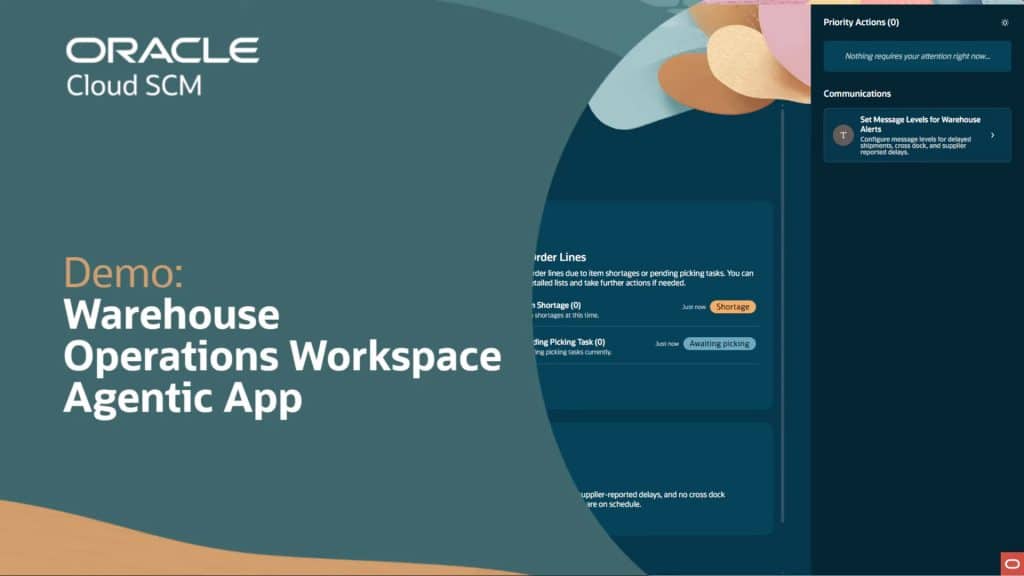
The Warehouse Operations Workspace demo shows a manager quickly assessing stockout risk. Agents analyze supply and demand signals, identify the root cause of a shortage, and present replenishment options, such as sourcing inventory from another location. The application doesn’t just report low inventory. It reasons across all relevant supply chain data to help the manager understand context, evaluate next steps, and act before a local issue becomes a broader fulfillment or production disruption.
Related demos to explore: The Sales Order Command Center supports order management teams as they resolve holds, exceptions, and returns. The Logistics Execution Command Center brings transportation and warehouse context together so logistics teams can focus on disruptions and critical deliveries.
Manufacturing, maintenance, and costing
Process manufacturing teams also need to spot issues early to protect throughput, quality, and yield. Small changes in batch conditions, inputs, or recipes can create avoidable variability.
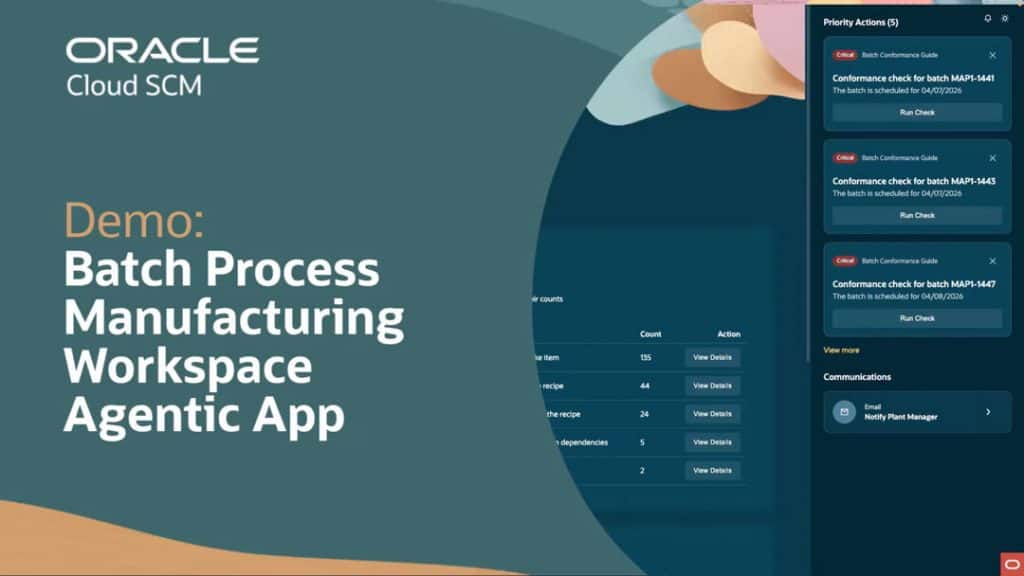
The Batch Process Manufacturing Workspace demo shows an engineer reviewing prioritized recipe and batch issues. The workspace highlights expected production deviations, helps assess yield impact, and brings attention to recipe exceptions and ingredient-lot quality conformance issues. The demo also shows how the engineer can use agent recommendations to investigate and resolve potential problems before they affect production.
The value is clear: the workspace helps manufacturing teams spend less time searching for exceptions and more time deciding what to do about them. By organizing deviations, recipe readiness, and conformance signals in one place, the application can support earlier triage and more consistent corrective action.
Related demos to explore: The Production Shift Operations Workspace connects production, maintenance, and quality data to help supervisors efficiently run the manufacturing floor. The Maintenance Operations Workspace enables maintenance supervisors to prioritize work orders, monitor equipment, and coordinate service to reduce downtime. The Cost Accounting Close Workspace helps finance and operations teams monitor financial close readiness and reduce manual effort at period end.
Bring AI into supply chain workflows
Together, the demos show a practical shift in how supply chain teams can use built-in AI. Rather than sending users to a separate tool, Fusion Agentic Applications bring insights, recommendations, and actions into the workflows where supply chain work already happens.
Related posts you might like
- New—more SCM and CX agents for Fusion Apps
- New Fusion Agentic Applications—details and demos
- New Fusion Agentic Applications drive work forward

If you’re an Oracle customer and want to get new stories from The Fusion Insider by email, sign up for Oracle Cloud Customer Connect. If you’re an Oracle partner and want to learn more, visit the Oracle Partner Community.