
Key takeaways
- Oracle Fusion Cloud Applications are moving from a “system of record” (passive data storage) to a “system of outcomes” (active execution). In this model, teams of specialized agents complete business processes.
- Release 26B introduces 22 Fusion Agentic Applications that work across Oracle Fusion Cloud ERP, HCM, SCM, and CX.
- Agentic apps move work forward by handling routine tasks autonomously while keeping people in the loop where judgment, review, or approval is required.
Oracle recently introduced Fusion Agentic Applications, detailing how they can help you drive work forward. This article highlights their fundamental characteristics and shows how they work across Oracle Cloud ERP, HCM, SCM, and CX. (For a more complete list of the Fusion Agentic Applications available in Release 26B, see the official announcements for Finance and Supply Chain, HR, and Customer Experience.)
What Fusion Agentic Applications have in common
Fusion Agentic Applications represent a step change in application design, from systems of record to systems of outcomes. In this new model, the application owns the outcome by reasoning over business data and coordinating among agents to complete a business process. Fusion Agentic Applications are characterized by:
- Outcome-driven coordination: Instead of performing individual tasks, teams of specialized agents work together to deliver complete business results.
- Adaptive user experience: The UX adapts to the specific user and the work being performed.
- Autonomous actions: Agents handle routine, repetitive actions autonomously, keeping work moving while surfacing exceptions and decisions that require human judgment.
- Native Fusion foundation: These applications are built natively on the Oracle Fusion data model, security, and business rules, ensuring that AI reasoning is grounded in business logic.
Oracle Fusion Cloud CX
New agentic applications target customer-facing functions across marketing, sales, and service. In marketing, agents evaluate customer data, prepare campaign content, and segment audiences for cross-selling. And in the Service Manager Workspace, agents reason over customer history and support data to help service leaders identify escalations before they impact customer satisfaction.
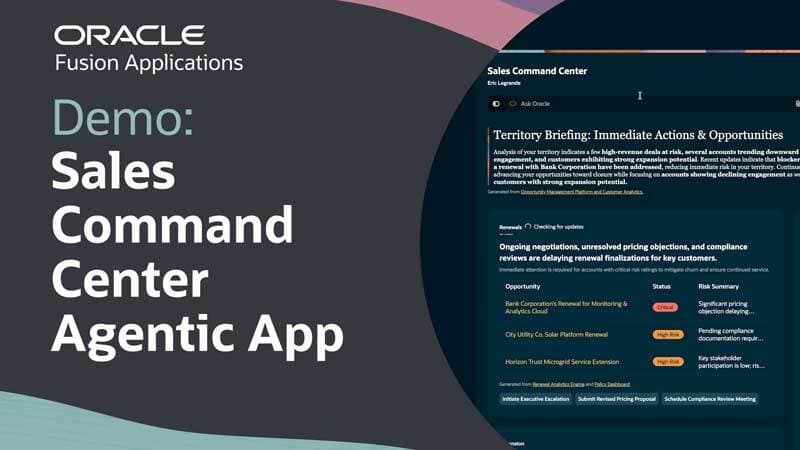
Demo spotlight—Sales Command Center: In this demo, agents identify contract renewal risk and recommend specific quote revisions based on total contract value, discount, and net profit margin. Agents also prepare customer communications, including presentations and follow-up emails.
Oracle Fusion Cloud ERP and Oracle Fusion Cloud SCM
The new applications for finance and supply chain focus on work that requires coordination across teams. In finance, agents in the Collectors Workspace evaluate overdue balances, invoice aging, risk signals, and recent interactions to recommend high-priority actions. In supply chain, the agentic apps cover a wide range of processes from product design and readiness to strategic sourcing, production, maintenance, logistics, and order management.
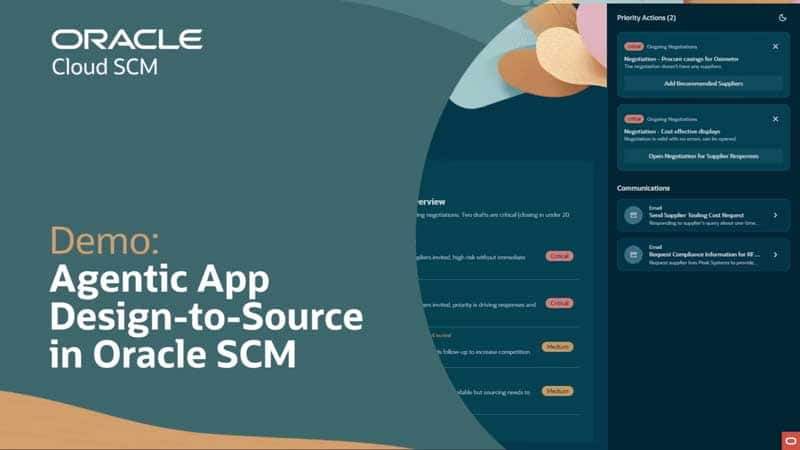
Demo spotlight—Design-to-Source Workspace: Agents reason across engineering and strategic sourcing, helping procurement teams respond quickly to design changes, manage risk, and automate quote requests to suppliers. It’s a good example of the broader pattern of working across functions by connecting engineering and commercial decisions in one workspace.
Oracle Fusion Cloud HCM
Agents automate operational tasks in human resources so work doesn’t become a constant cycle of updates, policy checks, and follow-ups. Release 26B includes applications for career advancement, manager support, learning, talent, and workforce operations. The common thread is that applications take on more of the coordination work, so people spend less time chasing information and more time acting on it.
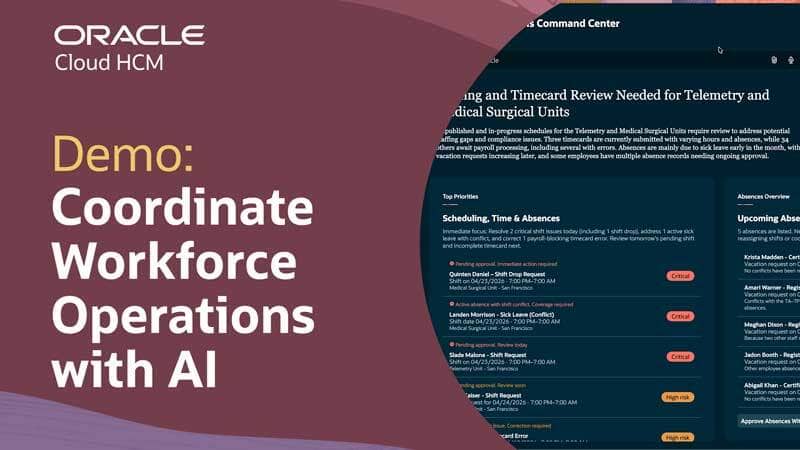
Demo spotlight—Workforce Operations Command Center: Agents continuously evaluate staffing coverage, policy risk, absence requests, and timecard data, then surface what needs attention. In the demo, you see a shift drop request with recommended replacements, a vacation request that conflicts with a scheduled shift policy, bulk approval of absences without shift conflicts, and more.
Conclusion
These updates show how Fusion Agentic Applications are moving enterprise software beyond systems that simply record activities. Across Fusion Apps, teams of agents reason over business conditions, coordinate actions, and advance work toward a defined outcome. Whether the goal is improving collections, managing workforce operations, or reducing renewal risk, the underlying model is the same: applications help move work forward while keeping people in control of the decisions that matter most.
Related posts you might like
- Get the latest Fusion Apps roadmaps for ERP, HCM, SCM, CX
- Introducing Fusion Agentic Applications
- This agent takes the hassle out of electronic invoicing

If you’re an Oracle customer and want to get new stories from The Fusion Insider by email, sign up for Oracle Cloud Customer Connect. If you’re an Oracle partner and want to learn more, visit the Oracle Partner Community.