
As we wrap up 2020, it’s time to reflect on the past and begin looking forward to the future. This year has been challenging and will have lasting impacts well into the future. We have all been touched in one way or another by the events of 2020 and there is still a long way to go till the world begins to resemble the one we all remember from 12 short months ago.
Exadata has had a huge year, again. Exadata X8M and X8, both released in 2019, have seen impressive uptake with customers. For customers invested in the previous generations of InfiniBand based machines, the X8 model allows you continue to add compute and/or storage capacity as needed while giving you time to begin planning for the transition to the RoCE (RDMA over Converged Ethernet) network based systems in the future.
For new Exadata deployments, new and existing customers alike have begun to reap benefits from the significant performance improvements to their OLTP workloads with the X8M machines. Our use of both RoCE and Persistent Memory, coupled with 40+ years of data management expertise and over a decade of Engineered Systems prowess is accelerating the performance advantage Exadata already enjoyed at an even greater rate and across all industry verticals. IDC believes that Exadata X8M is a “Revolution in Data Management“.
In the Exadata 20.1 software release, enhanced security for KVM based deployments was added with the addition of the Secure Fabric feature. This feature ensures that VM Clusters consolidated onto a shared X8M cannot directly communicate with one another despite the shared RoCE network.
To further improve OLTP performance, Smart Flash Log Write-Back was added to improve redo log throughput. By storing the contents of the redo logs in Smart Flash Cache and enabling write-back mode, OLTP workloads may see up to 2.5x performance increase. How is this achieved? HDD access is slow – in comparison to Flash – so by writing redo log data to Flash Cache instead of disk, we increase throughput and free disk IO for other operations such as backup, restore, GoldenGate capture and log archiving.
Databases utilizing the Database In-Memory features also saw an uplift in In-Memory population performance. Rather than reading data only from disk, the Fast In-Memory Columnar Cache creation feature makes use of data stored both in hybrid columnar format and stored in Flash Cache to improve DBIM cache creation. This also serves to reduce IO contention for workloads that are disk IO centric, such as backups.
As more workloads begin to benefit from the persistent memory of the X8M, planned maintenance is a topic that needs some discussion. In the 20.1 release, Exadata preserves contents of persistent memory during rebalance operations to maintain application performance. This is especially important to ensure that patching activities do not come at the expense of user satisfaction.
In June, Exadata Cloud@Customer X8M was released and alongside it came a host of cloud automation features to give you greater control of database consolidation and performance options. Check out more on these features at the following links: Shared Oracle Homes, Multi-VM support and OCPU scaling without Cloud Connectivity.
“We have implemented nearly 300 Exadata systems for our customers in manufacturing, financial services, construction and engineering, and public and private sector services. Aligning with our digital innovation strategy and our journey to enterprise cloud, we have now adopted the first Exadata Cloud@Customer in one of our data centers and look forward to deploying Oracle Autonomous Database.” Dr. WP Hong- CEO, Samsung SDS
2020 also saw the introduction of Exadata X8M into Oracle Cloud Infrastructure’s Exadata Cloud Service and significantly, the release of elastic configurations in a cloud-native deployment option. Exadata Cloud Service X8M begins with as few as 4-100 database cores and 120TB uncompressed usable database storage and scales online up to 1600 database cores and 2.5PB uncompressed usable database storage. No database or workload is too large! Check the below graphic for a more complete view of the scalability available in Exadata Cloud Service.
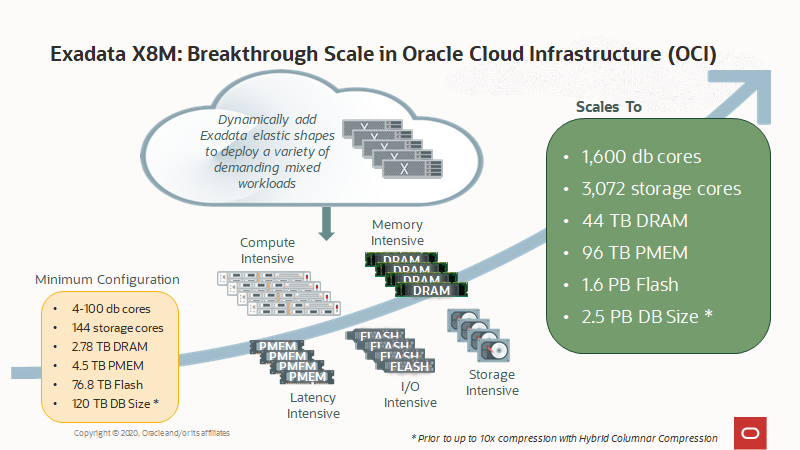
Finally, in addition to being available in Oracle Cloud Infrastructure, Autonomous Database – Dedicated landed on both the X8 & X8M Exadata Cloud@Customer rounding out an impressive array of deployment choice for customers. If you haven’t spent serious time investigating Oracle’s Autonomous Database, now is that time. Get on with driving real business and technical innovation by doing less work, not more. “Self-drive, self-securing, self-repairing” is just the beginning!
“As the core infrastructure for Docomo’s digital transformation and further business growth, I look forward to the continuous evolution of Oracle Exadata and the novel technology innovation driven by Autonomous Database on Exadata Cloud@Customer.” Taku Hasegawa Senior Vice President, General Manager of Information Systems Department, NTT Docomo
2021 will bring with it new opportunities, maybe even a new “normal” as we enter a post-pandemic world. For Exadata, new autonomous, cloud, software and hardware technologies are being worked on. We have a continued focus on integration into cloud and on-prem monitoring and management solutions as well as manageability enhancements across the whole lineup. And our relentless pursuit for performance continues to drive us just as it has for over a decade.

All in all, it should be a very exciting year!
The Oracle Exadata development team has had a busy year and there are no plans to slow down. As has been said before, we wouldn’t have accomplished these advances without the support, engagement and feedback of our customers and partners – your success is what drives us daily – Thank You! Thank you also to our field sales, marketing & support teams – keep up the amazing work.
From all of us in Oracle Development, have a safe and happy holiday season and all the best for 2021.