
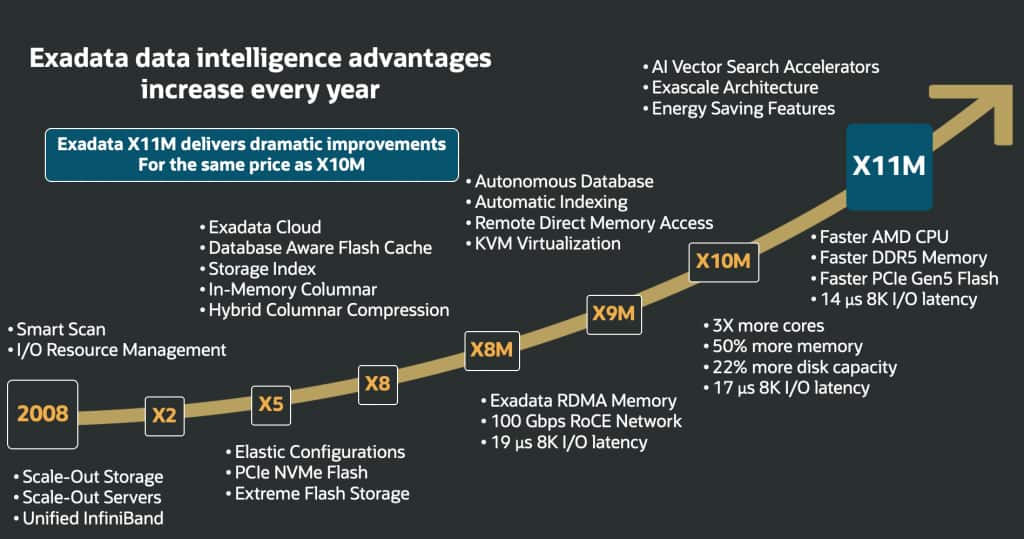
This year, 2026, marks the 18-year anniversary of the introduction of Oracle’s first engineered system, Oracle Exadata. Much has changed in 18 years, but the drivers behind the development of Exadata remain firmly in place. You can’t reliably push the limits of technology using generalized systems architected for generic workloads. Rather, Exadata re-imagines the interaction of database and storage, delivering mission critical performance, scalability, security, and availability.
Evolution of Exadata
Back in the mid-2000s, the conventional wisdom was that the best way to run mission-critical databases was to use a best-of-breed approach, stitching together the best servers, operating systems, infrastructure software, and databases to build a hand-crafted solution to meet the most demanding workload requirements. Every mission-critical deployment was a challenge in those days, as customers struggled to overcome hardware, firmware, and software incompatibilities between various components in the stack. Beyond stability, it was also difficult to meet the needs of a new class of extreme workloads with generic systems and servers that were designed to be used by any workload. Systems were not realizing the true potential of the components, as they were limited by the traditional boundaries of dedicated compute servers, dumb storage, and general-purpose networking.
Oracle studied the problem, looking to simultaneously improve the way Oracle Database ran across many dimensions:
- Performance: Optimize the performance and utilization of each component in the stack and reduce bottlenecks when processing Oracle Database specific workloads.
- Availability: Provide a new level of end-to-end availability, from the application, database servers, networking, and storage layers.
- Security: Protect end-user data from a variety of threats both internal and external to the system.
- Manageability: Reduce the management burden to operate, patch, and maintain the entire stack for an organization’s entire database fleet.
- Scalability: Grow the system as customer’s data processing demands increase, but without throwing out what they had and forcing them to start over.
- Economics: Leverage the economics of commodity components while exceeding the experience offered by specialized mission-critical components.
Understanding these goals and the capabilities of the component-level technologies available led to a simple solution—extend the engineering beyond the individual components and across the stack. In other words, engineer a purpose-built solution to provide extreme database performance, scalability, availability, security, and manageability. In 2008, the result of this effort, Oracle Exadata, was launched.
Prior to the introduction of Exadata, there was explosive growth in compute power, as Intel continually launched new CPUs with a greater number of cores. But databases are I/O (Input/Output) hungry beasts, and I/O was stuck in the slow lane. Organizations were deploying more applications on larger SANs, connecting the servers to the storage with shared-bandwidth pipes that were fast becoming a bottleneck for any I/O intensive application. The economics and complexity of SANs made it difficult to provide databases the bandwidth they required, and the result was lots of expensive compute power being starved for data. The burning question for most organizations was, “How can we more effectively get data from the storage array to the compute server?”
The answer was quite simple but required a different perspective. If you can’t bring the data to the compute, bring the compute to the data. The difficulty was you couldn’t do this with a commercial storage array—you needed a purpose-built storage server that could work cooperatively with the database to process vast amounts of data, offloading processing to the storage servers and reducing the demands on the storage network. From that insight, Oracle Exadata was born.
Continuous Innovation
Over the years, Oracle has built on this engineered platform, refining the architecture of the system, all while using the latest technology and components to reduce overall costs. More recently, Oracle has introduced new Exadata capabilities, leveraging its unique architecture to better run new modern AI workloads. Some of the innovations Exadata has brought to market include:
- Performance: Pushing AI, analytic, and OLTP work from the compute servers to the intelligent storage servers spreads the workload across the entire system while reducing I/O bottlenecks; interconnecting components with an RDMA fabric coupled with intelligent use of a smart data cache in the storage provides memory-speed performance with hard disk economics and capacities.
- Availability: Proven high availability configurations based on Real Application Clusters running on redundant hardware components enables extreme availability; Data Guard provides disaster protection by automatically maintaining a standby database in another geographic region; intelligent software identifies faults throughout the system and reacts to minimize or mask application impact. Customers are routinely running Exadata solutions in 24/7 mission-critical environments with 99.999% availability requirements.
- Security: Full stack patching and hardened security profiles reduce attack surfaces. A default Exadata deployment meets over 90% of STIG-SCAP requirements, making it fast and easy for customers to achieve the levels of security they require.
- Manageability: Integrated management tooling simplifies operations. Fleet automation can update multiple systems in parallel, enabling customers to update hundreds of racks in a single weekend.
- Scalability: Modular building blocks connected by a high-speed, low-latency RDMA over Converged Ethernet (RoCE) fabric allow configurations to scale from small entry systems to ones needed to support extremely large workloads.
- Economics: Built from industry standard components to deliver exceptional value and enhanced with unique Oracle Database and Exadata co-engineered features to deliver exemplary price-performance. Exadata’s unique architecture can provide better performance than all-flash arrays combined with the high capacity and low cost of hard disks.
Mission Critical Availability
Exadata is often associated with extreme performance, but Oracle has spent a great deal of time architecting in mission critical availability. Exadata delivers availability through a tightly integrated combination of hardware redundancy and Oracle AI Database high availability technologies that operate cohesively across the stack. Exadata customers can reference and implement the Oracle Maximum Availability Architecture (MAA) blueprint, engineered to provide extreme levels of mission-critical availability for Oracle databases.
At the database tier, Oracle Real Application Clusters (RAC) enables active-active clustering with cache fusion over a low-latency RDMA fabric, allowing server and instance failures to be transparently handled without interrupting application sessions. At the site level, Oracle Data Guard and Active Data Guard provide synchronous or asynchronous replication with automatic failover, enabling data protection and rapid recovery across regions.
Within the infrastructure, redundant compute nodes, storage servers, networking, and power domains help eliminate single points of failure, while Exadata System Software continuously monitors component health and performs online fault isolation and rebalancing. Planned maintenance is performed using live updates and rolling maintenance across database, grid infrastructure, and storage layers, enabling updates without application downtime. This end-to-end architecture allows Exadata to consistently meet stringent service levels, including continuous 24×7 operation with up to 99.999% availability.
Modern Workloads: AI and Cloud
The IT environment has changed over the past 18 years, but Exadata continues to adapt to new technology innovations. Given the ongoing shift to the cloud and the deployment of AI and other new classes of workloads, how do Exadata’s great innovations make those workloads come to life? Exadata has been successful with these new workloads for a reason—it continuously adds new capabilities, and it has the abilities needed to run these workloads as enterprise class applications!
AI doesn’t change the need for enterprise capabilities. In fact, AI workloads increase the relevance of these characteristics. Just as it pushes analytic functions down into the storage servers, Exadata can push AI vector searches down to storage, closer to data, where it can more quickly find semantically relevant matches. AI workloads can also dramatically increase the demands on the system, with agentic AI driving up the need for transactional performance by submitting work via model context protocol (MCP) servers in ways and at speeds that no human ever could. To meet this unpredictability in demand, customers now need the performance and scalability of Exadata more than ever.
Perhaps the biggest change in the industry, the move to cloud, highlights one of Exadata’s greatest differentiators. Exadata runs everywhere—on-premises, hybrid clouds, and in public clouds – including all the major hyperscalers (OCI, Azure, AWS, Google). This is key to making it easy for customers to migrate critical Oracle AI Database workloads to cloud. They need a platform that meets their performance, availability, security, manageability and scalability requirements, at a reasonable cost – and they need it to run in the cloud of their choice. Customers have found it difficult to run large mission-critical business databases in VMs hosted in the cloud. Existing Exadata customers don’t want to forgo the benefits they realized running Exadata on premises. Exadata in the cloud provides customers with a choice of running their Oracle AI Database on either dedicated Exadata systems, with all the characteristics they’ve come to appreciate, or shared Exascale infrastructure which combines a small, low-cost entry-point with exceptional scalability. Both options provide all the benefits of a cloud deployment: pay-as-you-go, simplified management, self-service, on-demand elasticity, paid for with a predictable operational expense budget with no customer-owned datacenter required.
Exadata in the cloud supports a choice of database services. If you need flexibility and control, Exadata Database Service provides full root access to the virtual machine running the database. In addition, the dynamic scalability of compute and storage combined with the platform-level availability provided by Exadata also became the perfect place to run the Oracle Autonomous AI Database. Autonomous AI Database frees customers to focus on their business, automating the entire database lifecycle. Designed to be self-driving, self-securing, and self-repairing, it significantly reduces the manual effort required from database administrators.
However, not everyone is ready to move to a public cloud region. While cloud economics and elasticity are extremely attractive to many customers, some are unwilling or unable to put their valuable data outside their firewalls. It may be because of regulatory issues, privacy issues, data center availability, or just plain conservative tendencies towards IT—they are not able or willing to move to the cloud. For these customers, Oracle provides Exadata Cloud@Customer, a solution that puts the Exadata Database Service and Autonomous Database in a customer data center, offering cloud economics, with on-premises control.
Customers have enthusiastically adopted Exadata to host their most demanding and mission-critical database workloads. Chances are you indirectly touch an Exadata every day—by visiting an ATM, buying groceries, reserving an airline ticket, paying a bill, or just browsing the internet. Nine of the top ten banking, telecommunication, and food and drug businesses rely on Exadata. An international bank moved their digital banking platform to Exadata and realized 70% better performance enhancing customer service. A major university saw queries against their data warehouse that used to take over 11 minutes return in a little over 90 seconds. Lastly, another financial service customer saw 300% improvements in data processing and 200% in data warehousing, with zero downtime or data loss. Visit the customer page on oracle.com for more detailed customer stories.
It’s been an awesome 18 years, and Oracle continues to innovate with Exadata. No matter whether you need an on-premises database, a public cloud solution, or are looking to bridge the two worlds with Cloud@Customer, Exadata is the ideal choice for running Oracle databases.