


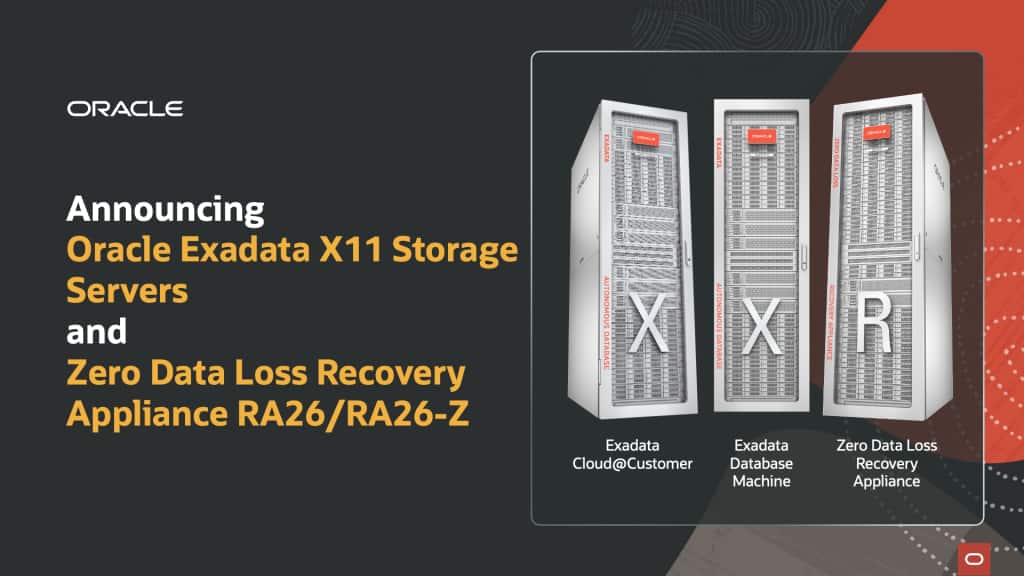
Oracle is announcing new Oracle Database infrastructure options that expand customer choice across performance, capacity, and data protection:
Exadata X11 Storage Servers
- Exadata X11 Extreme Flash
- Exadata X11 High Capacity
- Exadata X11-Z High Capacity
Zero Data Loss Recovery Appliances
- Recovery Appliance RA26
- Recovery Appliance RA26-Z
The new Exadata X11 storage servers introduce additional storage options for Oracle Database workloads, providing customers with greater flexibility to align performance, capacity, and cost with workload requirements while continuing to benefit from the Exadata architecture, management model, and intelligent database acceleration capabilities.
Oracle is also announcing Zero Data Loss Recovery Appliance RA26 and RA26-Z. With higher-capacity storage configurations based on 26 TB drives, RA26 and RA26-Z gives customers more capacity for growing database protection needs – and thus, lowering costs, while preserving the same architecture and data protection capabilities.
Introducing Exadata X11 Storage Servers
The new X11 storage servers expand the Exadata portfolio with additional storage options designed to address a broader range of Oracle Database workload requirements.
X11 High Capacity, Extreme Flash, and X11-Z High Capacity storage servers are designed without Exadata RDMA Memory (XRMEM). Additional memory can be added later to enable XRMEM as workload demands increase.
Same Exadata architecture
The new Exadata X11 storage servers leverage the same hardware and software architecture as their X11M counterparts, including Smart Flash Cache, Smart Scan, Storage Indexes, Hybrid Columnar Compression, automation, monitoring, and the security and reliability features customers expect from Exadata. Customers continue to benefit from intelligent SQL offload, database-aware storage optimization, automated management, and the integrated architecture that distinguishes Exadata from traditional storage platforms.
Existing Exadata X11M storage servers continue to provide Exadata’s highest-performance storage configurations, delivering the lowest latency and highest throughput for Oracle Database workloads. Exadata X11 storage servers provide an alternative storage configuration for customers seeking a different balance of performance, capacity, and cost, allowing customers to choose the configuration that best matches their workload and business priorities.
Exadata X11 storage servers are designed for AI, analytics, and mission-critical OLTP workloads. They use the same Exadata software to accelerate SQL processing and reduce I/O. X11 High Capacity and Extreme Flash storage servers deliver up to 100 GB/s of flash scan bandwidth, 1.2 million SQL read IOPS, and 8K read latency as low as 150 microseconds, while X11-Z High Capacity storage servers deliver up to 50 GB/s of flash scan bandwidth, 600K SQL read IOPS, and 8KB read latency as low as 150 microseconds.
Exadata X11 availability
Exadata X11 Extreme Flash and Exadata X11 High Capacity are available for both on-premises Exadata Database Machine and Exadata Cloud@Customer. Exadata X11-Z High Capacity is available for on-premises Exadata Database Machine.
For on-premises Exadata Database Machine, X11 storage servers can be deployed with any existing Exadata X8M or later system.
For Exadata Cloud@Customer, X11 storage servers can be deployed with Exadata X11M and later database servers. The storage server model selected when the system is initially deployed determines the storage server model that can be added for future storage expansions.
Minimum requirements
Exadata X11 storage servers require either Exadata System Software 26ai (release 26.1.0 or later) or Exadata System Software 25ai (release 25.1.17 or 25.2.10 or later).
Announcing Zero Data Loss Recovery Appliance RA26 and RA26-Z
Ransomware continues to be one of the most significant threats facing enterprise IT organizations. Modern AI attacks increasingly target backup infrastructure in addition to production systems, attempting to encrypt, delete, or corrupt recovery copies before launching attacks against critical databases. For organizations running mission-critical applications, the challenge is no longer simply creating backups—it’s ensuring those backups remain protected, recoverable, and continuously validated when they are needed most.
Oracle Zero Data Loss Recovery Appliance (ZDLRA) is designed to address this challenge. By combining real-time data protection, immutable backups, automated recovery validation, cyber vault architectures, and comprehensive protection observability, Recovery Appliance helps organizations defend against ransomware, eliminating data loss and minimizing recovery times. Over the past decade, Oracle has continuously evolved this platform to strengthen cyber resilience while increasing scale, performance, and efficiency.
Today, Oracle is announcing RA26 and RA26-Z, the latest generation of Zero Data Loss Recovery Appliance, delivering increased storage capacity for customers’ growing enterprise needs, while maintaining the proven performance and security capabilities customers rely on to protect their most valuable data assets.
What’s New in RA26 and RA26-Z
RA26 and RA26-Z increase usable capacity by 21% with new 26 TB disk drives and storage optimizations, up from the 22 TB drives used in the previous generation.
- RA26 base rack capacity increases from 274 TB to 332 TB
- RA26 full rack capacity reaches 1.9 PB
- RA26-Z base rack capacity increases from 135 TB to 164 TB
- RA26-Z full rack capacity reaches 943 TB
This additional capacity enables customers to retain more recovery points, extend protection windows, and support larger database environments without increasing rack footprint.
The new RA26 platform leverages the latest storage and performance optimizations delivered by ZDLRA 23.1 software. These enhancements provide a 21% net increase in usable capacity versus just 18% when strictly comparing 26 TB drives versus 22 TB in the prior generation. This additional capacity can amount to several 10s of terabytes in larger configurations, helping organizations maximize their investment. This latest generation also supports industry-leading, database-optimized backup and recovery operations of up to 60 TB/hour.
The RA26 platform continues to leverage high-performance compute and storage server architecture based on Oracle Exadata technology. Customers benefit from a proven design that delivers the performance required for large-scale backup, restore, and recovery operations while maintaining the reliability expected for mission-critical environments.
The result is an engineered system that delivers more capacity while maintaining the same operational model and data protection experience as with previous generations.
RA26 and RA26-Z build on Oracle’s unique decade-long innovations in real-time protection, enterprise-scale performance, and advanced resiliency capabilities needed to help customers recover quickly and confidently from modern AI-driven cyber attacks.
For customers facing growing backup capacity requirements, longer retention needs, or upcoming infrastructure refreshes, RA26 and RA26-Z provide a straightforward path to expand protection while maintaining existing operational processes.
Additional Oracle Database infrastructure choices
In addition to the new Exadata X11 storage servers and Recovery Appliance RA26, Oracle continues to offer additional infrastructure options designed for different workload, data lifecycle, and data protection requirements.
Exadata XT Storage Servers, available with Exadata Database Machine, provide a cost-effective storage tier for archival and less frequently accessed data while retaining Exadata management, security, and database integration capabilities. Base System Storage with lower-capacity provides an entry-level storage option for Exadata Cloud@Customer deployments.
Together, X11M, X11, XT, and Base System Storage provide customers with a broad range of infrastructure configurations that can be aligned to workload performance requirements, data access patterns, capacity needs, and deployment models.
Flexible storage management architecture choices
In addition to choosing the storage hardware configuration that best aligns with workload requirements, customers can also choose the storage management architecture that best fits their operating model. Oracle ASM continues to provide a proven, integrated storage management approach for Exadata Database Machine and Exadata Cloud@Customer. Exascale provides a cloud-native storage architecture with capabilities such as reimagined database snapshots and clones, Exascale volumes, and Exadata VM Live Migration.
Expanding the Oracle Exadata infrastructure portfolio for Oracle Database
With the introduction of Exadata X11 storage servers, RA26, and RA26-Z, Oracle expands its Oracle Database infrastructure portfolio with more choices across performance, capacity, deployment models, and data protection. Customers can select the storage and protection options that best align with their workload requirements while continuing to benefit from Oracle’s intelligent database acceleration capabilities, integrated architecture, and operational simplicity.
Additional information
Learn about Oracle Exadata Database Machine and the X11M family, including X11 at https://www.oracle.com/engineered-systems/exadata/ and the following resources:
For Zero Data Loss Recovery Appliance RA26 and RA26-Z, see the product data sheet and documentation at: https://oracle.com/zdlra. Also, check out the following resources:
- Zero Data Loss Recovery Appliance RA26/RA26-Z data sheet
- Data Protection & Recovery Product Management blog
Download the latest configuration and deployment assistants here:
Looking Ahead
As Oracle Database workloads continue to grow in scale and importance, organizations need infrastructure that can adapt to changing performance, capacity, and protection requirements without increasing operational complexity. The introduction of Exadata X11 Storage Servers for Exadata Database Machine and Exadata Cloud@Customer, along with Zero Data Loss Recovery Appliance RA26/RA26-Z expands customer choice and builds on the proven architecture, intelligent automation, and integrated management experience that define Exadata infrastructure.
Whether deploying high-performance transactional systems, AI and analytics platforms, large-scale database consolidation environments, or mission-critical data protection solutions, customers can select the combination of Exadata and Recovery Appliance technologies that best aligns with their business objectives. From performance-optimized flash storage to capacity-focused configurations and industry-leading cyber resilience, Oracle continues to provide a comprehensive portfolio designed specifically for Oracle Database.
With these latest additions, Oracle further extends its commitment to delivering the performance, scalability, security, and operational simplicity required to run the world’s most demanding database workloads, both today and in the future.