
Agentic AI is the first wave of enterprise AI that is truly operational.
It’s not just about generating text. Agents observe business events, reason over current context, and take action. For instance, flagging a risky order, opening an incident, escalating a workflow, updating a system of record, or triggering a downstream process. In other words: agentic systems don’t just answer questions; they participate in the business.
That shift changes the architecture requirements. When an agent is expected to act, the cost of stale context goes from “annoying” to “unacceptable.”
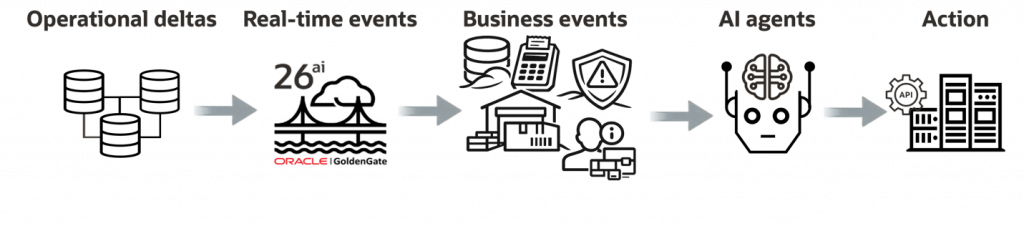
From operational change to agent action (in real-time).
The core problem: agentic systems need real-time signals, not snapshots
Most enterprises still deliver operational data to analytics and AI platforms through a mix of batch pipelines, scheduled jobs, and stitched-together integrations. Even if the AI layer is sophisticated, it’s often grounded on historical snapshots that lag behind reality.
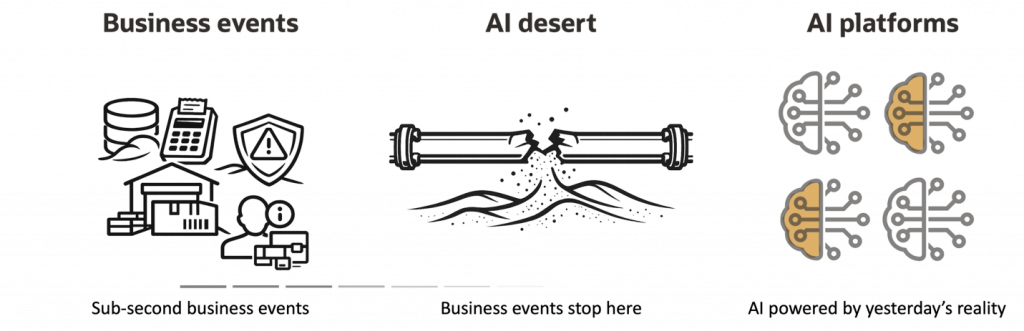
Agentic AI breaks when it runs on snapshots—closing the gap requires real-time signals.
That gap matters more than most teams expect. If an agent is subscribing to an outdated version of events, or reasoning on context that’s hours old, it will still produce fluent output. Just not output aligned with what’s happening right now.
For example: an AI order agent running on stale inventory can approve and bill an order that can’t be fulfilled—creating cancellations, costly remediation, and immediate trust damage with the customer.
Agentic AI raises the bar: the runtime needs a continuous stream of high-fidelity operational signals, across databases, applications, and clouds. Enabling agents to respond appropriately as circumstances change.
Oracle GoldenGate’s role: turn distributed operational change into agent-ready business events
GoldenGate 26ai is Oracle’s real-time data movement platform, designed to integrate business event change across heterogeneous systems and locations, on-premises, in OCI, and across multicloud environments. The strategic value for agentic architectures is simple: agents become dramatically more useful when they can sense operational change as it happens, without relying on delayed replicas or brittle pipelines.
The goal is straightforward:
- Reduce latency between “business event occurs” and “agent responds”
- Reduce complexity of distributing events across many consumers
- Increase reliability of action by grounding the agent in current operational reality
GoldenGate enables this by treating real-time change as first-class output, with data and events flowing to AI runtimes and the platforms around them.
GoldenGate Data Streams: a modern interface for reactive agents
Agentic systems are inherently event driven, but they need a standard way to subscribe to business events and trigger automation consistently across teams and environments.
GoldenGate Data Streams provides a pub/sub interface designed for that reality: it can publish transaction events as JSON CloudEvents over AsyncAPI channels, creating a standardized contract that’s easy for downstream consumers, including agents, to integrate with.
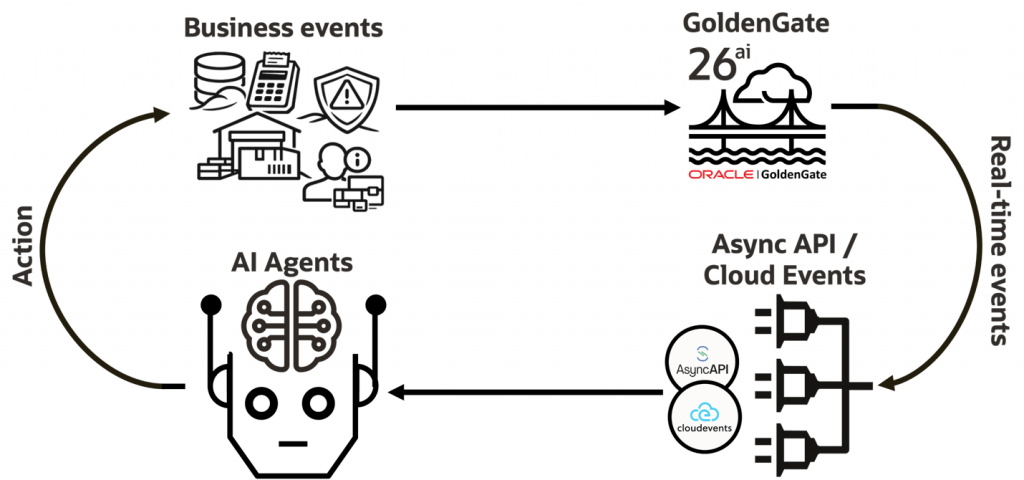
Reactive agents follow an event loop; GoldenGate Data Streams delivers business events via CloudEvents and AsyncAPI.
This is where agentic architecture stops being a bespoke project and starts becoming a repeatable pattern:
- Operational systems generate change
- GoldenGate publishes those changes as business events
- Agents subscribe to events and can take action immediately
- Teams standardize event schemas and integrations around a common event model
When you have dozens (or hundreds) of potential consumers, agents, microservices, analytics systems, monitoring pipelines, this model enables significant reuse so every team doesn’t have to build a custom event pipeline.
And, importantly for agentic systems, GoldenGate Data Streams supports exactly-once transaction event delivery, which is critical when an agent action might trigger downstream workflows that must not double-execute.
From “agents that chat” to “agents that operate”
A useful way to frame agentic maturity is the difference between:
- Retrieval: using retrieval augmented generation (RAG) to improve answers by injecting relevant context into prompts
- Reaction: subscribing to business events and executing actions in real time
Many organizations are investing heavily in retrieval and it’s a necessary step. But the real inflection point is when agents move from being informational to being operational.
Reactive agents are built on an event loop:
- Detect a business event
- Evaluate the context
- Decide what to do
- Take an action
- Record the outcome
GoldenGate is a strong fit for this architecture because it delivers the “detect” and “context” signals directly from operational changes.
A real-world example – real-time order operations
You don’t need a complicated scenario to see the value.
- A high-value order is created (or updated)
- An agent subscribes to the event stream
- The agent reasons over risk context (customer profile, location, patterns, policy)
- The agent takes action, flags the order, routes escalation, triggers validation, or updates a workflow
This is the kind of “small loop” that compounds into enterprise impact, because it’s fast, repeatable, and automatable.
GoldenGate 26ai AI Service: embedding generation and AI enrichment in the data flow
Agentic AI doesn’t only need events. It needs context that stays continuously aligned with operations. Including embeddings and vector representations used for grounding, similarity search, and downstream enrichment workflows.
GoldenGate 26ai introduces a built-in AI Service within GoldenGate deployments. This new service supports embedding generation and AI enrichment patterns directly in the real-time flow.
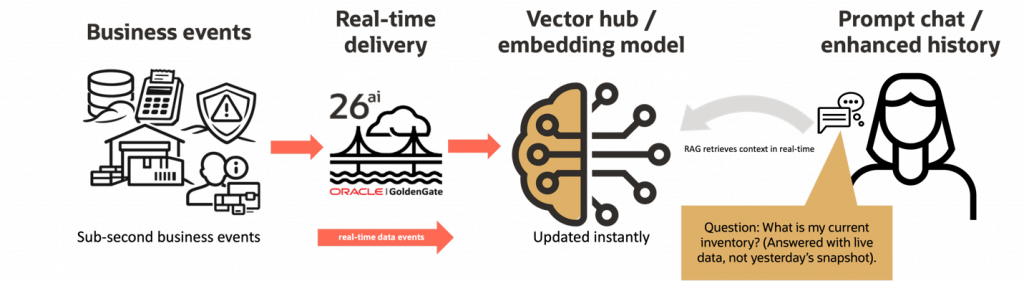
GoldenGate 26ai AI Service brings embedding generation and enrichment into the real-time flow.
This matters because many teams are currently building fragile “glue pipelines”:
- Capture operational change
- Custom integration to route change events to an embedding service
- Generate embeddings – requires API calls, retries, throttling
- Custom integration to write embeddings into a vector store
- Repeat steps 1–4 for every change to keep the vector store synchronized
- Operational guardrails so embedding workloads don’t overload production systems
GoldenGate 26ai’s AI Service helps reduce that complexity by shifting key AI plumbing into the movement layer, including bring-your-own-embedding model flexibility (local or remote).
The takeaway is simple: as business data changes, your AI context layer can update continuously without rebuilding bespoke integration for every system and team.
Real-time AI data flow integration: a scalable foundation for enterprise agentic architectures
Agentic AI isn’t a single application. It’s an architectural direction. Once enterprises prove value with one or two agents, the next challenge is scaling across domains, order operations, service, finance, supply chain, security, IT.
At scale, the bottleneck is rarely the LLM. The bottleneck is reliable access to current operational signals and consistent event contracts across a distributed data estate.
GoldenGate 26ai addresses that bottleneck by providing:
- Real-time operational change propagation across heterogeneous systems
- Standardized business event delivery designed for reactive agent subscriptions
- Built-in AI Service capabilities to support embedding/enrichment patterns as part of the flow
The result is a pragmatic, enterprise-grade foundation for agentic AI. Where agents can sense and respond in real time, grounded in operational change as it happens.