
Introduction
In healthcare, Electronic Data Interchange (EDI) is the standardized, computer-readable format for electronically exchanging business documents between healthcare trading partners, such as providers, payers, and clearinghouses. This automation streamlines processes like medical billing, claims processing, and eligibility verification by replacing manual, paper-based methods with digital data transfer, improving efficiency, reducing costs, and enhancing data accuracy to help address regulations like HIPAA.
The dominant Electronic Data Interchange (EDI) standard in the USA is ANSI X12, developed by the American National Standards Institute. It provides standardized formats for common business documents like invoices, purchase orders, and shipping notices, enabling consistent data exchange across industries such as retail, manufacturing, and healthcare.
HL7, which stands for Health Level Seven, is a set of international standards used to facilitate the exchange, integration, sharing, and retrieval of electronic health information between different healthcare systems. Essentially, it provides a common language for healthcare software to communicate with each other, enabling seamless data exchange for improved interoperability.
HL7 standards are used for exchanging a wide range of healthcare data, including patient demographics, lab results, and appointment information.
HIPAA (Health Insurance Portability and Accountability Act) is a 1996 US federal law that sets national standards for the privacy and security of patient health information. It protects Protected Health Information (PHI) from unauthorized disclosure, requires healthcare organizations to implement security measures for electronic health records, and grants patient’s rights to access and control their health data. The law is regulated by the Department of Health and Human Services (HHS).
The primary goal of HIPAA is to make easier for people to keep health insurance and protect confidentiality and security of healthcare information and help healthcare industry to control healthcare cost.
In this article, we will discuss how you can build a serverless cloud native EDI platform using Oracle Cloud Infrastructure (OCI) technology and services.
EDI Implementation Challenges
Data Mapping and Formatting
Different trading partners use various EDI standards and formats, requiring data translation and mapping to ensure compatibility with your internal systems.
System Integration
Integrating the EDI solution with existing internal systems like Enterprise Resource Planning (ERP), Warehouse Management Systems (WMS), and Transportation Management Systems (TMS) can be complex and require specific technical resources.
Interoperability
Different companies may use different EDI formats, necessitating tools and standards for data conversion and interoperability.
High Costs
Initial setup costs for software, hardware, integration, and ongoing maintenance, along with the expense of hiring and training staff, can be significant.
Resource Allocation
Companies often lack sufficient internal IT resources, skilled personnel, and the dedicated time needed to manage the EDI implementation process.
Data Quality
EDI relies on accurate and consistent data. Inaccurate, incomplete, or inconsistent information can disrupt the system and reduce data quality.
Security and Privacy
Exchanging sensitive business data requires robust security measures, including encryption, authentication, and access controls, to prevent breaches and address regulations like GDPR or HIPAA.
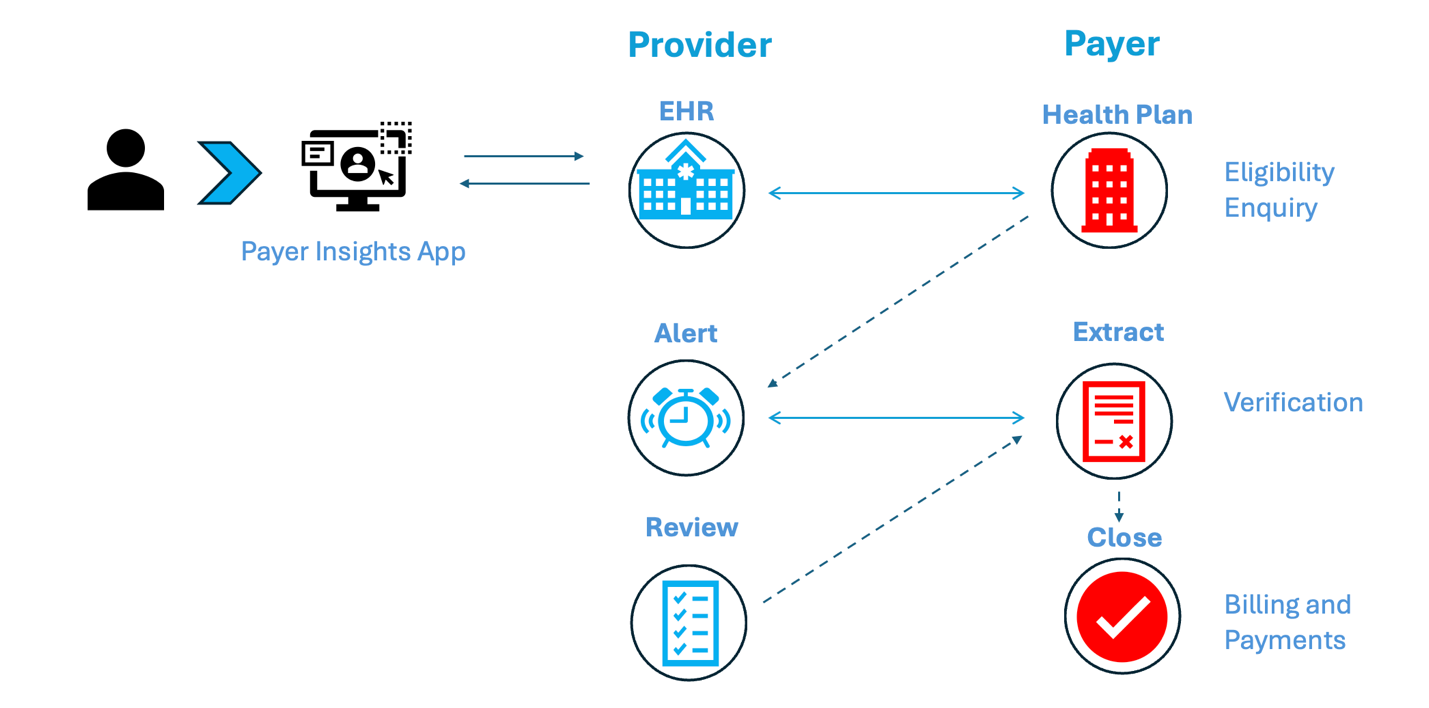
Due to its structured format, EDI participants exchange information between participating systems using a common consistent process. The primary EDI software first processes the information and then the information is imported and converted to more readable format that can be integrated into your application.
High-level EDI Process
System Challenges
Whether your payment structure is fee for service or value-based care, you need an accurate platform to help you reach performance year goals – close care gaps, increase revenue with new patients, track cost and utilization, and maximize reimbursements. a lack of system interoperability often leads to efficiency loss and higher operating expenses—from having to manage multiple systems and partners—while leaving vast amounts of data left in a non-useable form thus hindering meaningful organizational change.
Apart from the challenge of the implementation itself, it also brings several technical challenges to successfully scale, secure and maintain a flexible EDI system. Some of the common challenges are:
Scaling: Despite common standards, data types and business rules across different participants of the EDI system often differs making it difficult to scale and support diverse type of system of data and protocols.
Flexibility: As EDI systems evolves and standards changes your system should be flexible to reflect these changes, removing complexity and increasing agility.
Data Volume and Velocity: As volume of data increases and moving data between systems becomes crucial, your storage and data transformation system should be able to adjust to the requirements. A real-time data processing is necessary to handle request for information and processing promptly.
Compliance and Quality: Your system should quickly adapt to new Medicaid and Medicare rules for both states and federal and have HIPAA, CAQH CORE certifications.
Solution overview and architecture
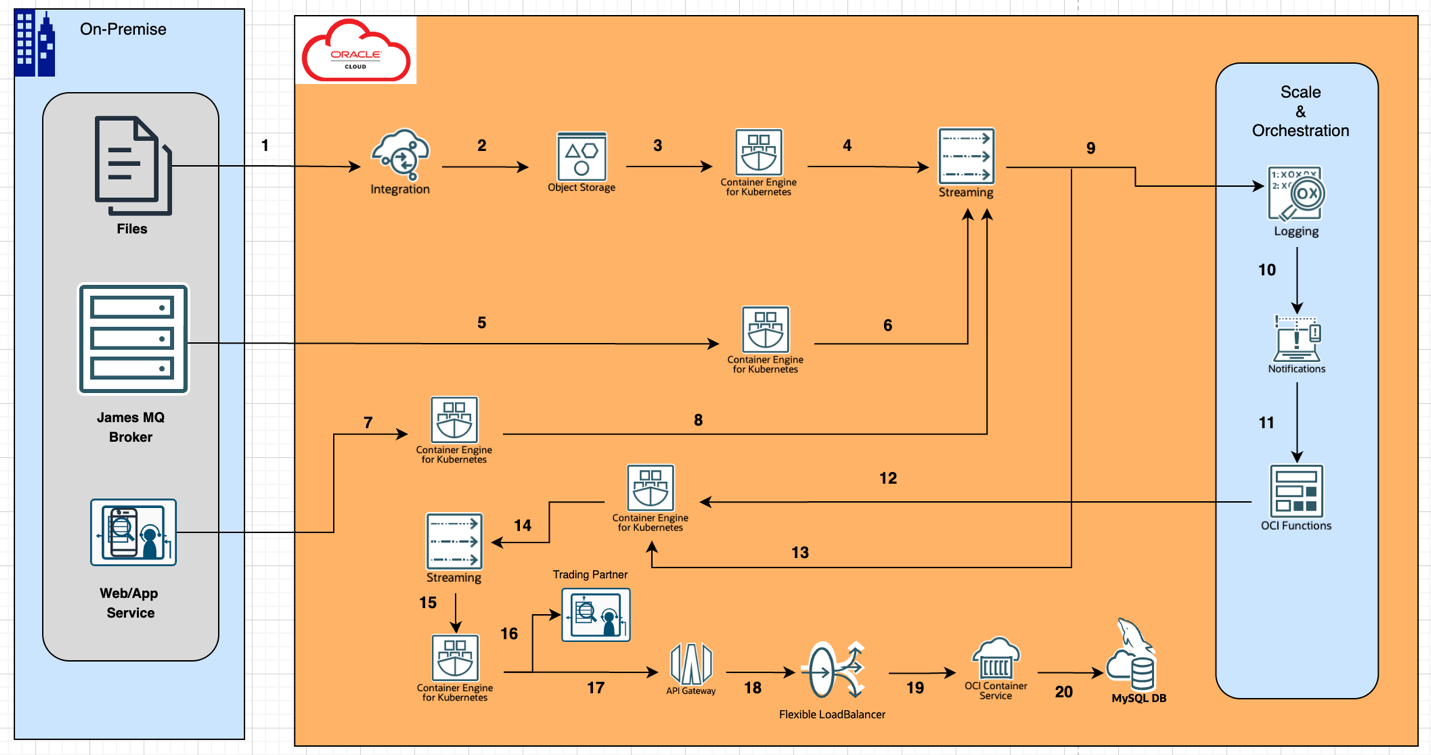
Providers and Payers can send requests as enrollment inquiry, certification request, or claim encounter to one another. This architecture uses these as source data requests coming from the Providers and Payers as flat files (.txt and .csv), Active Message Queues, and REST API calls.
The steps for the solution shown in the architecture diagram are as follows
- Flat, on-premises files are transferred to OCI Object Storage buckets using Oracle Integration Cloud (2). Oracle Integration cloud for healthcare supports HL7, FHIR and MLLP (Minimal Lower Layer Protocol).
- (3) Oracle Kubernetes Engine (OKE) which runs containers in fully managed cluster executes Python packages to convert the transactions into JSON messages, then queues it as MQ in OCI streaming service (4).
- (5) Java Message Service (JMS) Bridge, which runs Apache Camel on Oracle Kubernetes Engine (OKE), pulls the messages from the on-premises messaging systems and queues them on OCI streaming (6).
- (7) Oracle Kubernetes Engine (OKE) also runs programs to call the on-premises API or web services to get the transactions and queues it on OCI streaming service (8).
- (9) Oracle Logging and monitoring service monitors the queue depth. If queue depth goes beyond a set threshold, Oracle Notification Service sends notifications to the containers (10).
- (11) Oracle Cloud notification service triggers Oracle Cloud Functions, which adds tasks to Oracle Kubernetes Engine (12), horizontally scaling it to handle the spike via auto scaler and load balancer.
- (13) Oracle Kubernetes Engine runs Python programs to read the messages on OCI Streaming MQ message service and O
oracle Iintegration Ccloud uses packages to convert the JSON messages to EDI file formats, depending on the type of transactions. - (14) The container also may queue the EDI requests on different queues, as the solution uses multiple trading partners for these requests.
- (15) The solution runs Edifecs XEngine Server on Oracle Kubernetes Engine (OKE) with Docker image. This polls the messages from the queues previously mentioned and converts them to EDI specification by the trading partners that are registered with Edifecs.
- (16) Python module running on Oracle Kubernetes Engine (OKE) converts the response from the trading partners to JSON.
- (17) Oracle Kubernetes Engine (OKE) sends JSON payload as a POST request using Oracle Cloud API Gateway, which updates requestors’ backend systems/databases (12) that are running microservices on Oracle cloud container instance service.
- (18) The solution also runs Elastic Load Balancing to balance the load across the Oracle Cloud container instance service cluster to take care of any spikes.
- (19) Oracle Cloud container instance service runs microservices that uses Oracle Cloud Managed MySQL database (20) for domain specific data.
Conclusions
Disintegrated information is prohibitive for healthcare ecosystem; it increases cost of health services and introduce inefficiency. Poor data integration and interoperability also cause concern for data privacy and quality issues. Oracle cloud infrastructure integration services for healthcare provides modernized solution to integrate data across payers, providers, pharmacy and other healthcare solution providers, increasing collaboration, efficiency and security.
To learn more about oracle cloud infrastructure,
Oracle Cloud Integration for Healthcare