

In our previous blog on designing Zero Trust and resilient healthcare pipelines on Oracle Cloud Infrastructure (OCI), we explored secure data sharing. Clinical trial analytics, genomic analysis, and electronic health records also need protection during processing, together with evidence that the processing environment started in an approved state.
This proposed reference design targets a customer-managed SEV-SNP guest on supported OCI E5/E6 bare metal. COCONUT-SVSM would supply boot evidence alongside hardware memory protection. The combined stack requires configuration-specific integration and testing; it is not a documented configuration of an OCI-managed confidential virtual machine.
Pillar 1: Boot evidence through a custom SVSM integration
The COCONUT Secure VM Service Module (SVSM) provides isolated services inside a confidential virtual machine. Its virtual Trusted Platform Module (vTPM) runs at VM Privilege Level 0 (VMPL0), while the guest operating system runs at a less privilege VMPL. The project explicitly requires AMD SEV-SNP, particularly VMPL support.
In a compatible custom guest stack, firmware and boot software record cryptographic fingerprints in the vTPM’s Platform Configuration Registers (PCRs). A verifier compares a signed PCR quote and event log with approved values. This boot evidence requires customer integration and does not come from OCI’s managed Shielded Instance features.
COCONUT-SVSM’s vTPM supplies boot evidence by recording measurements and producing signed quotes. When configured, UEFI firmware supplies Secure Boot enforcement by checking boot-software signatures against the trusted policy. These complementary functions require separate configuration in the custom guest stack. A customer-operated verifier evaluates the evidence; if verification fails, the key broker withholds the healthcare data key. Boot-volume encryption remains a separate storage control.
Add explicit checks for the approved application, model, and configuration. Boot evidence only covers components included in the measurement policy.
Pillar 2: Memory protection with OCI Confidential Computing
On supported OCI E5/E6 platforms, AMD Secure Encrypted Virtualization with Secure Nested Paging (SEV-SNP) encrypts confidential VM memory and adds integrity protections against malicious memory remapping. Memory-encryption keys are held in the AMD Secure Processor and are unavailable to the hypervisor, OCI, and other tenants.
Patient records, analytics code, and data keys are processed inside protected private guest memory. The guest operating system remains within the workload’s trust boundary. Application security, access control, patching, encrypted storage, and protected network connections are still required.
Deployment scope and prerequisites
Shielded Instances and Confidential Computing cannot be enabled together. Oracle documents customer-built SEV-SNP guests on supported OCI E5/E6 bare metal. The COCONUT-SVSM installation guide requires compatible host kernels, modified QEMU, guest firmware, and guest kernels. This proposed integration needs platform validation.
The COCONUT-SVSM attestation documentation currently describes its attestation services as experimental and identifies key-authentication and rollback limitations. Assess and address those documented limitations before considering production use; this proposed design does not demonstrate their resolution. Hardware memory encryption can be transparent to applications; workload verification and conditional key release require integration.
Reference Architecture
OCI tenancy contains OCI Object Storage, OCI Vault, a customer-operated verifier and key broker, and the proposed customer-managed guest. Compatible KVM and QEMU components would launch the SEV-SNP guest, with COCONUT-SVSM and the application at different hardware privilege levels. Any UEFI Secure Boot enforcement shown is conditional on configuration and validation within this customer-managed stack.
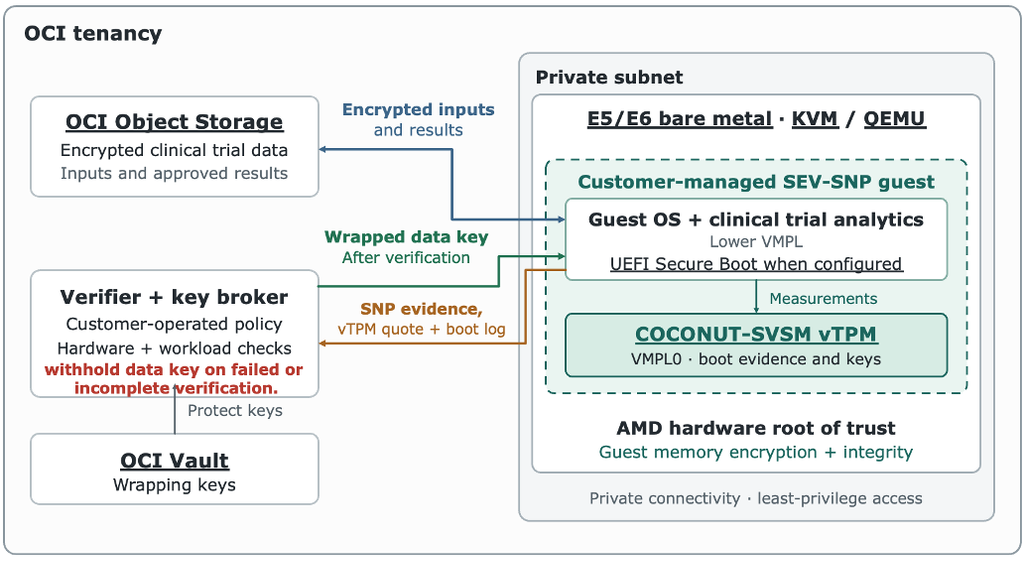
Use case helping protect clinical trial data
Consider a life sciences company using clinical trial data to analyze treatment outcomes.
1. Encrypt the dataset. Store encrypted trial data in OCI Object Storage. Use OCI Vault to protect the key that wraps the data encryption key.
2. Verify before access. Following configuration-specific testing of the custom stack,, check fresh SNP launch evidence, the vTPM identity, configured boot measurements, and approved workload measurements. Bind the evidence and key recipient to the same confidential guest.
3. Process inside the configured confidential guest. Release a wrapped data key only after policy approval. The application decrypts and analyzes the dataset inside protected guest memory, then encrypts approved results before storage.
4. Record the decision. Retain verification and key-release audit records. These support governance reviews; they do not automatically establish regulatory compliance.
After configuration-specific testing and assessment of the documented limitations, boot evidence, explicit workload approval, and hardware-backed memory protection can help strengthen the healthcare pipeline from startup through processing, within the defined trust boundary for sensitive data and proprietary analysis.
Next Steps
To evaluate this proposed reference architecture for your workloads, contact your OCI account representative to discuss technical prerequisites, supported OCI configurations, customer integration responsibilities, and testing requirements.