

Building an Interoperable Streaming Ecosystem
In our previous blog, we introduced Oracle Video @ Edge (OVE) and outlined how Media over QUIC (MoQ) establishes a new foundation for large-scale live streaming. This post builds on that foundation by focusing on how the architecture comes to life through a multi-partner ecosystem. As we head into NAB Show, we are presenting a collection of demonstrations developed with partners that show how independent systems interoperate through a shared transport model. These demonstrations highlight coordination across multiple components and how workflows can be assembled with speed, consistency, and flexibility.
A Simpler Model for Multi-Vendor Streaming
Modern streaming workflows are inherently multi-vendor, spanning encoding, packaging, delivery, and playback. As these workflows scale, the ability to connect systems quickly and operate them as a cohesive pipeline becomes increasingly important. MoQ enables a more streamlined and flexible approach to building and scaling live streaming workflows by providing a shared transport model across systems.
- Faster integration of ingest, delivery, and playback systems into a working pipeline
- More consistent interaction patterns across independently operated components
- Greater flexibility to combine vendors based on use case and requirements
- A foundation that supports real-time coordination across the workflow
How MoQ is structurally different: In HLS and DASH, each vendor integration requires negotiating a shared segment format, manifest schema, and HTTP pull timing, coordination that happens out-of-band through documentation and field testing. MoQ replaces this with a common object model: content is organized as Tracks (one per rendition), Groups (one per independently decodable unit, typically a GOP), and Objects (one per encoded frame or audio packet). Any system that speaks MoQT (Media over QUIC Transport) the IETF wire protocol, can publish or subscribe to any Track without prior bilateral negotiation. Put simply, MoQ reduces latency-driven spoilers caused by delivery delays—because no one wants to be the last house on the street to know their team has won.
Why MoQ Matters in Practice
MoQ provides a consistent and scalable method for connecting independent components across the streaming workflow. By standardizing how data is published, discovered, and consumed, it enables systems to interoperate through common patterns and allows workflows to be assembled and adapted with greater ease as requirements evolve.
- Standardized transport model that simplifies inter-system connectivity
- More predictable and repeatable integration patterns across vendors
- Reduced configuration overhead when assembling multi-vendor workflows
- Increased ability for the cloud provider to coordinate delivery behavior
What “standardized” means at the transport level: MoQT runs over QUIC, which multiplexes independent byte streams on a single UDP connection, each with its own flow control and loss recovery. MoQ maps each Object to its own QUIC stream, so a retransmitted packet for one frame does not stall delivery of subsequent frames. This contrasts with TCP-based HLS, where a single dropped packet blocks everything behind it. The protocol also carries an explicit delivery priority per Object: video keyframes (IDR) are prioritized over inter-frames, and audio is prioritized over video under congestion. A relay under load forwards the most perceptually critical data first, preserving audio continuity and enabling faster visual recovery.
OCI as the Connective Layer
OVE functions as a MoQT relay network rather than a CDN origin or traditional media server. It provides a unified layer that connects systems across the streaming workflow and coordinates how streams move between them. By normalizing transport and exposing a consistent interface for upstream and downstream components, OCI acts as the coordination layer across vendors, enabling workflows to operate as a cohesive system.
- Cloud-native relay layer for ingest, fanout, and delivery across regions
- Common transport model using MoQ to standardize inter-system communication
- Centralized control plane to manage session lifecycle and routing decisions
- Integrated telemetry layer to observe performance and inform optimization
How OVE relays distribute content: When a subscriber requests a Track from an edge relay, that relay issues its own upstream SUBSCRIBE toward the origin relay if the Track is not already cached locally, forming a pull-through tree on demand. Each relay maintains a short sliding-window cache of recent Objects, roughly one GOP in duration, so late-joining subscribers receive a clean starting point immediately. Regions with no active subscribers incur no upstream data transfer, a structural efficiency that push-based CDN topologies cannot replicate at sub-second latency. QUIC connection migration allows sessions to survive IP changes without requiring reconnects.
How the Workflow Comes Together
Each demonstration follows the full path from ingest to playback, showing how components connect into a cohesive workflow through OVE and MoQ. The flow is built progressively to illustrate how quickly systems integrate and how consistently they function once connected, making interoperability visible through real setup steps, active stream propagation, and immediate playback across different partner combinations.
- Encoder and packager configuration connecting into the relay layer via a MoQT PUBLISH
- Stream propagation through OVE relays, with downstream components joining via SUBSCRIBE
- Delivery into CDN environments where applicable, bridging MoQT to CMAF / HLS at the edge
- Player integration using relay endpoints to initiate playback over WebTransport
- Seamless propagation of streams across regions and delivery through relay-to-relay SUBSCRIBE forwarding
- Consistent behavior across different vendor combinations, thanks to the shared MoQT wire format
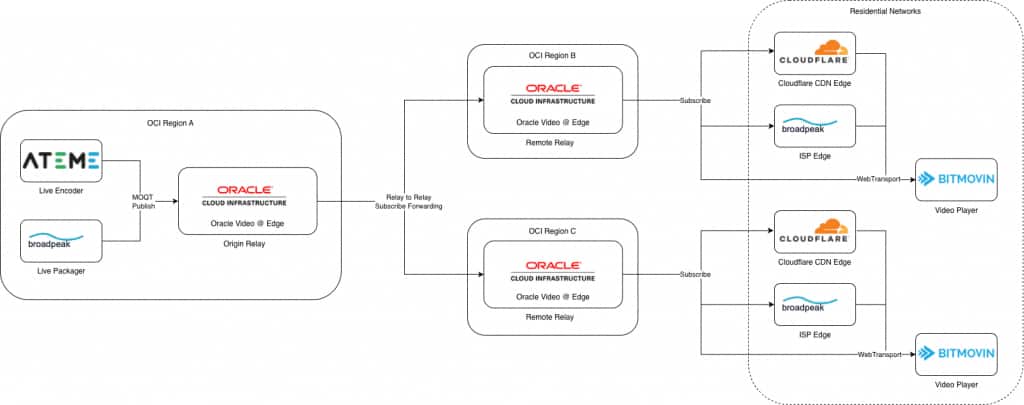
Demo: Ateme Output to OVE
Ateme provides the entry point into the workflow, where encoded video is introduced directly into the OVE relay fabric. The integration shows how ingest systems connect into the shared transport model and immediately participate in downstream distribution.
- Real-time encoding aligned with MoQ transport
- Direct connection from encoder into the OVE relay
- Immediate availability of the stream for downstream systems
- Where to see it at NAB: Ateme – Booth W1723 – West Hall
Demo: Broadpeak Packaging Integration
Broadpeak provides packaging within the workflow, illustrating how streams move through OVE into downstream delivery environments while maintaining consistent behavior across the pipeline.
- Packaging aligned with MoQ-based transport
- Participation in ingest-adjacent role
- Stream propagation into CDN environments through OVE
- Where to see it at NAB: Broadpeak – Booth W3034 – West Hall
Demo: CDN Delivery with Cloudflare and Broadpeak
Cloudflare represents CDN participation in the workflow, showing how streams extend beyond the relay layer into broader distribution environments while maintaining interoperability across delivery paths. Broadpeak adds another layer of interoperability by extending the reach inside the ISPs’ networks.
- Delivery from OVE relays into CDN infrastructure
- Consistent stream handling across delivery layers
- Flexibility to incorporate multiple CDN providers
- Where to see it at NAB:
- Cloudfare: AI Innovation Pavilion – Booth W2300G – West Hall
- Broadpeak: Booth W3034 – West Hall
Demo: Playback with Bitmovin
Bitmovin’s Player Web X brings commercial-grade MoQ support, connecting directly to relay endpoints and decoding streams natively. Built with an open plugin architecture, the MoQ implementation is fully customizable, making it straightforward to integrate into existing broadcast and streaming pipelines.
- Native MoQ decoding direct from relay endpoints, with no legacy format conversion
- Near-instant startup and channel switching as a result of Player Web X’s structured concurrency framework
- Interoperability across commercial and open ecosystems
- Where to see it at NAB: Bitmovin – Booth W3323 – West Hall
Looking Ahead
This set of NAB demonstrations represents an early step toward a more interoperable streaming ecosystem where systems can be combined and operated with greater speed and flexibility. As more partners adopt MoQ and integrate with OVE, this model will continue to expand, enabling new workflows and strengthening OCI’s role as the coordination layer for modern media delivery. We encourage attendees to visit partner booths across the show floor to see these demonstrations in action and engage directly with the teams building this ecosystem.
To meet with Oracle at NAB Show 2026: Please email media-entertainment_mb@oracle.com to schedule time onsite.