


As cloud environments evolve, teams are often focused on what comes next: onboarding workloads, supporting new business initiatives, and keeping pace with changing security and operational requirements. It can be difficult to step back and assess whether the underlying environment is still set up to support those priorities.
Oracle offers eligible customers a complimentary Oracle Cloud Infrastructure (OCI) Health Check to provide that perspective. The engagement is a structured, non-disruptive review of your OCI tenancy that identifies strengths, highlights opportunities for improvement, and provides practical next steps for your team.
A health check provides a practical view of your cloud environment
The assessment is designed to be collaborative and relevant to your environment. Oracle Cloud Engineering works with cloud, IT, and security stakeholders to understand current priorities and assess key aspects of the tenancy.
The review helps teams understand how the cloud foundation supports day-to-day operations and longer-term plans. It brings together technical configuration, operational practices, governance, and cost visibility in one conversation.
For organizations that are growing their cloud footprint, the assessment can help establish a baseline for future decisions. For organizations with established environments, it can help validate existing practices and identify areas where small, focused changes could have a meaningful effect.
Five domains reveal where focused improvements can help
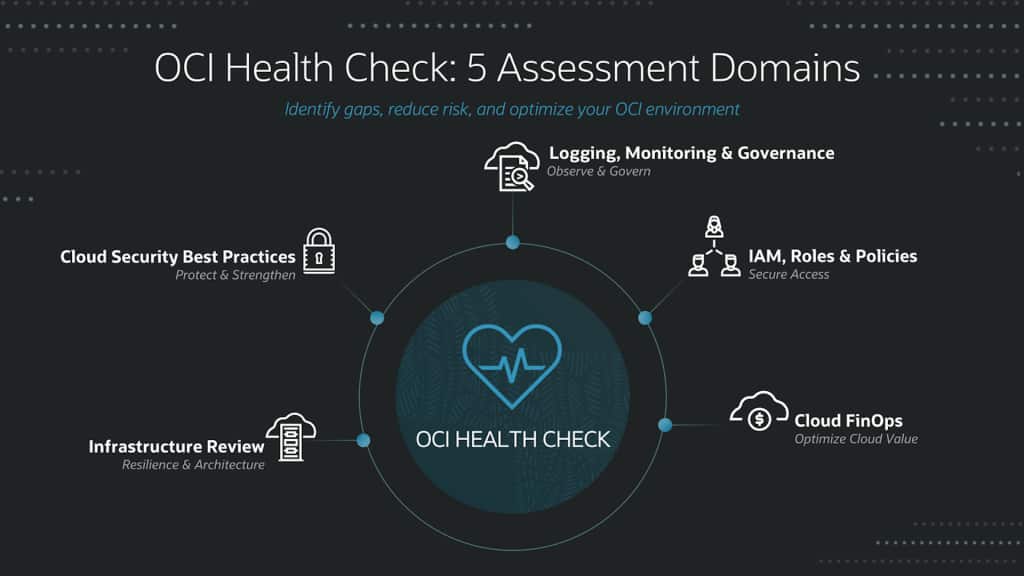
A strong cloud foundation depends on several disciplines working together. The OCI Health Check reviews five domains that commonly shape the security, resilience, and manageability of an environment.
- Infrastructure Review: The review considers tenancy architecture, connectivity, network configuration, high availability, and disaster recovery readiness. This can help teams evaluate whether network design and resiliency practices continue to align with workload requirements.
- Cloud Security Best Practices: Security considerations include configuration, data protection, backup and recovery practices, vulnerability management, and relevant OCI security services. For example, Oracle Cloud Guard can help teams monitor resources for configuration weaknesses and risky activity, based on the detectors and responder rules they configure.
- Logging, Monitoring, & Governance: Logs, metrics, alarms, notifications, retention practices, and security information and event management (SIEM) integration all contribute to effective operations. The review considers whether teams have the visibility needed to investigate events, respond to issues, and make informed operational decisions.
- IAM, Roles, & Policies: Identity and access management (IAM) includes compartments, groups, policies, federation, multi-factor authentication (MFA), and administrator responsibilities. OCI IAM enables organizations to control access to cloud resources through users, groups, compartments, and policies. A review of these practices can help identify opportunities to clarify ownership and reduce overly broad access.
- Cloud FinOps: Tagging, budgets, quotas, lifecycle policies, and cost analytics help teams understand and manage cloud consumption. Reviewing these practices can support more timely conversations about usage, planning, and resource optimization.
Security assessment guidance is informed by the CIS Oracle Cloud Infrastructure Foundations Benchmark, a community-developed set of secure configuration recommendations for OCI.
The engagement turns observations into prioritized next steps
The Health Check begins with a kickoff discussion to align on objectives, scope, and timing. Oracle Cloud Engineering then conducts the assessment and reviews the findings with relevant stakeholders.
The engagement is designed to minimize the time required from your team. Our team performs most of the assessment work, with results and recommendations typically delivered within one week.
The output is an executive summary that captures positive observations, key findings, and recommendations. It is intended to give both leadership and technical teams a shared view of the environment, including:
- Existing strengths that can be maintained or expanded
- Potential operational or configuration gaps
- Recommendations prioritized by likely impact and effort
- A practical roadmap for addressing the opportunities that matter most
This approach helps teams move from broad concerns, such as improving security posture or cloud-spend visibility, to specific actions that can be planned and owned.
Cloud Engineering can support the next phase
The assessment can also begin a broader conversation about enablement. When a team wants additional support, Oracle Cloud Engineering can help connect the findings to relevant technical discussions, workshops, architecture reviews, demonstrations, or implementation guidance.
For example, a team that identifies a need for stronger monitoring may want to explore logging, alarms, and notification practices in more detail. Another team may want to review access policies and compartment design as its organizational structure changes. A customer focused on cost management may want to discuss budgets, usage visibility, and the OCI billing and cost-management capabilities.
The right next step depends on the environment and the organization’s priorities. The purpose of follow-on enablement is to help teams apply the findings in a way that is practical for their architecture, operating model, and business goals.
Start with a clearer view of your cloud foundation
Cloud environments are most effective when teams can manage growth without losing visibility, control, or confidence in the underlying foundation. A health check provides a focused way to validate the current state of your OCI tenancy, identify the most valuable opportunities for improvement, and plan next steps with the right stakeholders.
Ready to strengthen your cloud foundation? Contact your Oracle account team to schedule a health check.