

The cars are already at speed.
But the race has already been run thousands of times.
Before a single pit stop happens, before a tire decision is made, Oracle Red Bull Racing has already simulated billions of possible outcomes using Oracle Cloud Infrastructure A4 Acceleron instances.
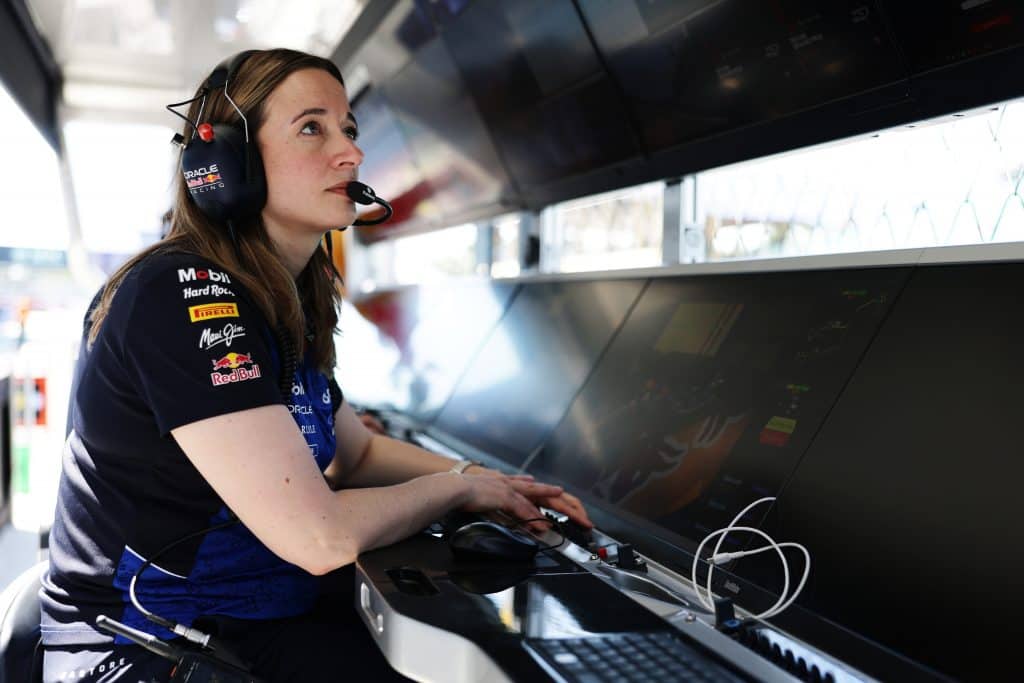
On track, everything looks reactive. Behind the pit wall, it is anything but.
Telemetry data streams in continuously. GPS position, tire degradation, weather, track conditions. Every variable feeds into a system that recalculates the race in real time.
Do they pit now, or extend the stint?
Which tire strategy holds over a full race distance?
When is the right moment to send the car out and avoid traffic?
And as conditions shift, how does the race actually unfold?
These are not decisions made in the moment. They are modeled, tested, and refined continuously as the race progresses.
What Is OCI A4 Acceleron
OCI A4 Acceleron instances are designed to run high-performance, scale-out workloads in Oracle Cloud Infrastructure.
They combine OCI Ampere® Arm-based compute with Oracle’s Acceleron architecture, which improves how networking, storage, and infrastructure processing are handled across distributed systems.
In distributed cloud computing environments, where workloads run across many nodes at once, this approach helps reduce overhead, improve throughput, and maintain consistent performance at scale. Rather than relying on a single large system, workloads are executed across a distributed system in cloud computing, allowing compute resources to be used more efficiently.
This makes A4 Acceleron particularly well suited for data-intensive applications like large-scale simulation, where performance depends on running many parallel tasks across a cloud and distributed computing architecture.
Why Oracle Red Bull Racing Runs on OCI A4 Acceleron
Oracle Red Bull Racing uses OCI A4 Acceleron instances powered by AmpereOne® M CPUs because they deliver the performance and efficiency required to run large-scale race strategy workloads in real time.
Their simulation workloads are compute-bound, meaning performance depends primarily on CPU processing power, and the system scales across multiple nodes, allowing many simulations to run in parallel.
For this type of modeling, that approach is more efficient. It allows the team to run large volumes of scenarios with consistent performance, without the overhead of GPU-heavy infrastructure.
In a sport governed by strict cost caps, that efficiency provides a meaningful advantage, enabling the team to maximize compute resources while allocating budget where it matters most.
Their simulation engine is built on highly optimized, time-based models refined over years of racing. These are not massive generative AI workloads. They are precision calculations that benefit from throughput, consistency, and the ability to scale across nodes.
That is where OCI Ampere A4 compute performance stands out.
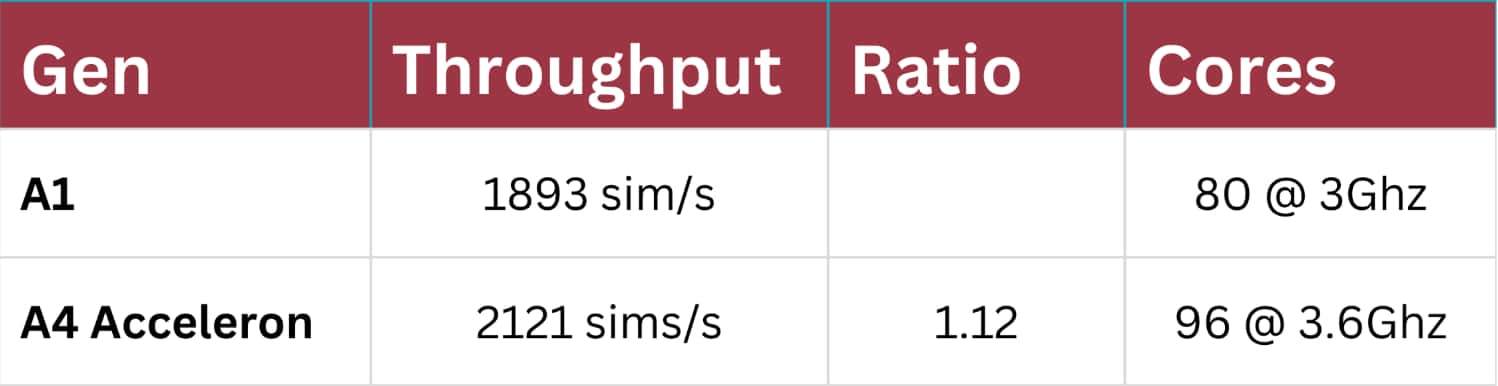
12% Higher Throughput and 7% Lower Cost
Performance improvements in this environment have a direct impact.
With A4 Acceleron, Oracle Red Bull Racing has seen roughly a 12-percent increase in simulation throughput compared to previous generations, along with an estimated 7-percent reduction in cost based on their current deployment.
That means more race scenarios can be evaluated within the same time window, improving decision-making during critical moments, while lowering infrastructure costs.
Rethinking CPU vs GPU for AI and Simulation
There is a tendency to default to GPUs for anything labeled AI. But many AI inference workloads and simulation models do not require that level of acceleration.
Oracle Red Bull’s environment is a good example. Their workloads depend on:
- High-throughput parallel computation
- Consistent performance across distributed systems
- Cost-efficient scaling over time
CPU-based infrastructure can meet those requirements without the cost overhead associated with GPU-heavy deployments. For organizations evaluating CPU vs GPU AI workloads, this distinction becomes important, especially when performance needs to be balanced against budget constraints.
What Acceleron Adds to the Equation
The performance story is not just about CPUs; it’s about how the entire system is designed.
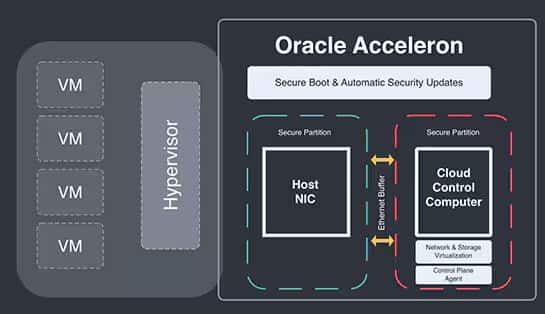
OCI A4 Acceleron builds on Oracle’s Acceleron architecture to reduce infrastructure overhead and improve how compute resources are used at scale.
Oracle Acceleron SmartNIC plays a key role by offloading networking and storage tasks from the CPU, allowing more of the available compute capacity to be dedicated to application workloads rather than infrastructure processing.
At scale, this becomes a meaningful advantage. By shifting infrastructure responsibilities away from the CPU, Acceleron helps maintain consistent performance and efficiency as workloads grow, particularly in environments where compute is the primary bottleneck.
How the System Operates During a Race
On race day, everything runs as a coordinated system.
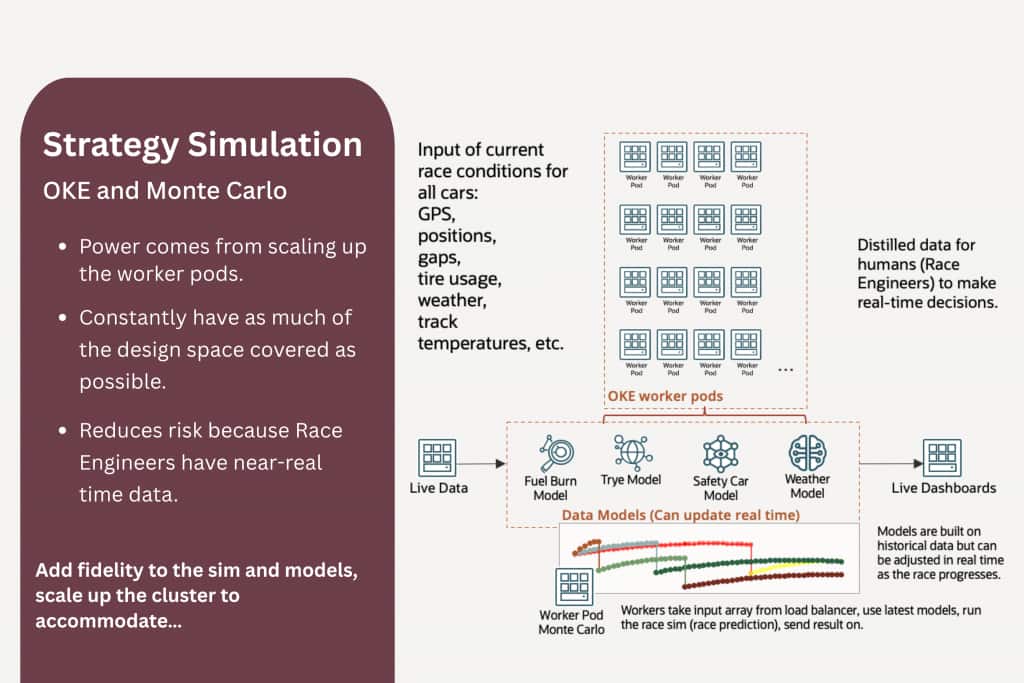
Telemetry flows continuously into OCI. Workloads are orchestrated through Oracle Kubernetes Engine, distributing simulation tasks across clusters of A4 instances. Each node processes a different set of scenarios, contributing to a constantly evolving model of the race.
As time progresses, the system recalculates outcomes based on the latest data. Older scenarios are discarded. New ones are generated. Engineers see updated probabilities in real time.
The process runs continuously throughout the race.
Expanding into AI and Inference Workloads
The same infrastructure is also supporting emerging AI-driven workflows.
Oracle Red Bull Racing is actively exploring how to extend its simulation environment into AI-driven use cases that build on the same data foundation. Some of these capabilities have already been tested trackside, while others are in development.
One example is a pit wall assistant that allows race engineers to query regulations or historical scenarios in real time. Instead of manually searching through documentation, they can ask a question and receive a response based on preloaded race data and rules.
These types of workloads represent targeted inference use cases that can complement existing systems without requiring large-scale training infrastructure. Depending on latency requirements, some of these workloads can run efficiently on CPU-based infrastructure, while others may require GPU acceleration.
This is where a flexible, hybrid approach becomes important. OCI A4 Acceleron instances provide a cost-efficient option, allowing teams to scale AI inference without relying exclusively on GPU-based systems.
The problems Oracle Red Bull Racing is solving are not unique to motorsport.
Many organizations are working with real-time data, running large-scale simulations, and evaluating where AI fits into their existing systems. The challenge is not just performance. It is finding the right balance between speed, cost, and scalability.
OCI A4 Acceleron instances demonstrate how CPU-based architectures can play a central role in that balance, particularly for workloads that benefit from parallel execution and do not require constant ultra-low latency.
Explore OCI A4 Acceleron
If you are running simulation-heavy workloads, building AI inference pipelines, or evaluating how to scale performance without increasing cost, OCI A4 is worth a closer look.
You can explore the full capabilities of OCI compute and A4 instances here.
For a deeper technical breakdown of Acceleron and how it enhances performance across networking and storage, see the A4 Acceleron announcement.