
The Canadian AI and IoT software company used a structured OCI proof of concept to validate production readiness, compare cloud economics with AWS, and build a scalable foundation for future growth while reducing cloud infrastructure costs by 35%.
For predictive maintenance platforms, cloud cost and scale are inseparable
For asset-intensive industries, every unexpected equipment failure can create a costly chain reaction: production delays, emergency maintenance, wasted energy, safety risks, and missed customer commitments. Nanoprecise helps industrial organizations reduce that risk with an AI- and IoT-based predictive maintenance platform designed to monitor machine health, identify early signs of failure, and help operations teams make more informed maintenance decisions through AI and IoT technology.
As Nanoprecise continued expanding across industries, the company needed cloud infrastructure that could keep pace with growing demand. The platform was already cloud native, but rising cloud infrastructure costs and the need for more flexible deployment options led Nanoprecise to evaluate OCI as an alternative to its AWS environment.
The evaluation centered on a practical question: Could OCI support Nanoprecise’s production-grade workloads while reducing cost, maintaining performance, protecting data integrity, and meeting security and compliance expectations?

Why Nanoprecise evaluated OCI
Nanoprecise was not looking for change for the sake of change. The company had a working cloud-native environment. The business case for OCI had to be proven across economics, architecture, and operational support.
- Lower infrastructure cost: Reduce the cost of running cloud-native production workloads without compromising reliability or customer experience.
- Flexible scaling: Match compute resources more closely to application requirements as customer adoption grows.
- Cloud-native portability: Preserve modern engineering patterns such as Kubernetes, Terraform, CI/CD automation, monitoring, and infrastructure as code.
- Better technical engagement: Validate the platform with direct architecture support, hands-on enablement, and migration planning.
Proving the Value Through a Performance POC
The Oracle and Nanoprecise teams treated the evaluation as a project, not just a bill comparison. The project plan tracked six completed phases, from assessment and planning through deployment readiness.
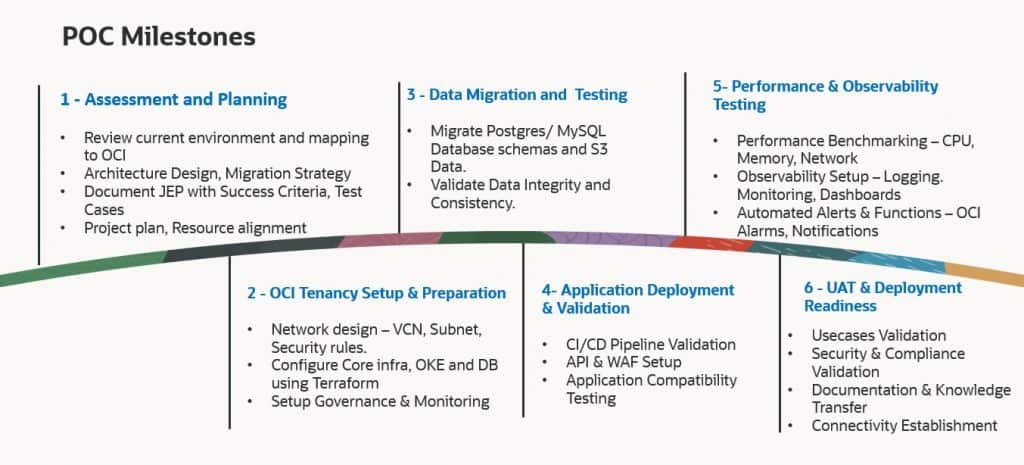
Figure 1 – Nanoprecise OCI proof-of-concept timeline from the project plan.
The proof of concept began with assessment and planning, including inventory analysis, dependency mapping, architecture review, service mapping, and documentation of the Joint Execution Plan (JEP), success criteria, and test cases. During OCI Tenancy Setup and Preparation, Oracle and Nanoprecise configured networking components and security controls, deployed core infrastructure and DB using Terraform, and implemented connectivity, governance, and monitoring capabilities. Later phases focused on data migration testing, application deployment and validation, performance and observability testing, user acceptance testing, security and compliance validation, knowledge transfer, and client-integration readiness.
Architecture and functionality
The OCI architecture was designed to support a familiar cloud-native operating model while giving Nanoprecise room to scale. Oracle Kubernetes Engine (OKE) runs front-end, back-end, and supporting application services. The design also includes public and private subnets, autoscaling, load balancing, NAT gateway, bastion access, Vault, DNS, Object Storage, and CI/CD tooling.
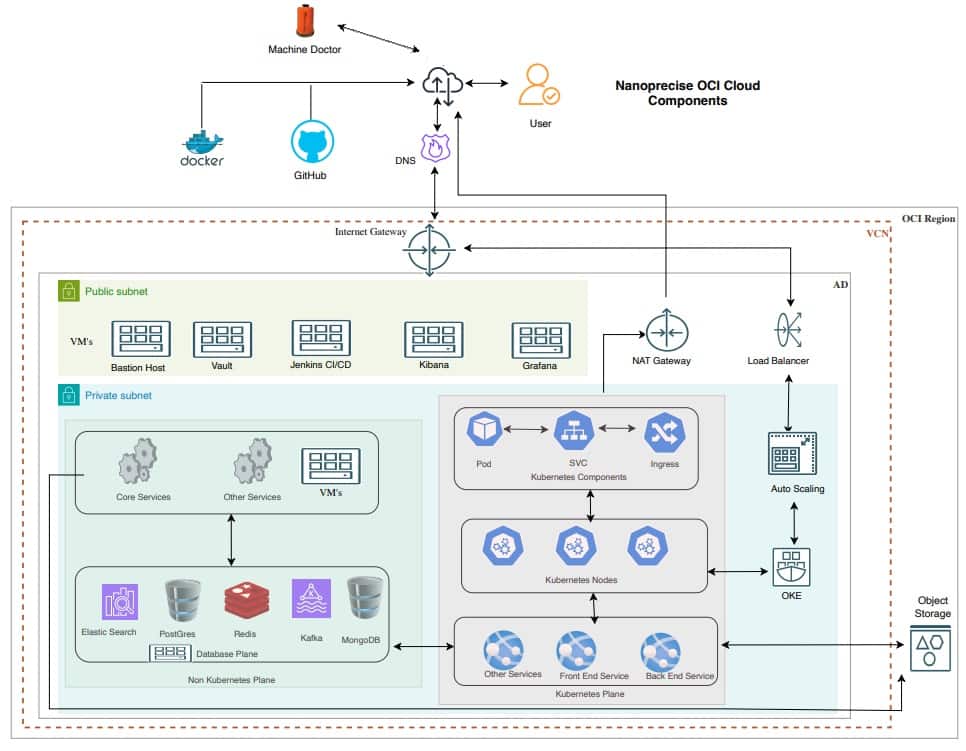
Figure 2. High-level Nanoprecise OCI cloud components used for the POC and target architecture.
The architecture separates Kubernetes and non-Kubernetes components. The Kubernetes plane supports application services, pods, services, ingress, and worker nodes. The non-Kubernetes plane includes data and messaging components such as PostgreSQL, Redis, Kafka, MongoDB, and search/analytics tooling. Operational tools such as Jenkins, Grafana, and Kibana support deployment, observability, and troubleshooting workflows.
What the POC needed to prove
For Nanoprecise, the POC needed to demonstrate more than “the application runs.” The success criteria were tied to production readiness and customer impact. The teams defined measurable criteria and test cases up front so that the OCI evaluation could be judged against the operational standards Nanoprecise applies to its customer-facing platform.
- Zero data loss and 100% data consistency during migration and validation activities.
- Application uptime maintained at or above 99.9% during the test window.
- Comparable or improved performance across latency, CPU, and memory metrics.
- Seamless DNS cutover with minimal downtime.
- Smooth user experience before, during, and after migration.
- Database integrity, cost efficiency compared with AWS, SOC 2-oriented security alignment, and monitoring and alerts.
Lower cost without giving up cloud-native flexibility
One of the clearest outcomes from the evaluation was cost reduction. Nanoprecise selected OCI to reduce cloud infrastructure costs by 35% while continuing to scale its AI- and IoT-based predictive maintenance platform.
A key driver is OCI’s flexible infrastructure model. Instead of forcing teams into fixed, predefined instance sizes that can lead to unused CPU or memory, OCI enables more granular matching of compute resources to application requirements. For a growing software company, that flexibility can help reduce overprovisioning while still giving engineering teams the capacity they need.
OCI also helped Nanoprecise address cost across multiple parts of the platform, including compute, storage, data transfer, Kubernetes, cache, and object storage. For a cloud-native ISV handling industrial machine data and AI/ML workloads, those savings can compound as adoption grows.
The Migration Journey: Guided by Oracle Enterprise Architects
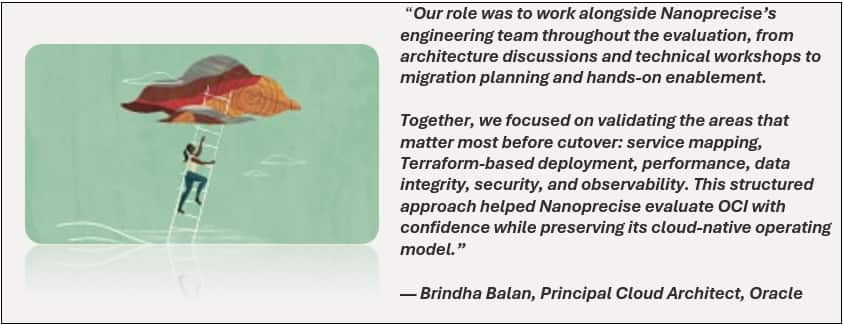
Cloud migration is not only a technical exercise. It requires trust, coordination, and access to the right expertise at the right time. Oracle worked closely with Nanoprecise to help reduce migration risk and validate OCI as a scalable foundation for future growth.
Lessons for cloud-native ISVs evaluating OCI
Nanoprecise’s experience offers a useful model for software companies running modern workloads on hyperscale cloud infrastructure.
- Look beyond cost savings – Cost analysis is a strong starting point, but it should not be the only factor in vendor evaluation. Organizations should also consider workload performance, security, operational support, white-glove technical guidance, and the breadth of cloud services needed to support long-term growth.
- Preserve engineering patterns that already work. With OKE, CI/CD tooling, observability integrations, and infrastructure as code, Nanoprecise could move to OCI while continuing to use a familiar cloud-native operating model.
- Engage the right experts – Migration success depends on more than technology. Direct collaboration with Oracle Enterprise Architects and specialists across infrastructure, security, Kubernetes, and operations helped Nanoprecise make faster decisions, reduce risk, and plan for future scale.
- Think beyond migration – The best cloud choice should support both today’s workload and tomorrow’s roadmap. For Nanoprecise, OCI provided a path to scale cloud-native AI workloads, expand data services, and support future innovation.
Next Steps
To learn more about Oracle Cloud Infrastructure and see how we can help you with cloud adoption, see the following resources:
- Oracle Cloud Native services, OCI’s capabilities for Kubernetes
- Compare OCI with AWS, Azure, and Google Cloud
- Optimize your cloud journey with Oracle Cloud Personalized Training
- Use Oracle Cloud Free Tier to try OCI.
Contributors
- Brindha Balan – Principal Cloud Architect, Oracle
- Rituraj Ubnare – Principal Architect, Nanoprecise