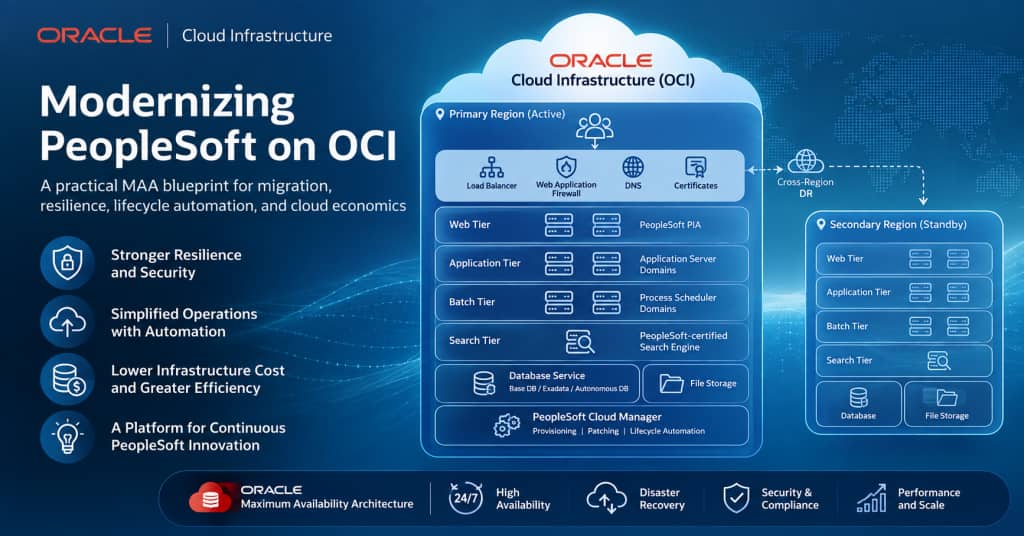
A practical MAA blueprint for migration, resilience, lifecycle automation, and cloud economics
Executive perspective
PeopleSoft continues to support critical finance, human resources, campus, and supply-chain operations for organizations around the world. Yet many of these environments still run in aging data centers, where infrastructure costs, manual administration, and recovery limitations can slow innovation and increase operational risk.
Oracle Cloud Infrastructure (OCI) offers a pragmatic modernization path. Organizations can retain established PeopleSoft business processes and customizations while moving to a governed cloud platform designed for stronger resilience, security, automation, and cost control. The objective is not simply to relocate virtual machines. It is to modernize the operating model around PeopleSoft.
Business outcome
A well-designed OCI landing zone turns PeopleSoft migration into a platform opportunity: compute, database, storage, networking, security, observability, backup, and disaster recovery can all become part of one governed cloud architecture.
Audience: CIOs, application owners, PeopleSoft administrators, enterprise architects, and cloud transformation teams.
Reference Architecture
The foundation architecture supports multiple PeopleSoft applications – such as Financials, HCM, Campus Solutions, CRM, and Interaction Hub – while keeping production and nonproduction environments isolated. Application-specific tiers can scale independently, and the primary and disaster-recovery regions follow the same logical blueprint.
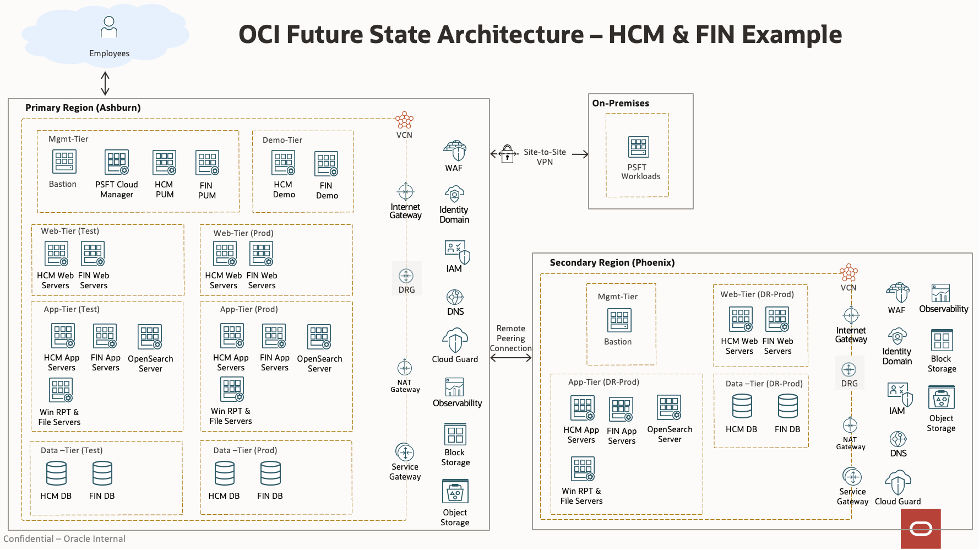
Figure 1. Example future-state PeopleSoft MAA topology on OCI, 2 applications, 2 environments
Core design principles
- Keep production and nonproduction on separate compute and security boundaries; do not share servers merely to reduce short-term cost.
- Separate PeopleSoft application families when their workload, release, security, or scaling profiles differ.
- Place web, application, batch, search, and management components in private subnets; expose only the required entry points through load balancers or controlled administrative access.
- Deploy at least two instances of critical web and application components across fault domains or availability domains where the region supports them.
- Use nonoverlapping CIDR ranges between primary and DR regions unless a deliberate overlay or address-preservation design is required.
- Automate provisioning and configuration with PeopleSoft Cloud Manager, Terraform, scripts, and repeatable image pipelines.
How the PeopleSoft tiers map to OCI
| Architecture layer | OCI / PeopleSoft components | Role in the solution |
| Access and edge | OCI Load Balancer, Web Application Firewall, DNS, certificates | Secure user entry, TLS termination, traffic distribution, and optional application-layer protection. |
| Web tier | PeopleSoft PIA on OCI Compute | Browser-facing PeopleSoft Pure Internet Architecture, deployed redundantly behind the load balancer. |
| Application tier | Application Server domains on OCI Compute | Executes business logic and connects the web tier to database services. |
| Batch tier | Process Scheduler domains on OCI Compute | Runs batch, reporting, integration, and scheduled processing; can share hosts with application servers or be separated for scale and isolation. |
| Search tier | PeopleSoft-certified search engine nodes | Supports Global Search, keyword search, and Insights; deploy multiple nodes and validate certification for the selected PeopleTools release. |
| File services | OCI File Storage or application-specific shared storage | Hosts shared PeopleSoft homes, report repositories, interfaces, and other shared files where appropriate. |
| Database tier | Base Database Service, Exadata Database Service, Autonomous Database where certified, or database on Compute | Select based on scale, availability objectives, licensing, operational model, and application certification. |
| Operations | PeopleSoft Cloud Manager, Bastion, Monitoring, Logging, Cloud Guard, Vault | Provides lifecycle automation, secure administration, observability, posture management, and secrets protection. |
Cloud-native PeopleSoft lifecycle components
- PeopleSoft Cloud Manager: Automates provisioning, cloning, patching, environment management, and lift-and-shift workflows for PeopleSoft environments on OCI.
- PeopleSoft Update Manager images: Prebuilt environments containing application maintenance, fixes, and change packages for a specific PeopleSoft release.
- Demo instances: Sample environments populated with demonstration data for training, testing, validation, and feature exploration.
- PeopleSoft PIA: The browser-based, multi-tier architecture that connects users through web, application, and database services.
- Search services: The back-end search and analytics capability for Global Search and PeopleSoft Insights; size and deploy according to index volume, query demand, and supported PeopleTools certification.
Designing for Maximum Availability Architecture
Oracle MAA applies proven high-availability and disaster-recovery practices across the database, middleware, and application tiers. The target design duplicates the primary application stack in a second region and keeps state synchronized through service-appropriate replication mechanisms.
- Use redundant HTTPS load balancing and at least two PIA web servers.
- Deploy two or more application servers and two or more Process Scheduler domains so a host failure does not stop transaction or batch processing.
- Use a resilient shared file system and replicate generated application files and reports to the secondary region.
- Use Oracle Data Guard or Active Data Guard for database replication and database role transition.
- Keep recovery plans version-controlled, prechecked, and periodically tested.
Choosing the right disaster-recovery posture
| Model | Typical setup | Trade-off | Best fit |
| Hot | Application and database tiers running in the DR region; replication continuously active. | Lowest RTO and RPO; highest steady-state cost. | Mission-critical operations with strict continuity requirements. |
| Warm | Database standby and selected core services running; application capacity is reduced or started during recovery. Compute is started during a DR event or drill. | Balanced cost and recovery speed. | Most enterprise PeopleSoft production environments. |
Automating recovery with OCI Full Stack Disaster Recovery
OCI Full Stack Disaster Recovery can orchestrate the ordered transition of compute, storage, database, load-balancing, and application components between regions. For PeopleSoft, a recovery plan can include database role transition, file-system availability, VM startup, service validation, search-tier activation, load-balancer updates, and application-specific scripts.
- Create paired disaster-recovery protection groups for the primary and standby regions.
- Build separate switchover and failover plans and add user-defined steps for PeopleSoft service control and validation.
- Run prechecks before every planned event.
- Execute periodic DR drills using isolated networks and test DNS records where production must remain online.
- Document failback and reprotection procedures, not only failover.
A pragmatic migration path
1. Discover – Inventory PeopleSoft applications, customizations, integrations, batch windows, search indexes, file shares, database size, network dependencies, and operational tooling.
2. Establish the landing zone – Create compartments, IAM, hub-and-spoke networking, connectivity, DNS, logging, security services, tagging, budgets, and key management.
3. Build the target – Provision database services, application compute, file storage, load balancers, search nodes, Cloud Manager, and management access.
4. Migrate and synchronize – Move the database with the selected migration method, copy application homes and configuration, establish file replication, and validate integrations.
5. Test – Perform functional, performance, security, failover, backup-restore, batch, and operational acceptance testing.
6. Cut over and optimize – Switch users and integrations, monitor production, right-size resources, schedule nonproduction shutdowns, and operationalize patching and DR drills.
Conclusion
OCI gives PeopleSoft customers a path to modernize infrastructure and operations without discarding years of application investment. The winning architecture combines isolated and scalable application tiers, a database platform aligned to service-level objectives, resilient file and search services, strong cloud security, lifecycle automation, and a tested cross-region recovery plan.
Ready to build your PeopleSoft modernization roadmap?
Engage your Oracle account team or OCI solution architect to assess your current environment, define the right availability and disaster-recovery posture, and develop a phased migration plan aligned to your business priorities.
Oracle references
Provision and Deploy a Maximum Availability Solution for PeopleSoft on Oracle Cloud