
Organizations are generating and retaining more data than ever before. As that data ages, much of it becomes cold where it is rarely accessed, but still critical for compliance, audits, investigations, analytics, AI initiatives, and long-term business insight.
The challenge is not simply where to store cold data. Organizations also need to ensure that archived data remains accessible, recoverable, secure, and cost-effective over time.
Oracle Cloud Infrastructure (OCI) provides a strong enterprise cloud foundation for managing data across multiple storage tiers. When paired with Geyser Data, organizations can build a modern cold data archiving strategy that reduces long-term storage costs while maintaining confidence in data access and recovery.
The Challenge of Cold Data Management
Cold data often includes:
- Historical records
- Archived logs
- Legacy datasets
- Backups and compliance archives
- Research and operational data
Although this data may not be accessed frequently, it often becomes critical during audits, security investigations, regulatory requests, analytics projects, or recovery events.
Traditional archive strategies can create operational and financial challenges:
- Data may be difficult to locate or restore
- Archive workflows often require specialized knowledge
- Retrieval, egress, and API charges can create unpredictable costs
- Teams may overuse expensive active storage to avoid archive complexity
- Long-term datasets can become disconnected from business users and applications
For many organizations, the issue is not only how long it takes to retrieve cold data, but also how to recover and handle it.
A Modern Approach to Cold Data on OCI
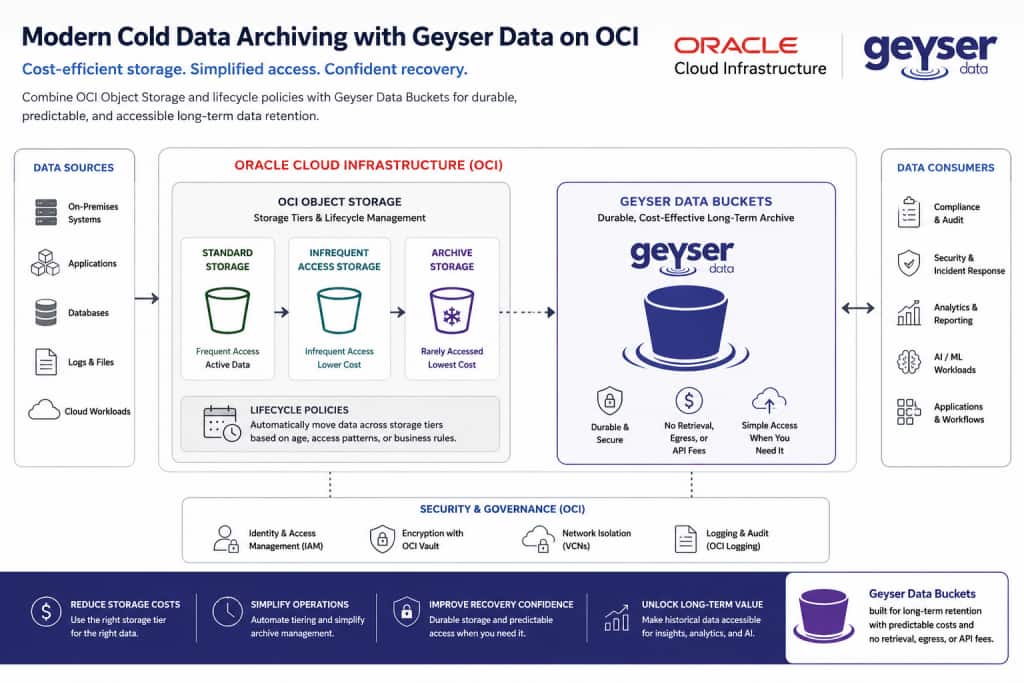
OCI Object Storage provides flexible storage tiers that help organizations balance cost and accessibility. OCI lifecycle policies can automatically move data across tiers based on age, access patterns, or business rules.
Geyser Data extends this strategy by providing dedicated archival storage optimized for long-term retention. Geyser Data Buckets offer organizations a durable, cost-efficient way to retain cold data in a simple, cost-effective, and durable way.
Together, OCI and Geyser Data help organizations:
- Reduce dependence on high-cost active storage
- Simplify archive operations and recovery workflows
- Support compliance, analytics, and security use cases
- Improve confidence in long-term retention and recovery
- Maintain predictable archive costs with no Geyser Data retrieval, egress, or API fees
This approach helps organizations preserve long-term data value without increasing operational complexity.
Architecture Framework on OCI
A typical implementation includes four major components:
Data Ingestion and Storage
Data from on-premises systems, applications, backups, and enterprise workflows can be ingested into OCI Object Storage or directed into an archive strategy using Geyser Data Buckets.
OCI lifecycle policies can automate movement between storage tiers based on retention requirements and access patterns.
Cold Data Archiving with Geyser Data
Geyser Data Buckets provide a managed archive destination designed for durable, long-term cold data retention.
Rather than managing tape infrastructure or complex archive systems directly, organizations can use Geyser Data to simplify archival operations while maintaining familiar access workflows.
Security and Governance
OCI provides enterprise-grade security capabilities that support secure archive architectures by incorporating the following security controls:
- Fine-grained access control with OCI Identity and Access Management (IAM)
- Encryption using OCI Vault
- Network isolation with Virtual Cloud Networks (VCNs)
- Auditability through OCI Logging and Audit services
These capabilities help organizations align cold data retention with governance and compliance requirements.
Data Consumers
Archived data may support:
- Compliance and audit teams
- Security and incident response teams
- Business analysts and developers
- AI and machine learning workloads
- Reporting and analytics platforms
The goal is not to make every cold dataset behave like production data. The goal is to help ensure retained data remains accessible and recoverable when the business needs it.
Key Design Considerations
Data Classification
Organizations should begin by classifying data based on business value, sensitivity, retention requirements, and expected access frequency. This helps determine whether data belongs in an OCI storage tier, or a Geyser Data Bucket.
Lifecycle Management
OCI lifecycle policies can automate data movement and reduce manual administration. Policies should be designed carefully to account for minimum retention periods, recovery expectations, access frequency and cost implications.
Predictable Archive Economics
Cold data costs can become difficult to forecast when retrieval, egress, or API fees are involved. Geyser Data Buckets help simplify cost planning with predictable pricing and no retrieval, egress, or API fees from Geyser Data. This provides organizations with clearer visibility into long-term archive growth and operational costs.
Operational Simplicity
Archived data should not require complicated manual workflows every time access is needed. Geyser Data can simplify archive operations through a managed archive platform that reduces operational burden and improves confidence in long-term recovery workflows.
Access and Recovery Confidence
A strong archive strategy should help organizations answer critical operational questions:
- Where is the data stored?
- What retention policies apply?
- Who has access?
- How is the data restored?
- What will recovery cost?
Geyser Data helps reduce archive complexity and improve confidence in long-term data accessibility.
Optional Extension: Cloud Sync for Additional Protection
Organizations seeking additional resilience can use Geyser Data Cloud Sync to create a second, independent copy of cloud bucket data. Cloud Sync can automatically synchronize OCI buckets into Geyser Data’s managed archive environment, helping organizations strengthen protection against:
- Accidental deletion
- Insider threats
- Ransomware events
Additional benefits include:
- Multi-cloud recovery options
- Restore flexibility across regions or cloud providers
- Low-cost protection for long-term cloud data
This can be especially valuable for organizations looking to strengthen recovery confidence beyond the primary cloud copy.
Common Use Cases
Regulatory Compliance and Audit
Retain historical records cost-effectively while maintaining access for future audits, legal holds, and regulatory requests.
Security and Incident Response
Archived logs and historical telemetry can support forensic investigations without requiring all data to remain in expensive active storage.
Analytics and AI/ML
Historical datasets often retain long-term value for analytics and machine learning initiatives. Geyser Data helps preserve these datasets economically.
Operational Insights
Historical transactions, application logs, and telemetry can support troubleshooting, trend analysis, and long-term operational planning.
Backup and Recovery Support
Organizations using cloud object storage for backup workflows can use Geyser Data as a durable archive layer for long-term retention.
Implementation Best Practices
Organizations can accelerate adoption with a structured approach:
- Classify Data
Identify retention requirements, business value, and expected access frequency. - Define Archive Policies
Determine which datasets should remain active, move to OCI archive tiers, or be retained in Geyser Data Buckets. - Align Storage to Business Requirements
Organize buckets based on security, retention, and organizational boundaries. - Integrate Geyser Data
Configure access controls, security policies, and operational workflows. - Validate Recovery Processes
Test restore workflows before urgent business needs arise. - Monitor Usage and Cost
Track growth, retention behavior, and archive economics over time.
Unlock the Value of Cold Data
Cold data should not become forgotten data. With OCI and Geyser Data, organizations can modernize cold data management by combining OCI’s enterprise cloud platform with Geyser Data Buckets for durable, cost-effective, and predictable long-term archiving.
Together, OCI and Geyser Data help organizations:
- Reduce unnecessary storage costs
- Simplify archive operations
- Improve recovery confidence
- Preserve long-term business value from retained data
As organizations continue to grow their data footprint, modern cold data strategies will play an increasingly important role in balancing cost, governance, resilience, and accessibility.
Get Started with Modern Cold Data Archiving on OCI
As organizations continue to retain larger volumes of historical data, modern archive strategies must balance cost efficiency, operational simplicity, security, and long-term accessibility. OCI and Geyser Data provide a flexible foundation for organizations looking to modernize cold data management without sacrificing recovery confidence or governance.
To learn more about Geyser Data and OCI, visit:
- Geyser Data OCI Partner Page
- OCI Object Storage Documentation
- Geyser Data Cloud Sync and Archive Resources
You can also explore a free trial to see how Geyser Data and OCI can help simplify enterprise cold data archiving and recovery workflows.

Manjusha Gangadharan
COO, Geyser Data