
As real-time data platforms continue to grow in scale and complexity, customers are asking for more flexibility in how they size, scale, and optimize their Apache Kafka clusters. At Oracle Cloud Infrastructure (OCI), we continue to invest in expanding the capabilities of OCI Streaming with Apache Kafka to meet the evolving needs of modern streaming workloads.
Today, we’re excited to announce two major enhancements to OCI Streaming with Apache Kafka:
- Increased storage capacity per broker from 5 TB to 16 TB
- Flexible broker shape selection with support for both ARM and x86 architectures
These enhancements provide customers with greater control over performance, cost, and scalability—making it easier to run production-grade Kafka workloads on OCI.
Why These Enhancements Matter
Kafka workloads rarely remain static. As organizations adopt event-driven architectures, real-time analytics, AI pipelines, and large-scale data ingestion, clusters must evolve to handle:
- Rapidly increasing data volumes
- Longer data retention requirements
- Diverse performance and compatibility needs
- Region-specific infrastructure availability
By expanding storage limits and introducing flexible broker shapes, OCI Streaming with Apache Kafka now supports a broader range of use cases, from cost-optimized ingestion pipelines to high-throughput, storage-heavy production workloads.
Increased Storage Capacity: Up to 16 TB Per Broker
You can now provision up to 16 TB of storage per Kafka broker, up from the previous 5 TB limit. This enhancement significantly increases the amount of data that can be retained per broker without requiring additional nodes, simplifying cluster design and reducing operational overhead.
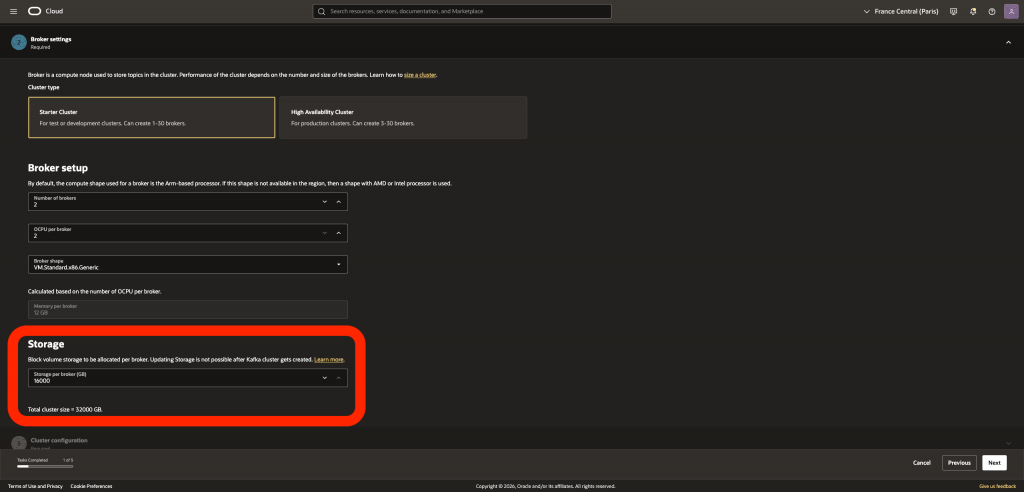
Why Customers Need Larger Broker Storage
Larger storage per broker enables customers to:
- Retain data longer without expanding cluster size
- Reduce the number of brokers needed for storage-heavy workloads
- Improve cost efficiency by minimizing infrastructure sprawl
- Simplify capacity planning for large topics and partitions
This is especially important for workloads where data retention is driven by regulatory, analytical, or operational requirements.
Common Use Cases Enabled by Larger Storage
- Change Data Capture (CDC)
Retain database change logs for extended periods while supporting replay and reprocessing. - Real-Time Analytics and Data Lakes
Stream high-volume data into analytics platforms while keeping longer historical windows available in Kafka. - AI and Machine Learning Pipelines
Store training and retraining data streams longer to support model iteration and validation. - IoT and Telemetry Platforms
Ingest continuous device data at scale while maintaining longer lookback windows for analysis and troubleshooting.
Flexible Broker Shapes: ARM and x86 Support
OCI Streaming with Apache Kafka now allows customers to choose broker shapes based on their workload and regional availability. In addition to ARM-based shapes, customers can now deploy Kafka brokers using x86-based compute shapes, including:
- ARM-based shapes (A1)
- x86-based shapes such as X9 and E5/E6 families
This flexibility allows customers to align Kafka infrastructure with application requirements, ecosystem dependencies, and cost or performance preferences.
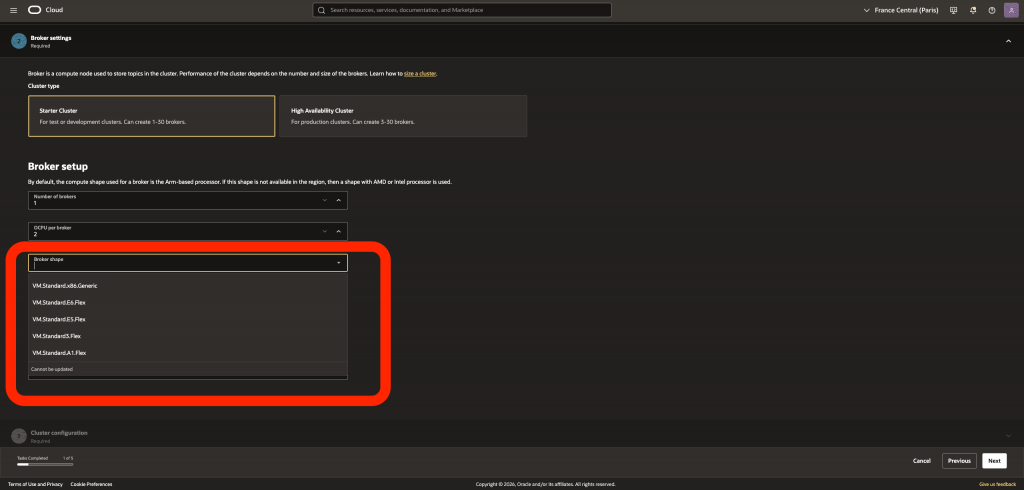
ARM vs. x86: Choosing the Right Shape
ARM-based shapes (A1) are ideal for:
- Cost-sensitive streaming workloads
- High-throughput ingestion pipelines
- Cloud-native, containerized applications
x86-based shapes (X9, E5/E6) are well-suited for:
- Workloads with native x86 dependencies
- Advanced monitoring, security, or JVM tooling
- High-memory or compute-intensive Kafka use cases
Customers can now choose the architecture that best fits their operational and performance requirements.
Regional and Realm Availability Considerations
While these enhancements significantly expand Kafka deployment options, availability may vary based on region, realm, and underlying infrastructure capacity.
- Not all broker shapes or memory configurations are available in every OCI region or realm.
- ARM and x86 availability depends on regional compute offerings.
- Storage and shape combinations may differ across commercial, government, and isolated realms.
We recommend reviewing regional service availability in the OCI Console or documentation before provisioning your cluster.
What This Means for Existing Customers
- Existing Kafka clusters continue to operate without changes.
- New clusters can immediately take advantage of larger storage and flexible shapes.
- Customers planning expansions or migrations can now design clusters with fewer brokers, higher density, or architecture-specific requirements.
Looking Ahead
These enhancements are part of our ongoing commitment to making OCI Streaming with Apache Kafka a highly scalable, flexible, and enterprise-ready managed Kafka service. We’ll continue to expand capabilities around performance, observability, networking, and security based on direct customer feedback and real-world workloads.
We look forward to seeing what you build next.
Getting Started
You can start using these new capabilities today through the Oracle Cloud Console, OCI CLI, or SDKs.
To learn more:
- Visit the OCI Streaming with Apache Kafka documentation
- Explore best practices for sizing brokers based on storage and compute needs