
Introduction
Many organizations running mission-critical applications on VMware rely on Oracle Database as the backbone for performance and reliability. As these workloads move to Oracle Cloud Infrastructure (OCI), disaster recovery becomes a key architectural concern.
In many environments, disaster recovery is handled separately: VMware tools protect applications, while database teams rely on independent mechanisms such as replication or backup strategies. While functional, this fragmented approach introduces operational complexity and increases the risk of inconsistent recovery during critical events.
The real challenge is not just protecting workloads—but ensuring that applications and databases fail over together, consistently and predictably.
OCI enables a unified solution by combining:
- Oracle Cloud VMware Solution (OCVS) for VMware workloads
- Exadata Database Service on Exascale Infrastructure (EXADB-XS) for high-performance databases
- Oracle Data Guard for continuous database replication
- VMware Live Site Recovery (VLSR) for orchestrated application recovery
Together, these services provide a coordinated, full-stack disaster recovery architecture.
Architecture Overview
To address these challenges, a cross-region architecture can be implemented where both application and database layers are protected and recovered in a coordinated manner.
- Primary OCVS and EXADB-XS deployed in Region A
- Standby OCVS and EXADB-XS deployed in Region B
- Oracle Data Guard ensures continuous database replication
- VMware Live Site Recovery orchestrates application failover
- DRG and VCN connectivity provide secure, low-latency communication
A common pitfall is designing disaster recovery independently for application and database tiers. This often leads to misaligned recovery timelines and increased operational risk during failover.
This architecture eliminates that gap by aligning both layers into a single, coordinated recovery model.
Architecture Diagram
The following diagram illustrates a coordinated cross-region disaster recovery architecture across both application and database layers.
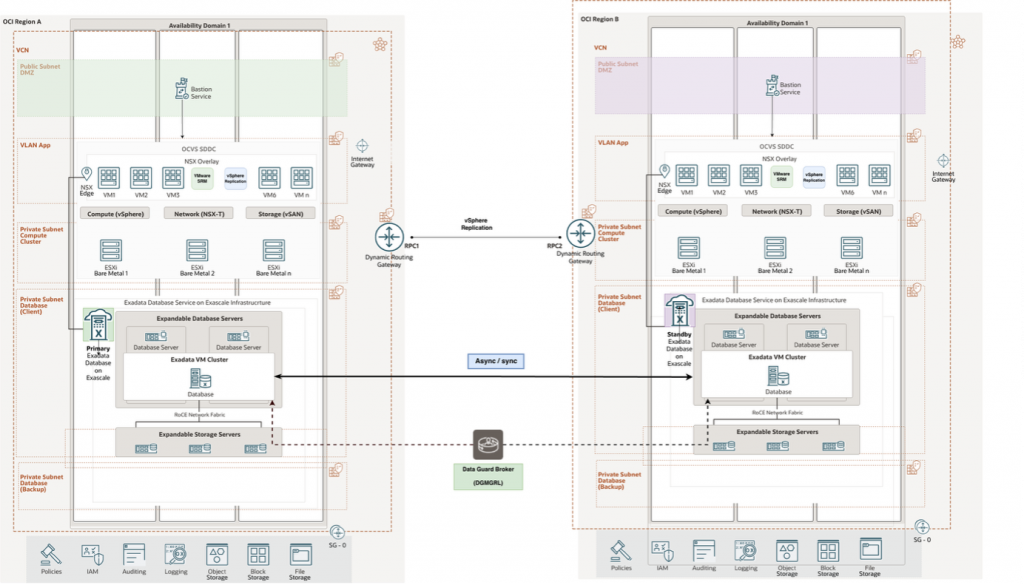
In this design:
- Region A hosts production workloads and the primary database
- Region B is fully prepared for failover
- Oracle Data Guard maintains real-time synchronization
- VMware Live Site Recovery orchestrates application recovery
- NSX-T and OCI networking ensure consistent connectivity across regions
The key value is coordination—both application and database layers fail over together, not independently.
Why Exadata Exascale Aligns with OCVS
A key requirement for enterprise disaster recovery is ensuring that database performance and availability are not compromised during failover scenarios. Exadata Exascale addresses this need while integrating seamlessly with VMware environments.
High Performance at Scale
- NVMe-based smart storage
- Low-latency RDMA (RoCE) networking
- Linear scalability for mixed workloads
Built-in Disaster Recovery
- Real-time redo apply with Data Guard
- Synchronous (zero data loss) or asynchronous replication
- Automated failover capabilities
Seamless Integration
- Private connectivity between application and database tiers
- No application redesign required
- Coordinated failover with VMware orchestration
Result: A complete, enterprise-grade disaster recovery platform for VMware and Oracle workloads.
Database Layer: Oracle Data Guard
One of the most critical risks in disaster recovery is data inconsistency. Oracle Data Guard mitigates this risk by ensuring continuous synchronization between regions.
- Primary database in Region A
- Standby database in Region B
- Synchronous or asynchronous replication
- Fast-start failover support
During a failure:
- The standby database is promoted to primary
- Database endpoints automatically switch
- Applications reconnect once recovery is complete
This ensures the database layer is always ready before application recovery begins.
Application Layer: VMware Live Site Recovery
While database recovery is critical, applications must also restart in a controlled and predictable manner. VMware Live Site Recovery ensures this orchestration.
- vSphere Replication protects virtual machines
- Recovery plans define startup order and dependencies
- NSX-T provides consistent networking
- Automated failover and failback capabilities
This coordination ensures applications come online only when the database is available, reducing downtime and recovery errors.
End-to-End Disaster Recovery Flow
- Region A failure impacts both applications and databases
- Data Guard promotes the standby database in Region B
- VLSR executes recovery plans for application workloads
- Applications reconnect to the new primary database
By coordinating these steps, organizations achieve predictable recovery times and minimal data loss.
Design Considerations
- Replication mode:
Choose synchronous for zero data loss or asynchronous for flexibility - Network latency:
Critical for Data Guard performance - Failover coordination:
Align application and database recovery processes - Testing strategy:
Regular DR testing ensures operational readiness
Failover coordination:
Align application and database recovery processes
Testing strategy:
Regular DR testing ensures operational readiness
When to Use This Architecture
- You run VMware workloads backed by Oracle Database
- You require coordinated application and database recovery
- You aim for zero or near-zero data loss
- You want consistent operations across regions
Key Benefits
- Reduced operational complexity
- Full-stack disaster recovery
- Predictable RTO and RPO
- Secure private connectivity
- Enterprise-grade performance and scalability
Conclusion
Disaster recovery is no longer just about protecting individual components—it is about ensuring that entire application stacks recover consistently and reliably.
By integrating OCVS, Exadata Exascale, Data Guard, and VMware Live Site Recovery, OCI provides a unified approach that simplifies operations, reduces risk, and delivers enterprise-grade resilience.