


Dedicated cloud investments are built for the long term. Customers need the flexibility to adapt as their business grows, without having to make every operating-model decision on day one.
Oracle Cloud Infrastructure Upgradeable Realms give eligible Dedicated Region customers a flexible, Oracle-led path to evolve their cloud operating model without starting over. Begin with the model that can meets today’s needs, then scale for greater governance and control or upgrade to Oracle Alloy and deliver branded, Oracle-powered cloud services to external customers.
What are Upgradable Realms?
The Upgradeable Realms capability is designed for eligible Dedicated Region customers whose operating needs have evolved as their organization grows, their governance requirements change, or they pursue new business opportunities.
Supported transition paths
Eligible customers can transition through the following supported paths:
- Single-Tenant Dedicated Region to Multi-Tenant Dedicated Region
- Single-Tenant Dedicated Region to Oracle Alloy
- Multi-Tenant Dedicated Region to Oracle Alloy
Each transition moves the realm fully to its target operating model. Eligibility and transition readiness are evaluated by Oracle; the available paths do not imply that every customer or realm will qualify.
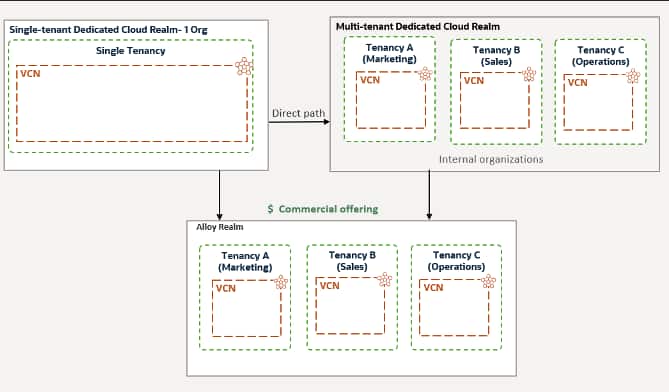
From internal cloud operations to a cloud-provider business
An organization may begin with a Single-Tenant Dedicated Region deployment for its own workloads. As its needs expand, it may need to serve multiple departments, agencies, business units, or other internal organizations through a centrally governed cloud operating model.
Multi-Tenant Dedicated Region can support that next stage of internal scale. Customers must be prepared to manage multiple internal tenancies and take on broader responsibilities for governance, administration, limits management, reporting, and first-line support. This remains a non-commercial model for the customer’s own enterprise.
For organizations ready to serve external customers, Oracle Alloy provides a distinct cloud-provider operating model. Eligible customers can offer branded, Oracle-powered cloud services; own the end-customer relationship; define offers and pricing; manage onboarding; and provide first-line support. This is a commercial and operational change, not solely an infrastructure transition.
How Upgradeable Realms work
Oracle leads each transition through a structured five-stage process, from initial assessment through readiness and execution. The process is designed to make the target operating model, customer responsibilities, and transition requirements explicit before the realm transitions to the target operating model.
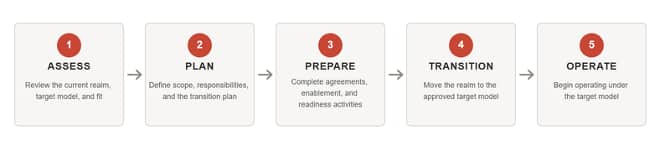
Each transition is assessed for technical readiness, operational ownership, commercial fit, and transition planning. It is a one-way move to the target operating model, not a self-service feature change or an additional layer on the existing realm.
Customer readiness depends on the target model. Multi-Tenant Dedicated Region customers need to be ready to manage multiple internal tenancies. Oracle Alloy customers need to be ready to operate a cloud business and support external customers.
When to consider an Upgradable Realm transition
Start with your organization’s governance needs. Do you need greater separation of internal workloads or more control over IT budgets and spend? Consider whether Multi-Tenant Dedicated Region fits those needs and whether your teams are ready to take on the responsibilities of managing multiple internal tenancies.
If you are considering Oracle Alloy, assess whether you have a business strategy and go-to-market plan for offering branded, Oracle-powered cloud services to external customers. Beyond the market opportunity, consider what owning the customer relationship and supporting those services would mean for your business. For either path, review the commercial and operational implications before pursuing a transition.
Learn more
- Learn more about OCI Dedicated Cloud Upgradable Realms
- Learn more about Oracle Dedicated Region
- Learn more about Oracle Alloy