
In enterprise imaging, the past is never quite past. Decades of radiology studies, cardiology cine loops, scanned documents, and increasingly, whole-slide pathology images, continue to accumulate into repositories that are both clinically indispensable and operationally complex.
Healthcare organizations are under pressure to modernize this infrastructure while improving accessibility, scalability, resilience, and interoperability across the enterprise. At the same time, imaging is expanding beyond traditional radiology workflows into pathology, specialty imaging, AI-enabled diagnostics, and broader clinical collaboration.
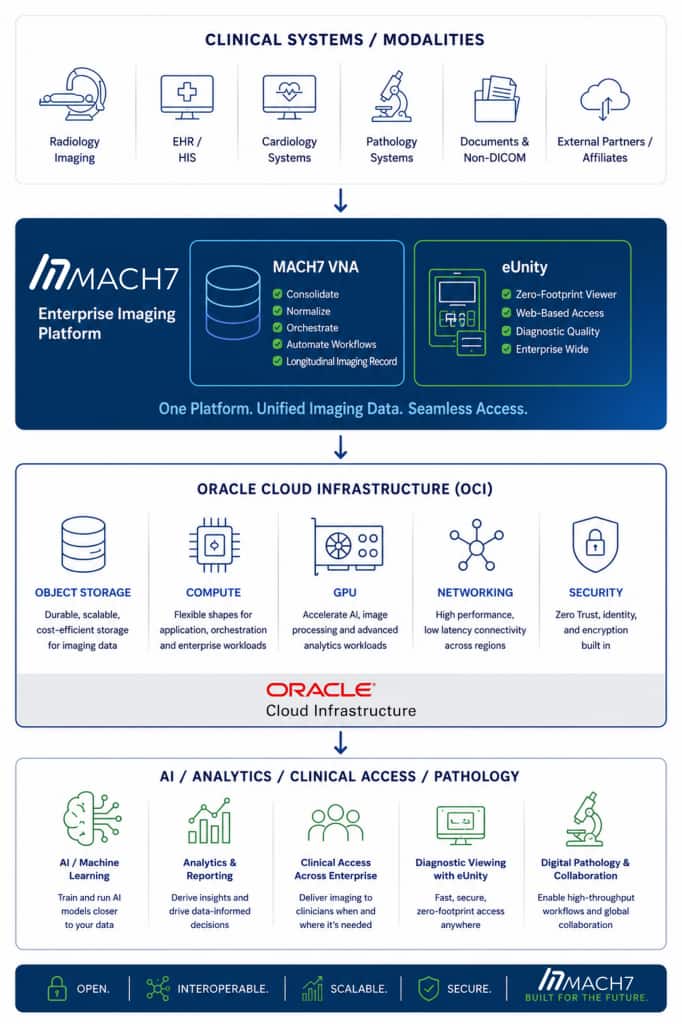
To help address these challenges, Mach7 and Oracle have collaborated to deploy the Mach7 Enterprise Imaging Platform on Oracle Cloud Infrastructure (OCI), combining Mach7 VNA and the eUnity diagnostic viewer in a scalable cloud architecture designed for modern enterprise imaging workloads.
This collaboration brings together Mach7’s expertise in enterprise imaging orchestration and access with OCI’s high-performance, secure, and cost-efficient cloud infrastructure.
From Archive to Enterprise Imaging Foundation
The Vendor Neutral Archive (VNA) originally emerged to solve a specific problem: freeing imaging data from proprietary silos and making it accessible across systems and departments. Today, however, healthcare organizations require more than centralized storage.
Modern enterprise imaging depends on the ability to consolidate, normalize, govern, and intelligently distribute imaging data across the organization.
Mach7’s Enterprise Imaging Platform is designed around this broader role. Its VNA serves as the data foundation for enterprise imaging, consolidating DICOM and non-DICOM imaging content into a unified, longitudinal patient imaging record. The platform resolves inconsistencies in patient and study data, supports standards-based interoperability, and orchestrates workflows that automatically route imaging where it is needed.
More than passive archival storage, this is active imaging data management designed to improve operational efficiency, clinical access, and continuity of care.
Mach7 eUnity, the platform’s zero-footprint diagnostic viewer, acts as the clinical access layer. Clinicians can securely access imaging across departments and locations within existing workflows, without local installs or dedicated workstation dependencies. Together, the platform enables healthcare organizations to manage, distribute, and visualize imaging data across the enterprise through a unified architecture.
Why OCI Matters for Enterprise Imaging
As enterprise imaging environments grow into petabyte-scale repositories, infrastructure decisions become increasingly consequential. Imaging workloads combine steady ingestion, unpredictable retrieval patterns, latency-sensitive clinical access, AI processing, and long-term retention requirements.
At this scale, the economics and architecture of the underlying cloud platform directly influence what organizations can realistically operationalize.
OCI introduces several advantages that align particularly well with enterprise imaging workloads.
Reducing the Friction of Data Movement
In many cloud environments, data egress charges can become an architectural constraint, discouraging replication, limiting data sharing, and complicating multi-cloud or multi-site strategies.
OCI’s materially lower data egress costs fundamentally change that equation.
For an enterprise imaging platform built around interoperability and data accessibility, lower-friction data movement is significant. Imaging data can be replicated across regions, exchanged with partner organizations, routed to downstream systems, or accessed by distributed clinical teams without the financial penalties often associated with large-scale imaging environments.
This becomes especially important in digital pathology and large-image workflows, where whole-slide image files can reach gigabyte-scale sizes and data movement is continuous rather than occasional. Organizations managing image-intensive workflows, research collaborations, educational reviews, or distributed-access scenarios all depend on high-throughput, economically sustainable access to imaging data.
Infrastructure Flexibility for Diverse Imaging Workloads
Enterprise imaging is not a single workload. Metadata indexing, image rendering, AI inference, workflow orchestration, and interoperability services each place different demands on infrastructure.
OCI’s flexible compute architecture allows organizations to independently tune CPU, memory, and GPU resources to support these varying requirements more efficiently.
Memory-intensive configurations can support metadata-heavy VNA operations. GPU-enabled environments can accelerate AI pipelines and advanced imaging workflows. Standard compute resources can efficiently support routing, orchestration, and interoperability services.
The result is infrastructure that can be aligned more precisely to operational and clinical requirements while optimizing resource utilization.
Operational Simplicity and Modernization
Beyond performance and economics, cloud deployment can simplify the operational burden associated with enterprise imaging infrastructure.
Many healthcare organizations continue to manage aging storage environments, fragmented imaging repositories, and increasingly complex infrastructure footprints. Scaling these environments on-premises often requires continuous investment in storage expansion, hardware refreshes, and operational oversight.
Deploying the Mach7 Enterprise Imaging Platform on OCI enables organizations to modernize incrementally while reducing infrastructure complexity over time.
Combined with Mach7’s vendor-neutral approach, healthcare organizations can evolve imaging strategies without requiring wholesale replacement of existing systems, supporting more flexible modernization paths across multi-site and multi-department environments.
Security Designed for Sensitive Imaging Environments
Enterprise imaging platforms centralize some of the most sensitive and widely accessed data in healthcare. At the same time, clinicians, operational teams, external partners, and AI workflows all require varying levels of access to that information.
Balancing accessibility with security is therefore a foundational architectural requirement.
OCI supports a this through a default-deny, zero-trust security approach. Communication between systems, services, and users is explicitly governed through segmented networking, granular identity controls, and tightly defined access policies.
For enterprise imaging environments, this model has practical implications.
Mach7 VNA acts as the centralized imaging data foundation, while eUnity expands secure clinical access across the enterprise. OCI’s zero-trust architecture helps reduce the risk of unintended exposure or lateral movement between systems by ensuring that access occurs only through explicitly authorized and auditable pathways.
In highly regulated healthcare environments, this level of architectural control supports both operational resilience and long-term governance requirements.
Supporting the Next Generation of Imaging Workflows
There is a broader alignment between Mach7 and OCI beyond infrastructure compatibility alone.
Mach7 is designed to help healthcare organizations eliminate dependency on proprietary imaging silos and support best-of-breed imaging ecosystems. OCI complements this approach by providing scalable infrastructure without imposing restrictive economic or operational barriers around data portability, compute flexibility, or workload design.
Together, the technologies create an environment where enterprise imaging can evolve more naturally:
- Imaging data becomes easier to access and share across the enterprise
- AI initiatives can scale beyond pilot projects
- Clinical workflows are supported by infrastructure rather than constrained by it
- Organizations gain flexibility to modernize over time while maintaining continuity
As healthcare organizations rethink imaging strategies in response to growth, digital pathology adoption, AI initiatives, and operational pressures, enterprise imaging increasingly becomes an architectural challenge as much as a clinical one.
By combining Mach7’s enterprise imaging capabilities with the scalability, flexibility, and security of Oracle Cloud Infrastructure, healthcare organizations can build a more resilient and future-ready imaging foundation for the years ahead.
Learn More About the Mach7 Enterprise Imaging Platform on OCI
Explore how Mach7 VNA and eUnity combine with Oracle Cloud Infrastructure to support scalable, secure, and future-ready enterprise imaging workflows by visiting this site or contacting an Oracle representative.
Product availability, regulatory status, intended use, and feature availability may vary by country, region, and healthcare setting. Digital pathology workflows are currently available only in the United States and are intended for reference and referral use only, not for primary diagnosis.
The information provided is for informational purposes only. Oracle does not endorse, validate, or independently review any third-party software, solutions, services, or content for compliance with applicable laws and regulations, including medical device laws.