
In the healthcare industry, providers, pharmaceutical, and biotechnology companies face an unprecedented challenge in efficiently managing and analyzing vast amounts of drug-related data from diverse sources. The healthcare industry is evolving at a rapid pace, and its data usage is growing exponentially. Currently, the healthcare industry amounts to approximately 30% of the world’s data, with that percentage growing with the advent of big data.
In the healthcare industry, it is also immensely important to protect patient and other health information privacy, align with compliance requirements, and adhere to best practices for healthcare data governance. Traditional data analysis methods prove inadequate for processing complex medical documentation that includes a mix of text, images, graphs, charts, and tables. Modern data analytics and multi-modal AI capabilities help healthcare organizations to ingest, integrate, analyze, and produce actionable intelligence from vast amounts of data.
Healthcare organizations, such as providers and payers, process a vast number of complex document formats and unstructured data that pose analytical challenges. Beyond traditional data formats, clinical study documents, research papers, and public information present an intricate blend of technical text, detailed tables, charts, and sophisticated statistical graphs, making automated data extraction and analysis particularly challenging.
An effective data platform and AI services solution helps large enterprises and drug research-based start-ups to efficiently use infrastructure and services to reduce the cost of research by allowing the use of hundreds of models, thereby improving operational efficiency by focusing energy on more value-added tasks for research scientists and AI developers.
This blog takes you through a solution to extract, analyze, and gain data-driven insights from complex research documents through a flexible choice of data processing with data privacy, security, and regulatory compliance adherence. Oracle’s integration solution for healthcare integrates and processes healthcare data formats in HL7 and FHIR to combine seamlessly with enterprise applications data. Oracle’s integration solution analyzes clinical trial data, patient outcomes, molecular diagrams, and safety reports from the research documents. It can help pharmaceutical companies accelerate their research process.
Challenges to effectively manage Healthcare Data
Data Silos
The healthcare ecosystem consists of various entities: healthcare service and patient care providers, payers, pharmaceuticals, drug makers, and clinical organizations. Healthcare organizations use vastly different types of applications and have different ways of storing, processing, and sharing data across entities, creating data sprawls and silos. This results in immense challenges regarding the ability to access, integrate, process, and generate actionable intelligence from data. Maintaining governance and security of data becomes a challenge that negatively impacts business processes, patient care, and efficient drug research.
Data Interoperability
Different formats for storing and processing data make it hard to share data across organizations. Healthcare compliance and regulatory requirements also pose challenges regarding adherence to strict data format and exchange processes, such as Health Level 7 (HL7), American National Standard Institute X12 (ANSI X12), and Fast Healthcare Interoperability Resources (FHIR). These are starkly different from the more typical data formats that healthcare organizations use in their applications, such as JSON, CSV, or XML. This creates challenges for integrating various data within organizations and communicating with other healthcare entities.
Data Privacy and Security Requirements
Healthcare data consists of personally identifiable information (PII), sensitive patient information, and health data. It is paramount for organizations to safeguard data privacy and security and to adhere to compliance and regulatory requirements. Accessing all healthcare data, integrating it, and maintaining data security, privacy, and compliance requirements remain the biggest challenges for the healthcare industry.
Data Quality and Standards
Healthcare employees in hospitals, patient care centers, and laboratories manually enter patient information and other healthcare data into multiple disconnected systems, causing data quality concerns and reducing trust in the data. Delays in finding issues with the data cause inefficiency in critical healthcare services provided to patients and take longer to provide quality healthcare to all. The lack of standardized data formats disconnected, and disparate systems used by different healthcare entities, complex and manual handling of data, and missing information cause degraded quality of patient care, increased healthcare service costs, as well as privacy and compliance concerns.
Scalability and Performance Concerns
Healthcare data is ever-growing, so applications and integration must scale to maintain performance and real-time data processing demands.
Impact of fragmented Healthcare Data
The consequences of disintegrated data silos of healthcare data, the lack of conformance to standards and delayed processing can have significant negative impact leading to:
- Poor patient care quality and delays
- Increased cost of care and operational overhead
- De-acceleration of innovation in medical research and drug discovery
Solve healthcare data management challenges on Oracle Cloud infrastructure and Data Platform
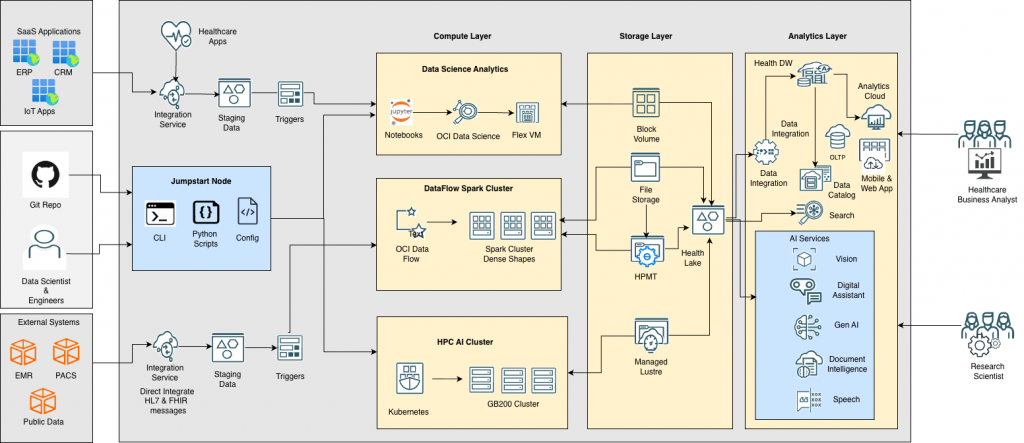
Efficient Data Integration and Interoperability:
Oracle’sintegration cloud healthcare edition is designed to help solve these healthcare data integration challenges, enabling healthcare organizations to ingest, process, combine and communicate with HL7 and FHIR data formats following healthcare industry standards and compliance requirements.
Oracle’s integration cloud healthcare edition provides the following features on top of Oracle’s integration cloud enterprise capabilities:
- Healthcare Message Editor to customize HL7 v2 message schemas with the built-in editor and includes all HL7 message versions.
- MLLP Adaptor has a new bidirectional (trigger and invoke) adapter supporting the TCP-based MLLP protocol and a native transport adapter for HL7 v2 messages.
- Healthcare Action, a new action in the OIC developer palette to provide the tools needed to parse, validate, and transform native HL7 messages in your OIC integration flows.
- FHIR Adapter (outbound) consumes external FHIR resources from your integration flows
High performance and scalable Data Processing
Oracle’s cloud infrastructure and data platform services enable healthcare organizations to choose from a variety of options for storing processing, analyzing and gaining insights from both structured and unstructured data at scale using both batch and real time processing.
Healthcare Data Staging and long-term retention
Healthcare data from disparate health systems such as healthcare pathways, EHR, EMR, providers and patient information, government and public data for research, and discovery can be ingested and stored in Oracle cloud object storage. Historical and ever-growing incremental data can be accessed from other data processing services like Big Data service, Dataflow and customized.
Data processing and Machine Learning at scale and in real time
On Oracle Cloud Infrastructure, healthcare organizations can choose from a variety of options to process data at scale and with required security and performance. Oracle Cloud Data Flow provides a fully managed open-source Spark cluster and application development platform to run Spark jobs in seconds and can auto-scale the Spark cluster on-demand.
The Oracle Cloud Infrastructure Data Science Platform is also a fully managed Platform as a Service (PaaS) for data scientists and engineers to build, train, evaluate, and implement machine learning applications using the popular JupyterLab notebook, launching jobs in predefined on-demand clusters of CPU or GPU VMs. This enables the process from model development to production use to occur quickly by using MLOps capability, model management, version control, repository automated pipelines, model deployments, and monitoring features.
You can also connect data science notebook sessions with Data Flow to run distributed computation, combining a user-friendly notebook developer interface and tooling of data science and Data Flow kernel as the compute environment, taking advantage of PySpark, Pandas API, MLlib, or SparkSQL with customizable Conda and Spark environments.
Data Management and Storage at Scale
Big Data processing requires fast data retrieval and data processing in petabytes of data in seconds. For data science, AI and ML applications which are IO latency and throughput sensitive, it is imperative to store and access data in a high-performance data store that can scale independently of the compute.
Oracle’s cloud big data provides scalable HDFS compliant data store to run big data applications using MapReduce framework for large batch data processing. You can flexibly choose scalable file storage and high-performance mount target to get 1 Gbps of read throughput of 1 tb file storage, up to 80 Gbps on an 80 TB file storage at no extra cost. Oracle also offers fully managed open-source Lustre for large scale distributed AI training for low latency and high throughput up to 1 Gbps per provisioned terabytes of storage and inference applications. Healthcare Biomedical Research, Drug Discovery and Genomic Data Analysis run large language models on hundreds and thousands of GPU cluster using terabytes of data a scale using Lustre file storage scaling to multiple PBs.
Oracle’s cloud provides a fully managed scalable autonomous data warehouse to build a health lake warehouse, use developer tools like oracle data integration, data loading open-source tools to develop extract, load and transform applications. You can use Oracle Data Catalog, a fully serverless catalog service, to store, process and manage metadata across all data services on OCI.
Data Analytics and Intelligent Apps
Healthcare customers can easily develop and implement web and mobile analytics applications on top of Oracle Cloud flexible infrastructure. You can use Oracle Cloud self-service analytics for data visualization and analytics, integrated with built-in machine learning and Oracle GenAI capabilities. Medical professionals including doctors, nurses, and pharmacists can leverage advanced AI capabilities using embedded AI and a Generative AI Assistant to move from data to decisions, improve productivity, and deliver actionable intelligence.
Healthcare industries can use fully managed Oracle GenAI services to seamlessly integrate GenAI capabilities in a wide range of use cases, for example:
- Automate summarization of clinical notes, discharge instructions, and referrals.
- GenAI models used in medical imaging, including detecting patterns and identifying anomalies.
- Biomedical pharma and biologists use AI to accelerate the identification of potential drug candidates, simulate molecular interactions, and design novel compounds.
- The GenAI service can help to analyze versatile data from patient history and can assist physicians in recommending tailored personalized treatment plans and care.
Conclusion
The timely availability, accuracy and quality of healthcare data is crucial for patient care, disease management, drug discovery and accelerating innovation by using artificial intelligence. Oracle’s cloud infrastructure brings flexible, scalable and highly secured services to fuel growth, accelerate innovation and address compliance and healthcare industry standards.
If you would like to learn more about Oracle cloud infrastructure, Data platform and AI services please use the links here.
Oracle Healthcare Cloud Infrastructure
Oracle Integration for Healthcare
Design Data Lakehouse on Oracle Cloud
Oracle Cloud Generative AI services