
Architecture recommendations for data-exfiltration controls, sensitive workloads, and per-service access with existing application URLs.
Object Storage holds some of an organization’s most valuable data: database backups, analytics datasets, application artifacts, and files exchanged with partners. Choosing how applications reach that data is an important security design decision.
The A-Team’s Service Gateway vs Private Endpoint vs Private Service Access in OCI: A Practical Decision Guide identifies Private Service Access (PSA) as the preferred starting point for many security-sensitive Object Storage workloads. Its Object Storage note highlights three restrictions: PSA blocks anonymous access, cross-tenancy pre-authenticated requests (PARs), and credentials from foreign tenancies. Together, those restrictions explain why PSA offers more than private connectivity for these workloads. The PSA path includes an IAM authentication (auth) check for signed requests, tying access to a valid identity in the PSA’s tenancy. Object Storage still applies the IAM permissions that authorize the requested resource operation.
This blog takes that Object Storage recommendation a level deeper. It explores how those access restrictions inform architecture choices for data-exfiltration controls, sensitive backups and datasets, and approved partner sharing. It also explains how per-service network controls can be introduced while applications retain supported service URLs, and where an integration’s identity or access requirements call for a different pattern.
The recommendations are intended for cloud architects, network and security engineers, and application owners designing Object Storage access. Each use case connects a business requirement to the identity, resource permissions, DNS, and network controls that belong in the design. PSA’s restrictions apply to requests using its path; a complete security architecture also accounts for IAM permissions and alternative egress paths.
For background on PSA itself, read Announcing Private Service Access: Fine-Grained, Private Connectivity for OCI Service Access, written by my colleague Brandon Beck. The A-Team decision guide provides the broader connectivity comparison; this article builds on its Object Storage recommendation through focused architecture use cases.
Object Storage use cases
Limit unapproved data transfers across tenancy boundaries
A workload that handles corporate data should have an approved set of storage destinations. PSA strengthens that boundary by rejecting foreign-tenancy credentials and foreign-tenancy pre-authenticated requests (PARs) on its Object Storage path. This makes it useful when the security objective includes preventing a workload from using an unrelated tenancy’s API keys or upload PAR as a transfer destination through that connection.
Design recommendation: Combine PSA’s credential boundary with least-privilege IAM and an egress architecture that accounts for alternative network paths. PSA does not prevent every form of data exfiltration. An authorized source-tenancy principal can still access a foreign bucket through cross-tenancy IAM, so approved resource destinations matter alongside credential ownership. See Object Storage PSA behavior.
Protect database backups, artifacts, and sensitive datasets
Backup pipelines, software distribution systems, and analytics platforms often need Object Storage from private subnets. PSA provides a private destination whose reachability can be governed by the network and security teams, while IAM limits each workload to the buckets and operations appropriate to its role.
Design recommendation: Separate backup writers, restore readers, artifact consumers, and analytics principals according to their data responsibilities. Pair endpoint controls with bucket permissions, encryption, retention, and credential lifecycle policies. A private connection contributes to this design; data protection also depends on who can read, change, or delete the stored objects.
Apply per-service controls without changing application URLs
An application may already use a supported regional Object Storage hostname, while the security team wants tighter controls over its service access. With PSA DNS mapping, the hostname resolves to the PSA private IP. The application can retain its supported service URL, and the network team can govern endpoint reachability through NSGs and, where configured, ZPR policies.
Design recommendation: Treat the supported hostname and private DNS resolution as part of the application’s architecture contract. Account for the hostnames used by its SDKs and integrations, along with authentication dependencies. Design PSA access around both its service-level network controls and its IAM auth check. Object Storage IAM policies define the allowed buckets and operations. Retaining the URL reduces application configuration changes; the identity and authorization model still needs to fit the workload. See the Oracle PSA overview.
Enable approved analytics across partner tenancies
An analytics application in tenancy A needs a dataset owned by a partner in tenancy B. A’s principal can use A’s PSA when matching Endorse and Admit policies authorize that principal to read B’s bucket. The partner retains control of the resource, and the application can use its own tenancy’s identity rather than holding the partner’s API keys.
Design recommendation: Prefer this identity model when the consuming organization should own the workload identity and the data owner should control which datasets it shares. Scope the relationship to the required group, bucket, and operations. Treat credential tenancy and resource tenancy as separate design decisions; a foreign resource does not inherently require foreign credentials.
Support integrations that require destination-tenancy credentials
Some partner integrations require a principal from the resource-owning tenancy. Those credentials cannot use a PSA owned by the consumer tenancy. An Object Storage private endpoint (PE) can support this requirement when its access targets permit the destination namespace and resources and the principal has the necessary IAM permissions. The consumer tenancy retains control over the storage destinations reachable through the PE. Access targets can limit requests to approved namespaces, compartments, and buckets, blocking transfers through that endpoint to destinations outside the allowed scope—even when the workload uses valid destination-tenancy credentials.
Design recommendation: Choose the identity model before selecting the endpoint. When destination-tenancy credentials are a fixed requirement, allow for the PE’s custom hostname in the client design and for the associated credential ownership and rotation responsibilities. The A-Team decision guide provides the broader access-model context.
Give application tiers a defined bucket scope
A processing tier may need an ingestion bucket, while a reporting tier should read a separate dataset. PSA supplies the Object Storage service connection, with IAM defining each tier’s permitted resources and operations. A design that also requires a dedicated endpoint with namespace, compartment, and bucket access targets may benefit from Object Storage PE.
Design recommendation: Keep service reachability and data authorization distinct. PE access targets add an endpoint-level resource restriction; they do not grant IAM permissions. PSA and Object Storage PE give the endpoint-hosting tenancy different controls over storage access. PSA enforces the caller’s credential-tenancy boundary, while PE access targets restrict the namespaces, compartments, and buckets reachable through the endpoint. Both help constrain transfers to untrusted destinations when combined with appropriate IAM and egress policies. Separately, creating either endpoint does not make a bucket accessible only through that connection; bucket access through other paths requires its own policy controls. See Object Storage PE access targets.
Extend sensitive Object Storage access to on-premises workloads
An enterprise may want on-premises backup or data-processing systems to use the same Object Storage service as OCI applications. PSA can be reached over an appropriately designed FastConnect private-peering or Site-to-Site VPN connection, with private routing and DNS resolution aligned to the endpoint.
These protections apply to requests that use the PSA path. An on-premises workload may also have internet access or another route to Object Storage, so private connectivity alone does not constrain every storage destination it can reach. The design should account for those alternate paths and retain the applicable network-based access controls. Where resource access must depend on the originating corporate network, OCI IAM network sources can express approved public IP ranges or VCN sources in resource policies. This is a separate policy mechanism rather than a feature supplied by PSA.
Design recommendation: Include hybrid connectivity, DNS ownership, workload identity, and storage permissions in the same architecture. On-premises clients need a DNS resolution path for the supported Object Storage hostname to the PSA private IP, as well as network reachability to that address. Consider availability and capacity across both the WAN connection and the resolver path.
The A-Team blog OCI Private DNS – Common Scenarios explains private resolver endpoints, forwarding rules, and integration with on-premises DNS. Its hybrid patterns complement the A-Team decision guide’s connectivity discussion.
Account for PAR workflows and public-download dependencies
A same-tenancy PAR can support an approved read or upload workflow through PSA, subject to its scope and validity. Foreign-tenancy PARs are rejected through PSA. Anonymous reads based on public bucket visibility are also rejected, including public buckets in the PSA’s tenancy; an authorized same-tenancy authenticated request can still access the bucket.
Design recommendation: Classify integrations by their authorization model: authenticated identity, same-tenancy PAR, foreign PAR, or anonymous download. Treat PAR URLs as authorization capabilities with deliberate scope and lifetime. Software distribution and partner exchanges that depend on unsigned requests may need authenticated access or a separately approved connectivity pattern. These dependencies can influence the architecture even when application URLs remain unchanged.
Plan for sustained backup and analytics throughput
Large backup windows, restore objectives, and concurrent analytics transfers can make capacity a deciding factor. Object Storage PSA and PE each support up to 25 Gbps per endpoint. End-to-end throughput also depends on clients, concurrency, and the network path.
Design recommendation: Size the service connection around peak aggregate demand, recovery requirements, and growth. Retain Service Gateway as a design option when throughput requirements warrant it, with the security implications of that path included in the decision. Refer to the A-Team decision guide and current service documentation for the broader tradeoffs.
Design the complete Object Storage control boundary
A sound design answers three questions: which workloads can reach Object Storage, which identities can perform which operations on which resources, and which alternative paths remain available. PSA combines a service-specific private access point with identity-aware enforcement. These controls contribute different parts of the access decision:
- Network reachability: Security rules, NSGs, and ZPR policies, where configured, govern which workloads can reach the PSA endpoint.
- PSA IAM auth check: For signed API requests, IAM authentication establishes the caller’s identity, and the PSA path enforces that the credentials belong to the PSA’s tenancy. Valid credentials from another tenancy are rejected on this path. Reaching the private IP alone is insufficient.
- Object Storage resource authorization: IAM policies determine whether the authenticated principal may perform the requested operation on the bucket or object. Approved cross-tenancy resource access uses matching Endorse and Admit authorization while retaining the source-tenancy identity.
Design recommendation: Combine the PSA IAM authentication and credential-tenancy check with Object Storage resource permissions and network reachability controls. Security rules, NSGs, and ZPR policies, where configured, govern access to the endpoint; IAM governs the permitted resource operations. An accepted source identity does not automatically gain access to every bucket. Same-tenancy PARs use the PAR’s authorization and scope rather than a signed caller identity; foreign PARs and anonymous public-bucket reads remain blocked through PSA.
Where policy requires a designated PSA path, the architecture also needs the documented IAM and network controls that enforce that requirement. Creating an endpoint does not remove public service endpoints or other egress options. Brandon’s announcement explains PSA’s identity integration and IAM Deny controls, and the A-Team guide covers security and coexistence considerations.
Figure 1. Animated Object Storage request and IAM auth flow
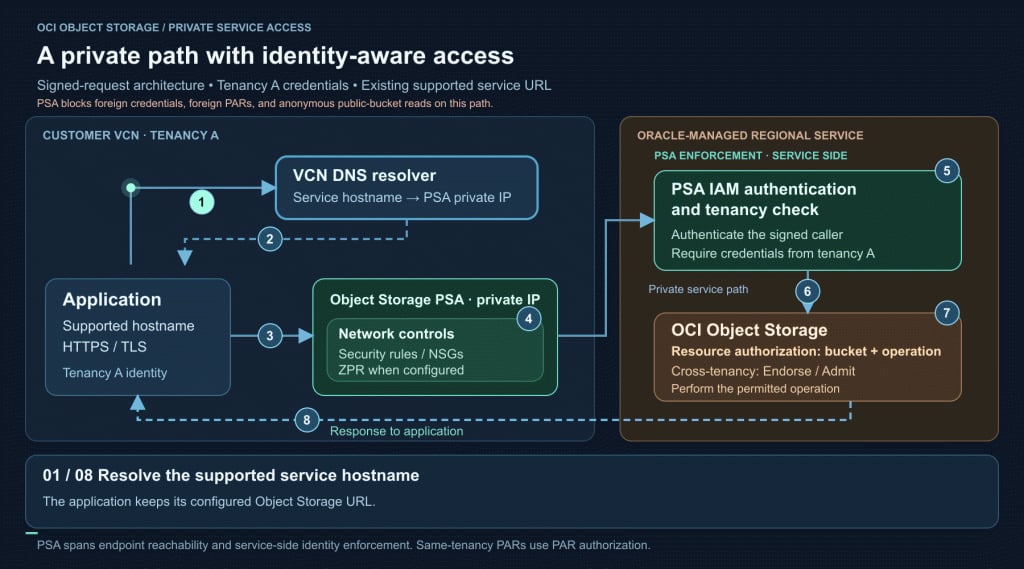
Numbered flow: 1. Resolve the service hostname; 2. Return the PSA private IP; 3. Send the signed HTTPS request; 4. Apply network controls; 5. Perform the service-side PSA IAM authentication and tenancy check; 6. Continue to Object Storage over the private service path; 7. Authorize the Object Storage operation; 8. Return the response.
Design approved cross-tenancy sharing around the source identity
PSA is designed to prevent unapproved cross-tenancy access through its private path by blocking foreign-tenancy credentials and cross-tenancy PARs. However, legitimate use cases, such as reading a partner-owned analytics dataset, require private access to Object Storage resources in another tenancy. The architectural distinction is between using another tenancy’s credentials and using an approved local identity to access another tenancy’s resources. PSA blocks the former on its path; OCI cross-tenancy IAM can authorize the latter.
The identity model determines the appropriate private-access pattern. The following designs cover the two requirements: a consumer that retains its own identity, and an integration that must use credentials from the resource-owning tenancy.
Use the consumer’s identity for approved partner data access
Consider a partner analytics architecture in which tenancy A owns the application, its IAM principal, and the Object Storage PSA endpoint. Tenancy B owns the namespace, bucket, and shared dataset. The application signs its request with A’s credentials while identifying B’s namespace and bucket as the resource destination.
The identity belongs to A; the resource belongs to B. Matching Endorse and Admit policies establish the sharing relationship: A endorses its source principal, and B admits that principal to the selected resources. The PSA IAM auth check retains the source-tenancy credential boundary, while Object Storage evaluates the cross-tenancy resource permissions. The consumer can manage its own workload identity without holding the partner’s API keys, and the partner retains authority over its data.
Design recommendation: Choose a supported workload identity appropriate to the application, such as an instance principal associated with a dynamic group for a VM workload, rather than assuming that partner data requires partner API keys. Keep authorization limited to the intended source principal, destination bucket, and operations. A read-only analytics relationship should remain distinct from ingestion, write, or delete permissions. The source organization owns its identity and Endorse authorization; the resource owner owns its Admit authorization, defined in the target tenancy’s root compartment, with resource scope limited as required.
Object Storage is a regional service. Access to B’s bucket through A’s PSA does not, by itself, require VCN peering with B or a PSA endpoint in B. The architecture relies on A’s private path to Object Storage and the explicitly authorized relationship between A’s identity and B’s resources.
Figure 2. Animated source-identity access to a partner-owned bucket
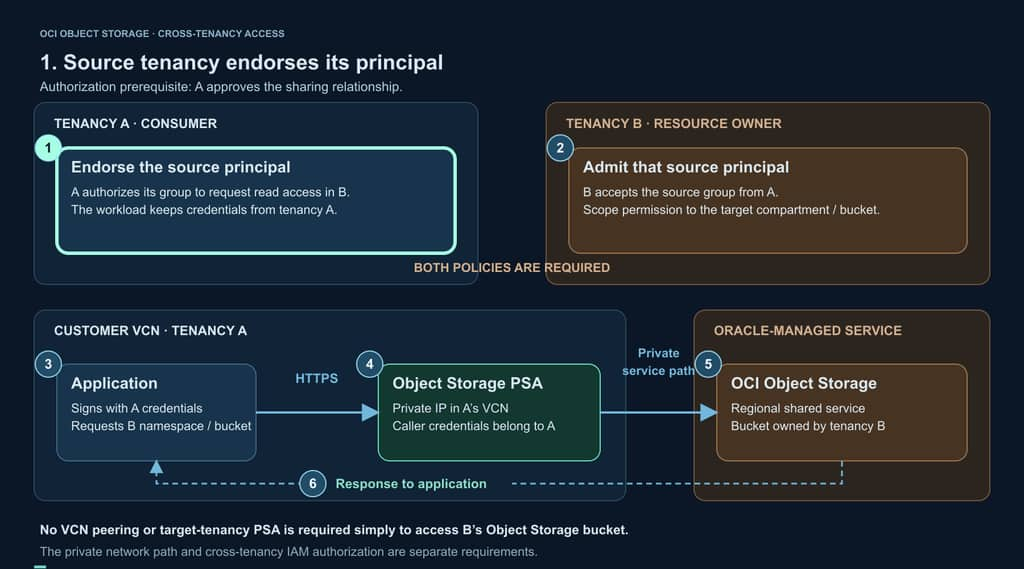
Numbered flow: 1. Source Endorse policy; 2. Destination Admit policy; 3. Application signs with the source identity; 4. PSA applies its IAM auth and credential-tenancy check; 5. Object Storage authorizes the destination resource operation; 6. Response returns to the application. Callouts 1 and 2 are authorization prerequisites for the request path shown in 3–6.
Use a private endpoint when the integration requires partner credentials
A different requirement arises when the workload in A must authenticate with credentials from B. Those credentials cannot use A’s PSA. An Object Storage private endpoint in A’s VCN can support this pattern when its access targets permit B’s namespace and the relevant compartments or buckets, and B’s principal is authorized for the requested data operation.
Design recommendation: Reserve this pattern for integrations whose identity requirements call for it. The architecture includes endpoint reachability, explicit client use of the PE’s custom hostname, appropriate access-target scope, and ownership of the partner credential lifecycle. Scope the PE’s access targets to the approved partner resources so that accepting partner credentials does not open that endpoint to unrelated storage destinations. B’s IAM policies still govern what its principal can do. If the same PE also serves A’s local Object Storage requirements, its access-target design must account for both namespaces.
These two patterns preserve an explicit trust relationship. PSA supports approved cross-tenancy resources while keeping the caller identity local to the PSA’s tenancy. PE accommodates the separate requirement to use a foreign-tenancy identity. The cross-tenancy Object Storage documentation describes the authorization model, while the A-Team decision guide supplies the broader connectivity context.
Match Object Storage capabilities to the design objective
| Design objective | Recommended pattern | Architectural consideration |
|---|---|---|
| Per-service private access with existing supported URLs | PSA with private DNS and endpoint network controls | PSA’s service-side IAM authentication and credential-tenancy check constrains callers; Object Storage IAM defines resource permissions. DNS selects the private destination. |
| Restrict foreign credentials and foreign PARs on the Object Storage path | PSA combined with least-privilege IAM and egress controls | Approved cross-tenancy resource access and alternative network paths remain separate policy decisions. |
| Read a partner-owned dataset using the consumer’s identity | Consumer-tenancy PSA with matched Endorse/Admit authorization | Both organizations govern the sharing relationship; the data owner controls resource scope. |
| Use credentials belonging to the resource-owning partner | Object Storage PE with appropriate access targets and IAM | Access targets restrict transfers through the PE to approved destinations. The client design includes the PE hostname and partner credential lifecycle. |
| Add endpoint-level namespace, compartment, and bucket restrictions | Object Storage PE access targets alongside IAM | Access targets supplement authorization and do not make the bucket exclusive to that endpoint. |
| Use PAR-based exchange or anonymous public downloads | Same-tenancy PARs can fit PSA; other authorization models need an appropriate approved pattern | Foreign PARs and anonymous public reads cannot use PSA. |
| Reach Object Storage from an on-premises application | PSA over private hybrid connectivity with integrated private DNS | WAN availability, private DNS, capacity, and identity ownership are part of the design. Alternate internet or storage paths need their own egress and resource controls. |
| Support large backup and analytics transfer windows | Capacity planning across the complete path; consider SGW where demand warrants it | PSA and PE support up to 25 Gbps per endpoint; connectivity choice also affects security controls. |
Final Thoughts
Private Service Access gives Object Storage architectures a private, service-specific access point while applications retain supported service URLs. Its IAM auth and credential-tenancy check, together with the restrictions on foreign-tenancy PARs and anonymous public-bucket reads, make it especially useful for security-sensitive workloads and data-exfiltration controls. Network reachability, caller identity, and bucket permissions remain distinct parts of the design.
These controls support secure backups, artifact delivery, and analytics. They also govern access across application tiers, on-premises systems, and PAR-based exchanges. The right access pattern depends on DNS, connectivity, performance needs, and application requirements. Least-privilege IAM and deliberate egress controls complete the architecture around the PSA endpoint.
Approved partner sharing depends on the identity model. A workload can use its source-tenancy identity through PSA to access another tenancy’s bucket when matched Endorse and Admit policies authorize the operation. When an integration requires the resource owner’s credentials or endpoint-level resource restrictions, Object Storage private endpoints provide another design option. Clear ownership of workload identities, DNS and connectivity, endpoint controls, and data permissions keeps these relationships manageable as applications and datasets evolve.
For supported services and recommended practices, explore the Private Service Access overview. For technical concepts, service-specific considerations, and endpoint management guidance, see Private Service Access in the OCI Documentation Portal.