
Kafka-compatible streaming can separate compute from object storage. This post outlines deployment considerations for running WarpStream on Oracle Cloud Infrastructure (OCI) with private Kubernetes, Oracle Cloud Infrastructure Object Storage, layered security, operational telemetry, and cross-region recovery considerations.
Teams modernizing event streaming often want the familiar Kafka producer and consumer experience while separating compute scaling from object-storage management. A cloud-native Kafka-compatible platform such as WarpStream can support that goal, but it still needs an intentionally designed production foundation: network paths that match each client population, durable object-backed storage, defined identity and certificate management procedures, and a clear plan for observability and recovery.
This post walks through a practical OCI reference architecture for deploying WarpStream. It is designed for organizations that want to bring their Kafka applications and operating model to OCI while keeping Kafka client access private unless external access is explicitly configured. Document required egress to the WarpStream control plane and other service dependencies.
The architecture: private access by design, with deliberate Kafka access paths
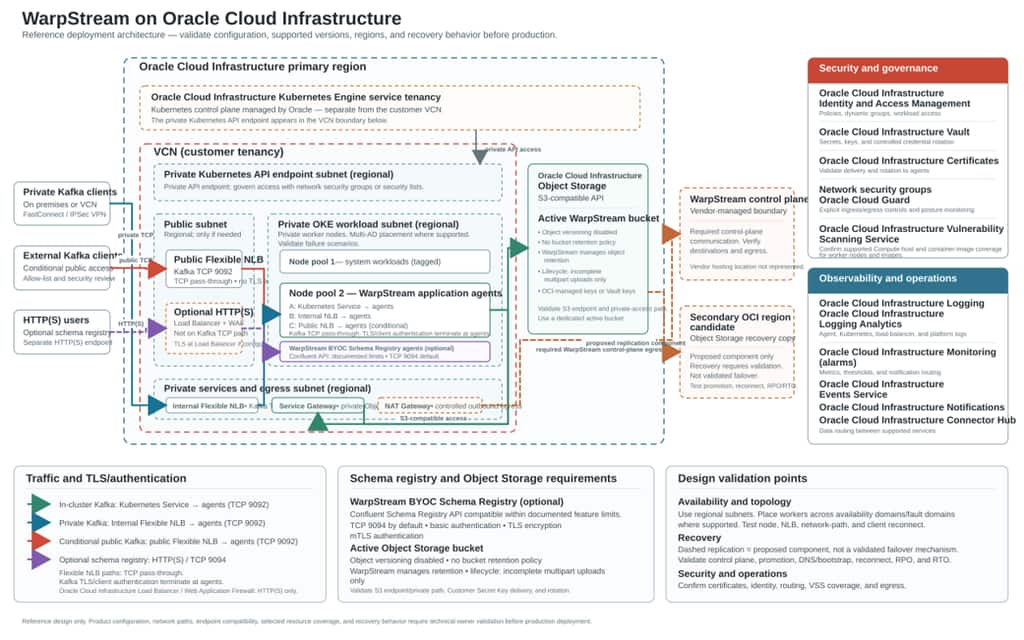
At the center of the design is a private Oracle Cloud Infrastructure Kubernetes Engine (OKE) cluster. The OKE control plane is managed by OCI in the OKE service tenancy, with a private Kubernetes API endpoint in the VCN; the worker nodes and WarpStream agents run in private regional subnets. Spread the workload across availability domains where the selected region supports multiple availability domains, and use Kubernetes pod-distribution rules to avoid concentrating replicas on a single node or failure domain.
The key design choice is to separate access paths by client type rather than forcing every Kafka client through one endpoint:
- In-cluster clients use a Kubernetes Service or direct pod connectivity on TCP 9092. This keeps internal traffic local to the cluster and avoids an unnecessary load-balancer hop.
- Private virtual cloud network (VCN) clients use an internal Oracle Cloud Infrastructure Flexible Network Load Balancer (NLB) on TCP 9092. This gives applications in the VCN a stable private endpoint for Kafka client traffic.
- External clients, when required, use a public NLB on TCP 9092 with TLS and authentication. Place the public NLB in a public subnet and apply an allow-listing, routing, and security review before enabling it. A web application firewall can be evaluated for supporting web-facing endpoints, but Kafka TCP data-plane protection should be designed with network controls, TLS, and identity rather than assumed to be covered by an HTTP-focused control.
This load balancer is a fit for the Kafka data plane because it operates at layers 3 and 4 and supports TCP. For Kubernetes Services of type LoadBalancer, OKE can provision an NLB; production implementations should explicitly manage the associated network security groups (NSGs) and security rules.
Build the OKE data plane for independent scale
Use dedicated OKE node pools to help limit resource contention between the streaming data plane, Kubernetes system components, and observability workloads. A useful baseline is one tagged system node pool, one application node pool for WarpStream agents, and one observability and platform node pool. The application pool runs stateless WarpStream agents, enabling horizontal scale: any healthy agent in the virtual cluster can serve a topic partition, so capacity can grow by adding replicas and nodes subject to workload testing and applicable service limits.
Configure the application group with a Horizontal Pod Autoscaler (HPA) based on the signals that matter to the workload, such as CPU and network-related indicators, and use PodDisruptionBudgets to help limit maintenance-related disruptions. Use readiness and liveness probes, topology spread constraints, and resource requests and limits. The result is a data plane that can be updated or expanded with less dependence on any individual node.
Use OCI Object Storage as the durable storage layer
The reference design uses an OCI Object Storage bucket as the durable data layer, accessed through the Amazon S3 Compatibility API. That matters operationally because applications and platforms built for an S3-compatible object interface can be configured to use OCI endpoints while retaining their object-storage integration pattern. Confirm the required S3 API calls and client settings during a proof of concept; for example, OCI supports Signature Version 4, and its documentation lists the supported bucket, object, multipart, and tagging APIs.
Treat the bucket as a production data asset. Follow WarpStream’s documented bucket configuration requirements. Do not enable object versioning on the active WarpStream bucket; let WarpStream manage data retention and object deletion. Do not configure bucket retention policies or manually delete WarpStream-managed objects. Limit bucket lifecycle policies to supported cleanup of incomplete multipart uploads. Evaluate immutable-retention requirements separately with the product teams. Encrypt data at rest using OCI-managed keys or keys in Oracle Cloud Infrastructure Vault, according to the organization’s key-management standard. Use a supported private access path to Object Storage and validate its compatibility with the selected S3 endpoint and network design.
Evaluate cross-region bucket replication as one component of a proposed disaster-recovery design to be validated with WarpStream. The recovery plan should include more than data replication: validate WarpStream control-plane and metadata dependencies, document DNS or bootstrap changes, validate how clients reconnect, test the promotion procedure, and measure observed data loss and recovery time against the agreed recovery point and recovery time objectives.
Connect enterprise producers and consumers without flattening the trust boundary
Many Kafka estates are hybrid. In this design, applications running on premises connect to OCI through Oracle Cloud Infrastructure FastConnect or an IPSec VPN. The VCN provides the routing boundary, with separate public and private subnets, including the combined private-services and egress subnet shown in the diagram. Keep all OKE worker nodes private; use a NAT gateway only for controlled outbound access from private workloads, and use Oracle Cloud Infrastructure Bastion for privileged administration instead of assigning public addresses to nodes.
An optional schema registry endpoint can be exposed separately, using the port supported by the chosen registry configuration, so that it has its own authentication, authorization, and network policy. This separation is useful because Kafka data traffic and schema-management traffic typically have different consumers, access patterns, and audit requirements.
Make security controls part of the platform
Production streaming services need defined security controls. Start with Oracle Cloud Infrastructure Identity and Access Management (IAM), federated single sign-on for administration, and least-privilege policies. Use dynamic groups only where supported by the selected integration. Workloads should receive only the permissions needed to access their bucket, keys, certificates, and telemetry destinations. Configure Customer Secret Key authentication for the Amazon S3 Compatibility API, with controlled credential delivery and rotation. Avoid hard-coding cloud credentials in images or pod manifests.
OCI Vault can store secrets and encryption keys, while Oracle Cloud Infrastructure Certificates can support certificate lifecycle management; confirm how certificates are delivered and rotated at the selected TLS endpoints. Configure NSGs and explicit security rules for load balancers, nodes, and private services. Then layer in Oracle Cloud Guard and vulnerability scanning for posture and exposure visibility for supported resources. These controls complement Kubernetes hardening; they do not replace image governance, admission controls, or application-level authorization.
Operate the service as a measurable system
The architecture includes Prometheus, Grafana, Fluent Bit, Metrics Server, and kube-state-metrics on a dedicated OKE observability node pool. Together, these components provide Kubernetes and application telemetry close to the workload. Oracle Cloud Infrastructure Logging and Oracle Cloud Infrastructure Logging Analytics can retain and analyze operational signals, while Oracle Cloud Infrastructure Monitoring supports metric-based alarms. Monitoring alarms and Oracle Cloud Infrastructure Events Service can trigger Oracle Cloud Infrastructure Notifications, and Oracle Cloud Infrastructure Connector Hub can route data between supported services.
The operational objective is simple: identify an unhealthy agent, an elevated client error rate, a saturation trend, or an object-storage access failure before it becomes an application incident. Define alert thresholds from real workload baselines, include owner and runbook information in notifications, and run failure exercises for an agent loss, a node loss, a load-balancer path failure, and a regional recovery.
A concise implementation checklist
- Create the VCN, private OKE cluster, regional subnets, NSGs, and hybrid connectivity paths.
- Deploy separate OKE node pools for system components, WarpStream agents, and observability services.
- Expose only the needed client routes: in-cluster service, private NLB, and—only when justified—public NLB with TLS and authentication.
- Create the Object Storage bucket and configure the S3-compatible endpoint, encryption, and WarpStream-compatible bucket settings.
- Validate the proposed cross-region recovery design with WarpStream and test a documented recovery procedure.
- Implement least-privilege access, supported authentication, managed secrets, certificate handling, Oracle Cloud Guard, and vulnerability scanning.
- Instrument the platform, set alarms and notifications, and validate horizontal scaling, pod disruption, and failure scenarios before production cutover.
Conclusion
A WarpStream deployment on OCI is not simply a Kubernetes installation. It is a streaming platform built from a private OKE data plane, client-specific Kafka access paths, S3-compatible durable storage, hybrid networking, layered network and identity controls, and configured telemetry. By making these layers explicit and validating them with representative workloads, teams can assess scalability, operational visibility, and regional recovery for their deployment.
Design each deployment around application dependencies, data residency requirements, throughput expectations, and planned maintenance windows. Validate producer and consumer compatibility, security controls, and data integrity with representative workflows before moving into production. For each deployment, define workload-specific acceptance criteria, monitor end-to-end data flows, and maintain a tested rollback plan before go-live.
Further reading
OCI Object Storage Amazon S3 Compatibility API Support
Provisioning OCI Network Load Balancers for Kubernetes Services
Managing Custom Gold Images on OCI for Secure and Compliant Compute Launches