
When situations evolve quickly, teams need fast communication and shared context to coordinate an effective response. Field personnel need efficient ways to exchange information, while command teams need visibility into what is happening so they can make informed decisions and coordinate next steps.
Oracle Radio provides field and command teams with a shared communications environment that can help them stay connected as operations unfold, exchange information, and maintain visibility into ongoing activity.
Every transmission counts. So does the context.
A voice transmission may last only seconds, but the information it carries can remain important long after the exchange ends. Teams need to communicate in the moment, revisit information later, and understand activity across channels.
Oracle Radio is an OCI-native communication service that extends familiar push-to-talk communications with capabilities such as channel activity, message history, and personnel location information when available and authorized. That combination allows information exchanged in the moment to remain useful as an operation progresses.
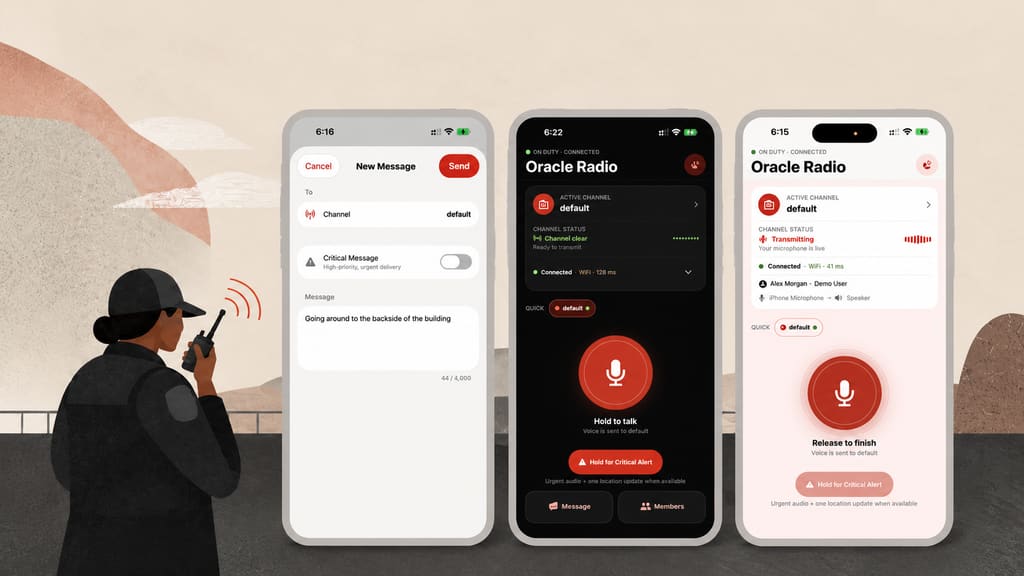
Communicate across the channels that matter
Field and command teams often need to follow activity across multiple channels while directing communications to the right group.
Oracle Radio lets users transmit on a selected talk channel while monitoring traffic from other joined channels. Channel busy status and authorized priority talk help users understand channel activity and determine when to communicate.
When voice is not the best option, teams can use routine or critical text. Authorized critical alerts provide an additional option for urgent voice communications on the selected channel. Presence, authorized maps, message history, and transcripts can provide additional context for ongoing activity.
Keep teams coordinated with presence and location context
Operational awareness depends on understanding what teams are communicating, who is active, and, when location data is available, where personnel were last reported.
Oracle Radio provides visibility into active channel members and, when sharing is permitted, recent reported positions on an operational map. Duty-state controls help maintain an up-to-date view of who is actively participating in communications, and users can transition between active and inactive radio sessions without signing out, based on configuration and permissions.
Together, these capabilities can help field and command teams maintain a shared view of personnel availability and activity across an operation.
Turn live communications into useful context
Operational communications can remain important long after an exchange ends. Access to previously exchanged information can help teams maintain continuity and understand what happened earlier in an operation.
Authorized users can review sent and received messages through channel activity and mobile inbox views and replay saved voice when available. When transcription is enabled, voice transmissions can also be converted to text after they end, although transcripts may be delayed or unavailable if recognition is unsuccessful.
Message history, saved voice, and transcripts can help teams carry context forward into shift handoffs, incident follow-up, and after-action reviews.
Stay focused in the field
Field personnel need communication tools that support fast interaction without pulling attention away from the operation.
Oracle Radio provides direct access to push-to-talk, text, channels, message history, and authorized member locations through native iOS and Android apps, which can help users navigate communications during active work. A web client extends access to users working outside the mobile experience.
Support operations from response through handoff
Oracle Radio1 can support communication and coordination across operational workflows, including incident response, field dispatch, shift transitions, and follow-up.
By combining real-time communications with presence, location context, and message history, teams can maintain awareness during active operations and carry important context forward as responsibilities shift.
Learn more about Oracle Radio
- Important considerations: Organizations should establish appropriate access controls, retention periods, and audit practices for communications, transcripts, and location data based on their organizational policies and applicable legal requirements ↩︎