
AI coding agents are changing how software gets built. Instead of suggesting the next line of code, an agent like OpenAI Codex can read a codebase, write and edit code, run commands, and work through a development task with you from start to finish. That shift from autocomplete to collaborator is changing what developers, tech leads, and engineering teams need to know.
To help individuals and organizations build these skills, we are pleased to announce two new courses from Oracle University: Codex Foundations and Agentic Engineering with Codex.
Together, they take you from your first Codex session to a disciplined workflow for agentic engineering that you can adapt to your organization’s security and delivery requirements.
Why We Built These Courses
Most people come to coding agents with one of two questions:
- “How do I get started with Codex in my day-to-day work?” Developers want a practical, hands-on path, not a feature tour.
- “How do we use coding agents safely across a team?” Tech leads and platform teams want a repeatable workflow with guardrails, approvals, and evidence that changes are ready to ship.
So, we built one course for each. Codex Foundations gets you productive with Codex quickly. Agentic Engineering with Codex turns that into an engineering discipline you can apply across the full software development lifecycle.
These courses equip developers to use Codex across projects and technology stacks. For developers working with OCI, Oracle Fusion Applications, Oracle AI Data Platform (AIDP), Oracle AI Database, or other Oracle technologies, Codex can help you design, build, and test AI agents and applications, and deploy those solutions on Oracle platforms using their supported tools and deployment workflows.
Who These Courses Are For
Both courses are built for the same audience: developers, tech leads, and engineers who build and run software and applications. What changes is where you are with Codex and what you expect from it.
| Role | Codex Foundations | Agentic Engineering with Codex |
| Software developers and engineers | Add an AI coding agent to your daily workflow. | Apply Codex to real team workflows. |
| Technical leads and architects | Evaluate how agents can speed up development. | Define standards, guardrails, and review practices for coding agents. |
| DevOps, cloud, and platform engineers | Use Codex to maintain scripts, tools, and web apps. | Build repeatable workflows for validating agent-generated changes and preparing them for delivery pipelines. |
| QA and test automation engineers | Get hands-on with Codex before going deeper. | Focus on verification and runtime evidence. |
Course 1: Codex Foundations
Codex Foundations gives you a practical foundation in using Codex effectively.
Rather than working through isolated examples, you learn by doing. You step into a realistic scenario: you pick up a website project left behind by a previous developer and work through tickets from a product manager. Along the way, you use Codex to understand unfamiliar code, diagnose and fix bugs, add features, and ship improvements.
You’ll work with both the Codex CLI and Codex in the ChatGPT desktop app, so you can choose the workflow that fits how you work. You’ll need a ChatGPT account with access to Codex and a computer where you can install software. The current lab guides use Windows and PowerShell.
What You’ll Learn
By the end of the course, you will be able to:
- Set up the Codex CLI and use Codex in the ChatGPT desktop app.
- Give Codex the right context with effective prompts and AGENTS.md.
- Configure approval policies and sandbox boundaries.
- Choose an appropriate model for the task.
- Explore an unfamiliar codebase, fix bugs, and build new features.
- Review changes and manage them with Git commits and branches.
- Extend Codex with skills.
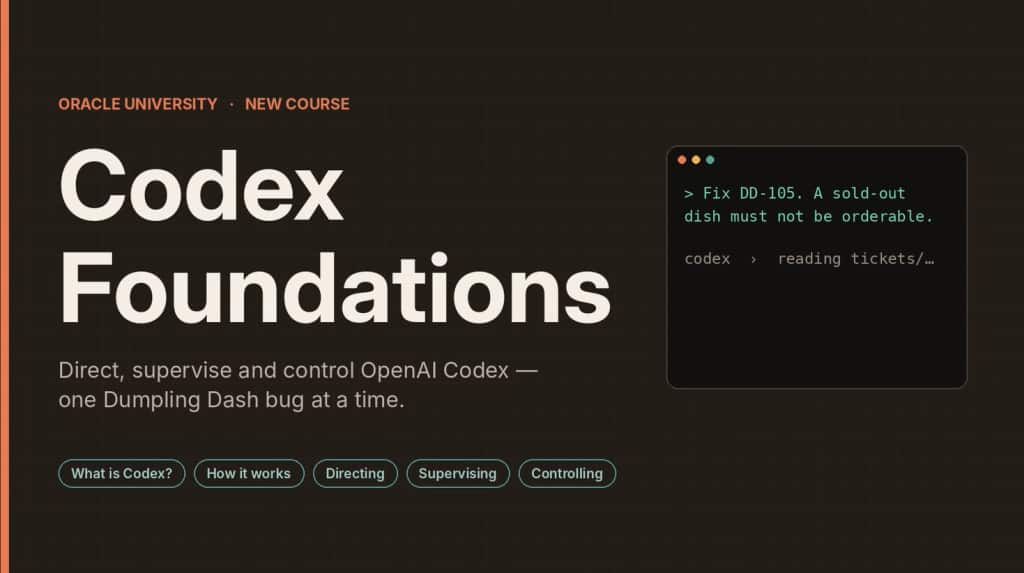
Take a Quick Video Tour
Want a fast look at what’s inside before you start? The visual flipbook video tour (click on the image below) walks through all the five modules in under three minutes so you can see the scope and flow at a glance.
Course 2: Agentic Engineering with Codex
Agentic Engineering with Codex teaches you to work with Codex as a true engineering collaborator across the full software development lifecycle: understanding an existing repository, planning, building, verifying, and preparing changes for release.
The focus is a disciplined, repeatable workflow. You onboard Codex to an existing codebase, engineer durable project context with AGENTS.md, and turn business requirements into reviewed engineering plans. Then you implement, debug, and refactor with Codex while staying in control of every change.
From there, the course moves into practices that help teams manage risk when using coding agents in enterprise development: reusable skills, external tools through Model Context Protocol (MCP), verification with tests and runtime evidence, multiple agents working in parallel, and the guardrails, approvals, and human review that keep it all accountable.
What You’ll Learn
By the end of the course, you will be able to:
- Onboard Codex safely to an existing enterprise repository.
- Engineer durable project context with AGENTS.md, repository maps, and context packs.
- Turn business requirements into reviewed plans with acceptance criteria.
- Implement, debug, and refactor with Codex while reviewing every change.
- Scale your workflow with reusable skills, tools connected through MCP, parallel subagents, and Git worktrees for isolating independent development tasks.
- Verify changes with tests and runtime evidence and apply guardrails before rollout.
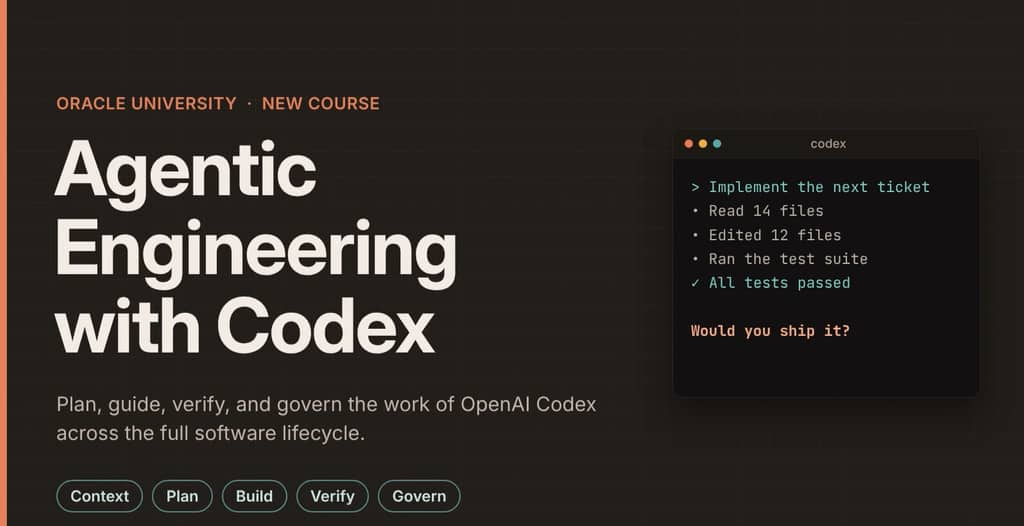
Take a Quick Video Tour
Want a fast look at what’s inside before you start? The visual flipbook video tour (click on the image below) walks through all the nine modules in under three minutes so you can see the scope and flow at a glance.
Which Course Is Right for You?
Think of the two courses as a single journey.
- New to Codex? Start with Codex Foundations. You’ll get set up, learn how to give Codex context and control what it can do, and build confidence by fixing and shipping a real website.
- Already using Codex? Go straight to Agentic Engineering with Codex. You’ll turn individual productivity into a team workflow, with plans, verification, parallel agents, and the guardrails enterprises need.
If you’re not sure, start with Foundations. Codex Foundations is the prerequisite for the second course. Its concepts including AGENTS.md, approval policies, sandboxing, and skills provide the foundation for the advanced workflows covered in the Agentic Engineering with Codex course.
Get Started
- Start here: Codex Foundations
- Go deeper: Agentic Engineering with Codex
So, here’s our ask: take the courses and share your achievement on LinkedIn. Tag Oracle University so we can celebrate with you. Then put Codex to work on the real code, real tickets, and real projects in front of you.
The best way to learn agentic engineering is to ship with it. Go build!