


Oracle Fusion Cloud Applications protect data at rest in the Fusion database using Transparent Data Encryption (TDE) and Oracle-managed encryption keys. This protection applies with or without Oracle Break Glass.
For eligible Fusion environments, Bring Your Own Key (BYOK) is an optional Oracle Break Glass capability for customer-managed keys. It gives customers additional control over the TDE master encryption key’s lifecycle and availability. BYOK does not introduce encryption to an otherwise unencrypted service.
How BYOK Works
A Two-Tier TDE Key Architecture
TDE uses a two-tier key architecture. Data encryption keys encrypt and decrypt data stored in the Fusion database. The TDE master encryption key protects those data encryption keys.
BYOK applies to the master encryption key. Oracle continues to manage the data encryption keys and the underlying database-encryption process, while the customer governs the master encryption key used to protect them.
The customer-managed master encryption key is not applied directly to every application read or write. Oracle Database transparently uses data encryption keys for authorized processing; applications and users do not provide the master key or seek approval for each transaction. BYOK does not authorize Oracle personnel or govern normal application access.
Key Availability Is an Operational Responsibility
The active master encryption key must remain available for the Fusion database to operate. Disabling it can make the Fusion database and dependent services unavailable. Re-enabling a key can allow restoration to begin, but shutdown and restoration are not instantaneous; each process should complete before further key changes are made.
Establishing and Managing a Customer-Managed Key
Four Stages of the Key Lifecycle
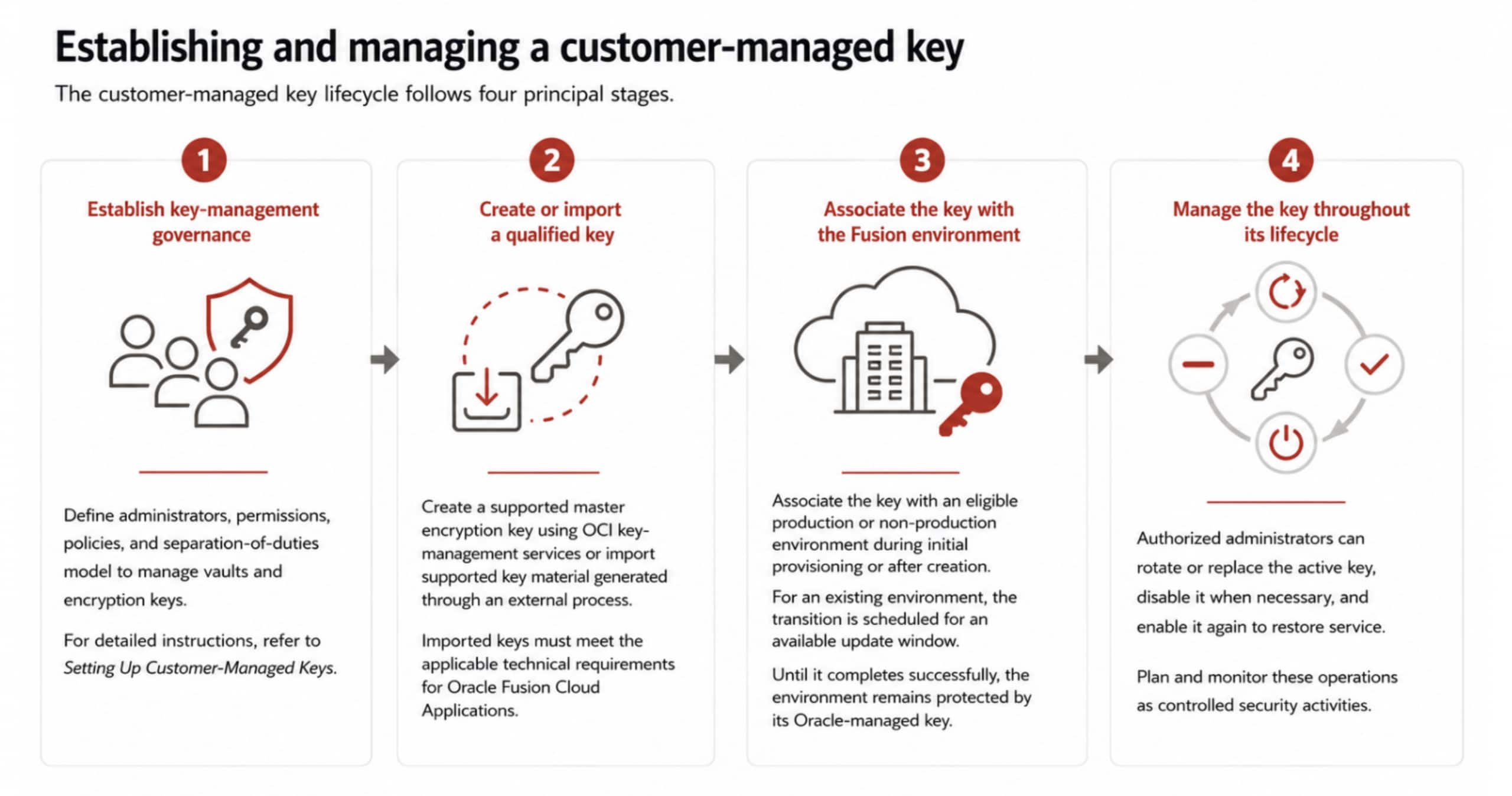
The customer-managed key lifecycle follows four principal stages:
- Establish key-management governance.
The customer defines the administrators, permissions, policies, and separation-of-duties model required to manage its vaults and encryption keys. For detailed instructions, refer to Setting Up Customer-Managed Keys.
- Create or import a qualified key.
The customer creates a supported master encryption key through OCI key-management services or imports supported key material generated through an external process. Imported keys must meet the applicable technical requirements for Oracle Fusion Cloud Applications.
- Associate the key with the Fusion environment.
A customer-managed key can be associated with an eligible production or non-production environment during initial provisioning or after the environment has been created. For an existing environment, the transition is scheduled for an available update window. Until it completes successfully, the environment remains protected by its Oracle-managed key.
- Manage the key throughout its lifecycle.
Authorized customer administrators can rotate or replace the active key, disable it when necessary, and enable it again to restore service. These operations should be planned and monitored as controlled security activities.
Continuity, Recovery, and Disaster Recovery
Guard Against Key Loss
Important: Customer-managed key availability and recovery. Customer control of encryption keys includes responsibility for preserving the key material and key-version history required for service and backup recovery. If a required customer-managed key or key version is deleted, permanently lost, or otherwise unavailable when needed, affected backups may be unrecoverable and encrypted resources—including the Fusion database and its associated data—may become unusable or irretrievable. Organizations should strictly limit key-management and deletion privileges and maintain documented recovery procedures.
Plan for Recovery Before It Is Needed
To mitigate these risks, customers should:
- Restrict key-management and deletion privileges.
- Preserve the required key material and key-version history.
- Align key-retention practices with backup-retention periods.
- Document procedures for restoring disabled keys.
- Coordinate key changes with maintenance, refresh, backup, and recovery activities.
- Include key availability in business-continuity and disaster-recovery planning.
For production environments, follow Oracle’s current requirements for replicating the production vault to its paired disaster-recovery region. Vault replication synchronizes keys and key versions. For external key-management configurations, confirm the availability, replication, and recoverability requirements for key material.
Visibility Into Key-Management Activity
Customers can use OCI Audit to review supported API activity involving customer-managed vaults and encryption keys. Audit records can identify when activity occurred and its source, target, action, and response. This supports diagnostics, governance, compliance, and monitoring.
OCI Audit is distinct from Managed Access reporting: it records supported vault- and key-management API activity, while Managed Access provides a high-level, timestamped history of requests for exceptional Oracle administrative access. The records describe different events and are not a command-level audit of all database, application, or data-access activity.
Customer Control, With Operational Responsibility
BYOK gives eligible customers control over the TDE master encryption key, while Oracle continues to operate the service and manage database encryption. It builds on Fusion Cloud’s secure-by-default foundation; it does not replace it.
Together, Managed Access and BYOK govern two decisions: exceptional Oracle administrative access and the master encryption key. To confirm eligibility, responsibilities, and ordering options, consult your Oracle account representative or Oracle Sales.