

Moving a large dataset is rarely only a storage problem. The challenge is creating a private, predictable network path that can sustain transfer throughput, recover cleanly from interruptions, and remain supportable after migration day. In this multi-region connectivity design OCI FastConnect is used for the private edge, a pair of regional hub networks, Dynamic Routing Gateways (DRGs), Remote Peering Connection (RPC) and a Local Peering Gateway (LPG) to reach a distributed target workload.
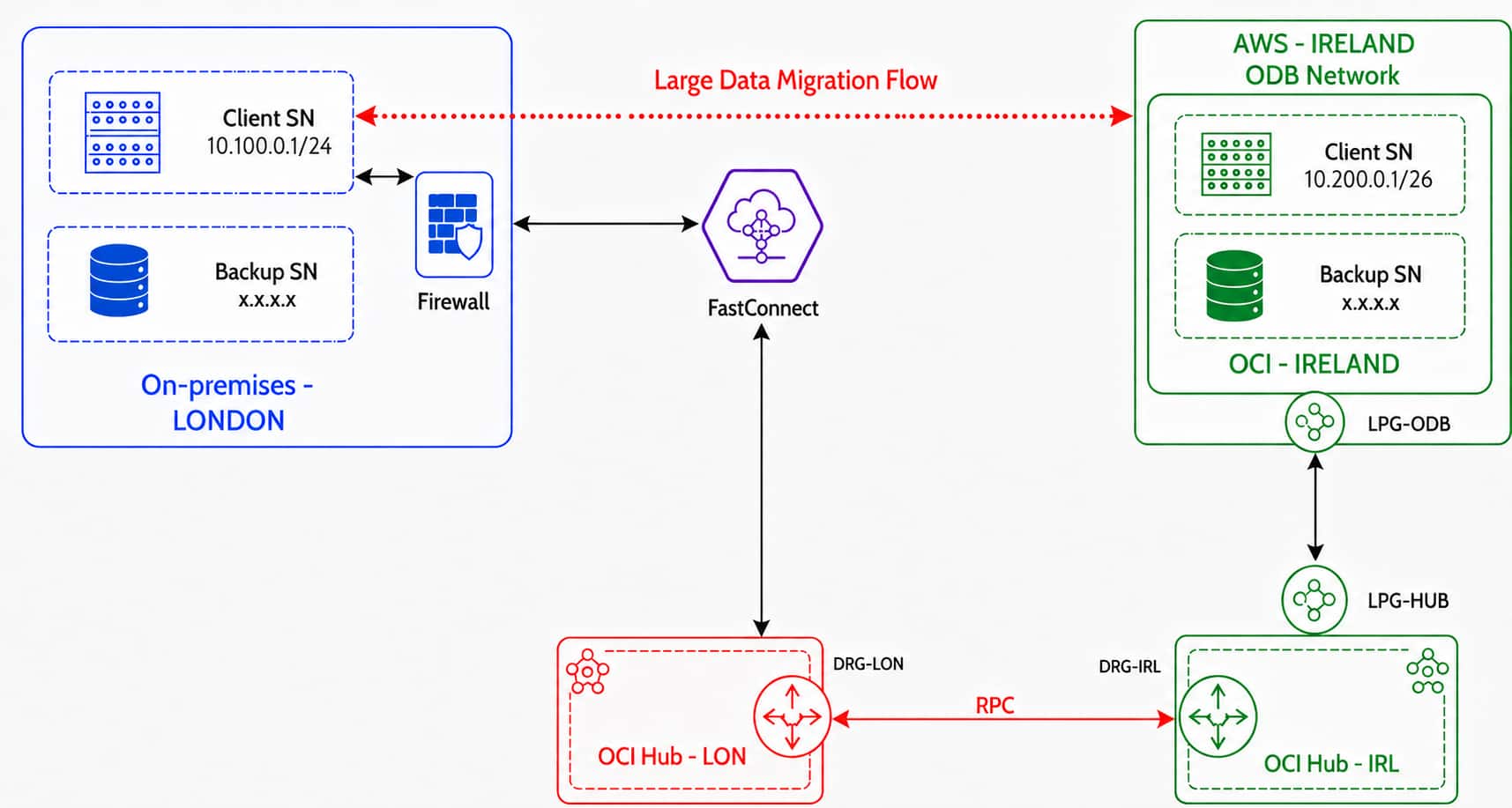
Note: London and Ireland are example regions here. An on-premises London environment connects to an OCI hub in London, crosses OCI regions to an Ireland hub, and reaches an Oracle AI Database@AWS (ODB) network. You can apply the same pattern to Oracle AI Database@Azure and Oracle AI Database@Google Cloud for other supported regions.
FastConnect: the private network highway!
OCI FastConnect is Oracle Cloud Infrastructure’s private, dedicated connection between an on-premises data centre (or colocation/provider network) and OCI. It uses a private physical network path and virtual circuits instead of carrying migration traffic across the public internet with SD-WAN/IPSEC solutions. In this design, private peering extends controlled private addressing between the on-premises environment and OCI VCNs.
What the architecture is doing
- A London client subnet (10.100.0.1/24) sends data through the on-premises firewall.
- The firewall forwards approved migration prefixes across FastConnect into the OCI London hub VCN.
- The London DRG carries the prefixes across Remote Peering Connection (RPC) to the OCI Ireland hub DRG.
- The Ireland hub VCN reaches the Oracle AI Database@AWS workload network through an LPG attachment.
- The destination client subnet (10.200.0.1/26) receives the migrated data; the backup subnet follows the same controlled path once its CIDR is confirmed.
The hub-and-spoke model separates connectivity from workloads. In the example, London is the on-premises ingress point and Ireland hosts the destination. Keeping inter-region transport at the DRG layer avoids a direct dependency between the on-premises edge and each workload VCN.
Why this pattern suits large data migration
FastConnect provides more consistent latency and throughput characteristics than internet-based transfer. Regional hubs make the path reusable: additional OCI Multicloud migration targets, even in different Clouds, can attach to the destination hub without redesigning the on-premises FastConnect. Treat connectivity and the transfer process as separate concerns. The network must sustain the agreed migration window; transfer tooling must provide checkpointing, integrity verification, retries, throttling, and resumable transfers. A healthy circuit alone does not prove a data copy is complete.
Routing and security design
Advertise only the prefixes required for the migration and its supporting operations.
On OCI, configure DRG route tables and route distributions so the FastConnect attachment learns only required on-premises prefixes, the RPC exports approved inter-region routes, and the LPG path exposes only Ireland workload prefixes. In each VCN, add matching route entries for the relevant DRG or LPG next hop.
- Use explicit source and destination CIDRs; do not allow broad RFC1918 ranges by default.
- Permit only the required migration protocols and endpoints at the firewall and OCI network controls.
- Separate migration, backup, and administration routing.
- Retain flow logs and firewall logs for the migration period.
- Validate every return path; do not rely on assumed transitive routing.
FastConnect provides private ingress; DRG-based hubs provide regional transit; RPC carries traffic between OCI regions; and the destination attachment reaches the workload network. London and Ireland are illustrative only. The result is a controlled, extensible data path for large migrations to Oracle AI Database@AWS, Oracle AI Database@Azure, Oracle AI Database@Google, or OCI-native workloads.