
Defense organizations are under pressure to modernize at speed while protecting sovereignty, resilience, security, and operational control. Across NATO and allied nations, trusted data, cloud infrastructure, and AI have become strategic capabilities that can directly influence mission readiness.
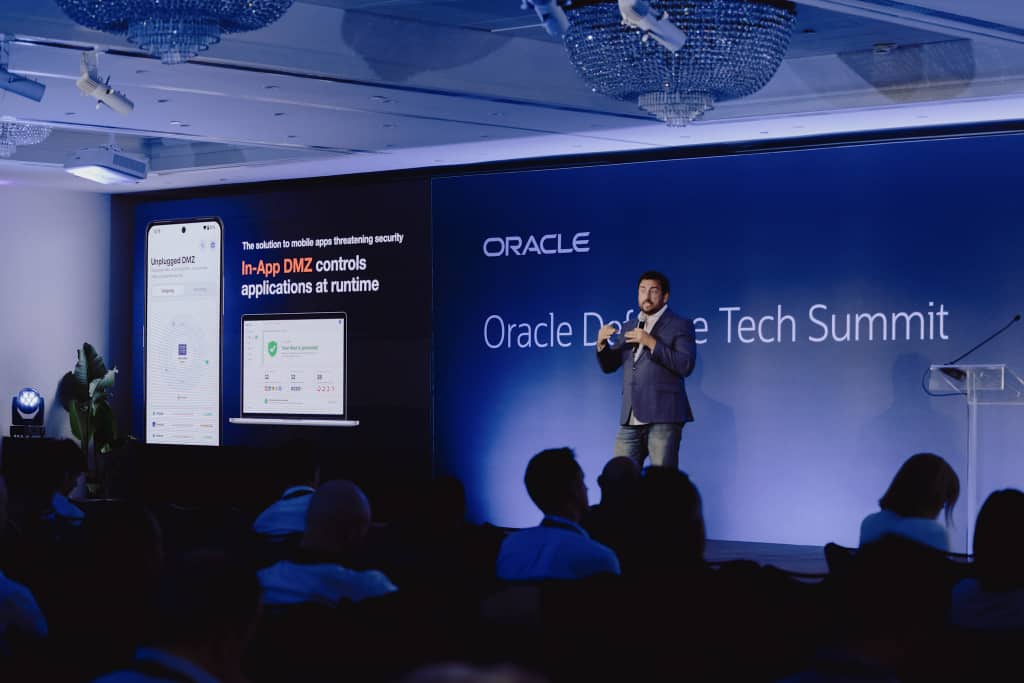
These priorities shaped discussions at the Oracle Defence Tech Summit in Brussels on June 25, 2026, which brought together defense leaders, public sector decision makers, and defense technology startups. The event focused on one of the most urgent questions facing the sector today: how do we move critical technology from promising concept to operational advantage, faster?
The day’s sessions pointed to a consistent solution: accelerating mission advantage requires more than any single product, platform, or policy. Oracle recognizes an ecosystem is needed for connecting secure cloud infrastructure with trusted AI solutions and operational expertise.
Oracle’s mission is to provide the secure cloud infrastructure and sovereign deployment options that help defense organizations modernize with operational control. Through the Oracle Defense Ecosystem, customers also gain access to a growing community of innovators building solutions for real operational needs.
Sovereignty as a defense imperative
An overarching theme throughout the summit was sovereign control in the Western technology stack. Defense organizations cannot treat cloud, AI, and data infrastructure as generic IT decisions. Rather, the IT stack affects national autonomy, strategic vulnerabilities, coalition readiness, and the ability to respond when conditions change.
The program explored how sovereign cloud environments can help defense customers protect sensitive workloads while still benefiting from modern cloud economics, automation, analytics, and AI. In sessions focused on the future of tactical advantage, data-centric warfare, and rethinking the defense cloud approach, speakers emphasized that sovereignty is about where data sits as well as who controls it, who can access it, how it is governed, and whether mission systems can continue to operate under stress.
That matters because defense modernization is no longer confined to the data center. The operational edge is expanding, and sensors, autonomous systems, AI models, field applications, and coalition data-sharing workflows are becoming integral to the mission fabric. The underlying infrastructure must be secure, resilient, interoperable, and deployable across diverse environments.
From data-centric warfare to decision advantage
Another central theme was the shift from data visibility to decision advantage. Defense organizations are generating and receiving more data than ever before, but more data does not automatically mean better decisions. In contested environments, the value comes from turning fragmented signals into trusted, timely action.
The innovation pitches from the Oracle Defense Ecosystem’s third cohort of members made that point tangible.
Trusted data
- TACTIQL presented FULCRUM, a sovereign operational data backbone designed to help move fragmented sensor data into standardized, interoperable, AI-ready formats. TACTIQL believes that operational advantage is supported by getting mission-critical data to the right operator, or machine, in time to support decisions. TACTIQL also introduced LISRD, a ruggedized edge compute node built for distributed intelligence in denied, degraded, intermittent, and limited-bandwidth environments.
- Quori introduced its Operational Intelligence System, Q-OIS, which turns fragmented operational data, sensor feeds, imagery, reports, and OSINT into clear outputs commanders can act on. Built for complex global environments across land, sea, and air, the platform helps teams move beyond reactive dashboards to predict and identify emerging risks, prioritize resources, and make faster, more confident decisions before threats escalate.
Trusted AI
- Legion Intelligence explored how defense organizations are moving beyond AI experimentation toward AI deployed in real operational environments. Rather than focusing solely on model performance, the presentation addressed the broader challenge of operationalizing AI across headquarters, classified environments, tactical edge deployments, and disconnected operations. Legion emphasized that defense customers are looking for secure, mission-ready AI that integrates with existing workflows, governance requirements, and infrastructure.
- Resaro addressed trust, one of the most important barriers to defense AI adoption. Resaro’s Approved Intelligence Platform tests, evaluates, verifies, and validates mission-critical AI systems. As AI moves from experimentation into operational workflows, commanders and operators need evidence that systems are performing as expected in their intended operational context, remain safe under edge cases and adversarial conditions, and can be explained to technical and non-technical stakeholders alike. As a deep-tech assurance company, Resaro made clear that the future of AI in defense depends as much on independent, measurable validation as on model performance.
- Two Delta closed the innovation showcase with the future of AI deployment: AI you own. The platform turns open models into specialized models that are designed to outperform frontier models on targeted tasks while reducing compute costs, and runs them wherever the mission requires: cloud, on-premises, or fully air-gapped. In defense, efficiency determines whether AI is practical for mission use. Ownership determines whether it is possible at all.
Mission infrastructure and edge resilience
- Revobeam brought the conversation into the electromagnetic environment and presented battlefield-proven capabilities for sensing, detection, and communications. Revobeam’s portfolio includes resilient UAV communications in jamming conditions, passive RF counter-UAS detection, GNSS-denied RF localization payloads, and modular unmanned surface vessel concepts. The pitch underscored a reality seen across current conflicts that spectrum superiority has become increasingly important to battlefield survival and operational effectiveness.
- Marlin Intelligence showcased a biomimetic soft-robotic underwater surveillance platform designed for littoral and shallow-water intelligence, surveillance, and reconnaissance (ISR). Their pitch focused on a gap in naval domain environments where large underwater vehicles may be too visible, too noisy, or too difficult to deploy. By combining swarm-capable underwater platforms, flexible payloads, and edge-to-cloud mission workflows, Marlin showed how autonomous systems could support mine detection, harbor-based maritime ISR, infrastructure monitoring, and other maritime missions.
- Chariot Defense focused on one of the less visible but increasingly critical challenges of tactical power facing modern military operations. As sensors, AI, communications, autonomy, and electronic warfare systems continue to increase power demands, the gap between available and required energy is becoming an operational constraint. Chariot showcased an approach to resilient, scalable battlefield power that enables longer duration missions across everything from dismounted operations to armored platforms. The presentation reinforced that compute, AI, and connectivity are only as effective as the energy infrastructure supporting them, making tactical power an essential enabler of next-generation defense capabilities.
- Unplugged tackled a growing and often overlooked security threat: the advertising data ecosystem of mobile phones. Smartphones continuously generate location, movement, and telemetry data that can be aggregated through advertising networks and exploited by adversaries to track military personnel, government officials, and critical operations. Unplugged’s solution takes a different approach to mobile security by combining a secure smartphone with an operating system that preserves compatibility with everyday applications while introducing an intelligence layer that monitors and anonymizes the telemetry generated by those apps in real time. By giving organizations visibility and control of the data leaving each device, Unplugged helps reduce the digital footprint that can expose personnel, deployments, and mission activities.
Warfighter readiness
- HPO Technologies focused on the human side of defense readiness. Their platform is designed as an operating system for warfighter health, readiness, and performance, helping leaders, subject matter experts, and end users make better use of readiness data. Their message broadened the summit’s definition of capability, reinforcing that modern defense technology is not only about platforms and sensors. It is also about understanding organizational culture, continuously iterating on technology to improve human performance, and making more people ready, more of the time.
Europe’s defense tech opportunity
For defense organizations in Europe, accessing the latest defense technology requires building faster pathways between operational demand and technology supply. This means helping sovereign and allied organizations access the best commercial innovation without compromising security or control.
The Oracle Defence Tech Summit showed the direction modern defense technology must take: it must be sovereign by design, AI-enabled, data-centric, interoperable, and built for the edge. It also showed that no single organization can deliver that future alone. Oracle brings secure cloud infrastructure, sovereign deployment options, and global reach. Partners bring domain-specific innovation. Defense customers bring the mission requirements, operational context, and urgency. The Oracle Defense Ecosystem brings them together.
The future of defense advantage is likely to be shaped by organizations that can connect trusted infrastructure with mission-ready innovation, at the speed of relevance. Learn more about the Oracle Defense Ecosystem here.