

Why Xstore deployment has traditionally been complex
Xstore has long been delivered in a way that reflects the realities of enterprise retail software: deeply customer-specific, highly configurable, and closely aligned with each organization’s operating model. That history has shaped Xstore into a platform where customization is not an exception, but a defining characteristic. Different customers may require different configuration sets, packaging inputs, certificates, rollout patterns, and integration points. This flexibility has been one of the platform’s enduring strengths.
At the same time, that same flexibility can make deployment and environment setup more demanding than with applications designed around a narrower operating model. In many cases, the path from infrastructure to a working Xstore environment spans multiple layers: cloud resources, operator systems, build tooling, package generation, and runtime deployment. Even when each step is individually well understood, the overall process can still be difficult to standardize and repeat. For organizations working across multiple teams and approval paths, this can stretch delivery timelines dramatically, turning what should ideally be hours into weeks or even months.
As organizations look at Oracle Cloud Infrastructure (OCI) and Oracle Kubernetes Engine (OKE) as target platforms for modern application hosting, an important question emerges: how can Xstore move toward a more repeatable cloud deployment model without losing the customer-level flexibility that has always defined it?
Separating platform initialization from customer-specific delivery
A useful way to approach this is to separate platform initialization from customer-specific delivery. The first concern is establishing a reliable cloud foundation: compute, networking, storage, registry access, operational access paths, and a Kubernetes runtime environment. The second concern is the continued generation and deployment of customer-specific Xstore packages, which still need to reflect each customer’s business, configuration, and release requirements.
This distinction matters because it avoids a false choice. Modernizing the deployment model does not have to mean flattening Xstore into a generic, one-size-fits-all application. A more practical direction is to create a repeatable baseline environment on OCI while preserving the ability for customers and delivery teams to continue shaping their own deployment outputs.
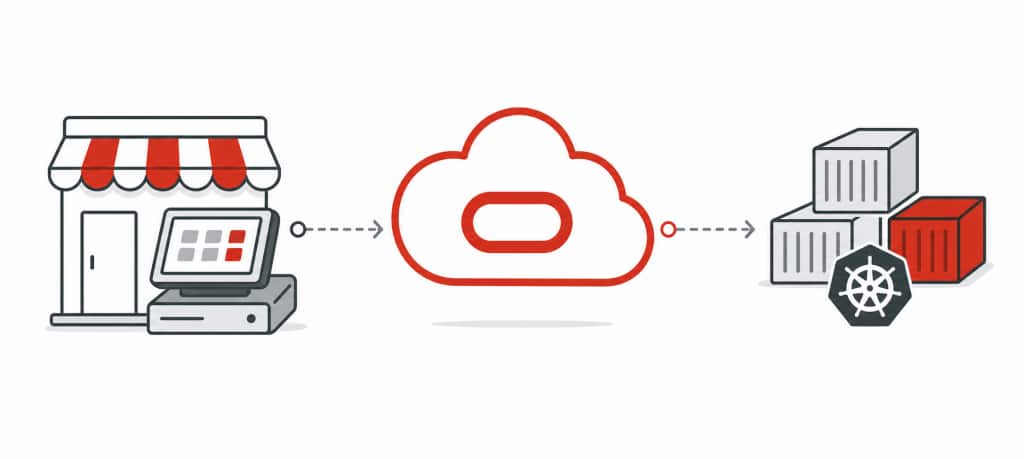
In this model, OCI provides the infrastructure foundation and OKE provides the runtime layer, while a CI/CD system such as Jenkins can serve as the operational bridge between platform readiness and customer-specific package generation. The result is not a fixed deployment template for every Xstore environment, but a structured path to getting a working baseline in place and then extending it according to customer needs.
That baseline can include the cloud infrastructure, access model, deployment workspace, build pipeline definitions, and an initial validation deployment used to confirm that the environment is functioning correctly. From there, teams can continue using their existing packaging and release logic to generate and deploy their own Xstore instances. In that sense, the cloud operating model becomes more repeatable, while the application delivery model remains customer-aware.
Reducing deployment time
This is especially relevant for enterprise retail platforms because the objective is rarely just to run containers. The real objective is to make the journey from environment creation to application rollout more predictable. When a platform like Xstore carries years of customer-driven configurability, the most useful improvement is often not the removal of variation, but the reduction of friction around it.
A repeatable platform model can significantly reduce deployment time, compressing what has traditionally taken months into a process that can be measured in hours for baseline environment readiness. That kind of improvement does not come from eliminating customer-specific behavior. It comes from standardizing the platform foundation so that teams no longer have to rebuild the same environment scaffolding again and again.
Making Xstore updates more predictable
A container-based deployment model also gives Xstore updates a stronger business profile. Rather than treating each release as a bespoke installation effort, organizations can promote a validated container image through a governed pipeline and deploy the same tested artifact consistently across environments.
This makes updates faster to distribute because refreshing service instances can often be handled through controlled container restart and replacement. It also makes delivery more predictable through standardized versioning, rollout, and rollback processes. The result is a more disciplined update model that reduces environment drift, improves release confidence, and helps technology teams deliver change at greater speed without sacrificing control.
Simplifying the rollout of new stores
A template-based store configurator running through a delivery pipeline can also simplify the initial deployment of a new store. Instead of assembling each location manually across infrastructure, application, and configuration layers, teams can use standardized templates to generate a store environment with the required baseline settings, connectivity, and deployment structure already aligned to enterprise standards.
This turns store rollout into a more repeatable provisioning process, where location-specific values are applied in a controlled way while the underlying pattern remains consistent. The business advantage is significant: new stores can be brought online faster, with less operational dependency on manual setup, lower risk of configuration variance, and a more scalable model for opening and supporting stores across multiple regions.
Why OCI and OKE fit this model
OKE is well suited to this direction because it offers a modern runtime environment while allowing teams to preserve control over how applications are packaged and exposed. OCI complements that with the surrounding services needed to build a practical delivery platform: networking, storage, registry integration, access isolation, and operational flexibility.
Together, they create an opportunity to move Xstore toward a cloud-native operating model without requiring the platform to abandon the characteristics that made it adaptable in the first place.
Conclusion
Seen this way, the future of Xstore deployment on OCI is not about replacing customer-specific delivery with rigid standardization. It is about building a stronger foundation under that flexibility. A repeatable cloud baseline, combined with customer-aware packaging and deployment workflows, offers a path toward modernization that respects both operational efficiency and the realities of enterprise retail customization.
For organizations exploring how Xstore can evolve on OCI, that may be the most practical direction of all: standardize the platform foundation, preserve the customer-specific application layer, and create a delivery path that is easier to repeat, easier to manage, and better aligned with modern cloud operations.