



AI Innovation Needs a Sovereignty Strategy
Sovereign customers are growing as regulatory expectations expand beyond basic data residency into operational control, jurisdictional oversight, auditability, and resilience. At the same time, customers are demanding greater control over where data is processed, who can access it, how AI systems are governed, and what evidence proves those controls are working. This shift is making sovereignty a core buying requirement for production AI, especially in government, financial services, healthcare, critical infrastructure, and other regulated sectors.
As organizations move AI into production, sovereign AI needs to be grounded in clear digital sovereignty principles: sovereign isolation across identity, operations, data, and network boundaries; clear rules for AI-related data such as prompts, embeddings, logs, telemetry, and model artifacts; an operating model that matches the customer’s sovereignty requirement; and architectural controls that protect sovereignty by structure, not just by contract.
Artificial intelligence is moving from experimentation to production, becoming essential to how organizations automate operations, improve decisions, accelerate research, modernize public services, and create new digital experiences. As that happens, sovereignty requirements change. It is no longer enough to ask where an application stores data. Organizations also need to understand where AI workloads run, who operates the infrastructure and services behind them, what guardrails are in place, and how trust is maintained across the systems.
Sovereign AI is not a single product or deployment pattern. It is an AI operating model for applying digital sovereignty principles across the full AI stack, helping organizations control where AI data, models, infrastructure, operations, and governance sit, who can access them, and what evidence proves those controls are working.
Data residency is a starting point but does not fully address the sovereignty requirements of production AI. AI systems create and use additional assets that can carry sensitive context, including prompts, embeddings, inference outputs, retrieval stores, model artifacts, logs, telemetry, support workflows, and operational metadata. A sovereign AI strategy needs to account for those assets across the full AI lifecycle.
Why Sovereign AI Matters to the Business
Sovereign AI matters because AI changes both opportunity and risk. As AI moves deeper into the enterprise, it creates new ways to serve customers, improve productivity, detect risk, accelerate research and personalize digital services. It also creates new forms of sensitive information: prompts, embeddings, model artifacts, inference outputs, evaluation data, logs and support interactions. These can reveal business strategy, customer behavior, operational weaknesses, intellectual property or regulated personal data.
For business leaders, sovereignty should not be framed only as a compliance constraint. Handled well, sovereignty can help AI projects get approved faster, reach regulated markets and earn user trust.
It supports market access. In public sector, financial services, healthcare, telecoms, defence, energy and other regulated environments, an AI use case may be valuable but difficult to deploy unless the organisation can show where data is processed, which legal framework applies, who can access the platform and how decisions are governed.
It builds adoption. AI systems are more useful when they reflect local language, local regulation, sector knowledge and institutional context. A powerful model that does not fit the operating environment may remain stuck in pilot mode. A model that fits the context is easier to embed into real workflows.
It enables risk-adjusted growth. Once AI becomes part of operational decision-making, leaders need confidence that sensitive data and derived assets are not moving into places they cannot inspect, govern or defend. Sovereign AI helps organizations scale AI while keeping control proportionate to workload sensitivity.
And it creates strategic leverage. Organizations can decide which AI capabilities they are comfortable consuming as standard services and which require stronger control over infrastructure, operations, models, data and jurisdiction. That choice matters as AI becomes part of competitive advantage.
Sovereign AI Across the Full Stack
A Sovereign AI strategy in most countries starts with regulatory requirements. Digital sovereignty can be understood as an organization’s ambition to maintain control over its data, operations, and technology in the face of external influences, while continuing to innovate and remain resilient.
As AI moves into production, sovereignty needs to be designed across the full stack: the data used, the models selected, the infrastructure deployed, the operations performed, and the governance evidence produced. This strengthens an organization’s ability to deploy AI with trust, resilience, and regulatory confidence while keeping control aligned to the needs of each workload.
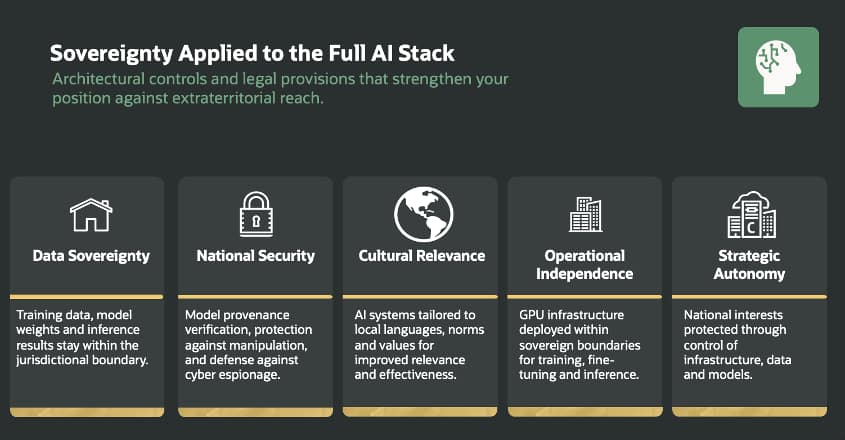
- Data sovereignty: Training data, prompts, embeddings, model artifacts, inference outputs, logs and telemetry remain within the required jurisdictional or organizational boundary.
- National security: Model provenance, validation, access control and cyber resilience help protect AI systems from manipulation, unauthorized access and operational disruption.
- Cultural relevance: AI systems are more effective when models, data and workflows reflect local language, regulation, norms and institutional context.
- Operational independence: GPU infrastructure, training, fine-tuning and inference can operate within the required sovereign boundary, with clear control over administration and support.
- Strategic autonomy: Organizations retain greater control over the infrastructure, data, models and AI capabilities that matter most to their mission and long-term resilience.
Sovereign AI is not just about where a model is hosted. It extends across the full AI stack: data, models, infrastructure, operations, people, and governance.
Four Principles for Sovereign AI Architecture
For AI systems that need higher control, four architectural principles help turn sovereignty from a concept into an operating model.
Sovereign isolation means separating identity, operations, data and network boundaries so AI workloads run within the intended perimeter. For AI, this includes the environments where models are hosted, fine-tuned, monitored and connected to enterprise data.
Your data, your boundary means treating AI-related data with the same discipline as primary business data. Prompts, embeddings, logs, telemetry, support interactions and model artifacts can carry sensitive context. They need clear rules for location, retention, access, encryption and movement.
Your cloud, your operator means matching the operating model to the requirement. Some workloads may be suitable for Oracle-operated public cloud regions. Others may need an EU sovereign realm, a government cloud, a customer-dedicated region, a partner-operated model or an isolated environment. The operator question matters because sovereignty is not only about where technology sits; it is also about who can operate, support and change it.
Protected by structure, not just contract means backing policy and legal commitments with architecture. Contractual safeguards matter, but the strongest sovereign designs also use physical separation, logical isolation, cryptographic controls, restricted access paths, operational segregation and auditable evidence.
How OCI Helps Customers Build Sovereign AI
OCI helps to brings Sovereign AI together including infrastructure, models, AI services, and AI applications.
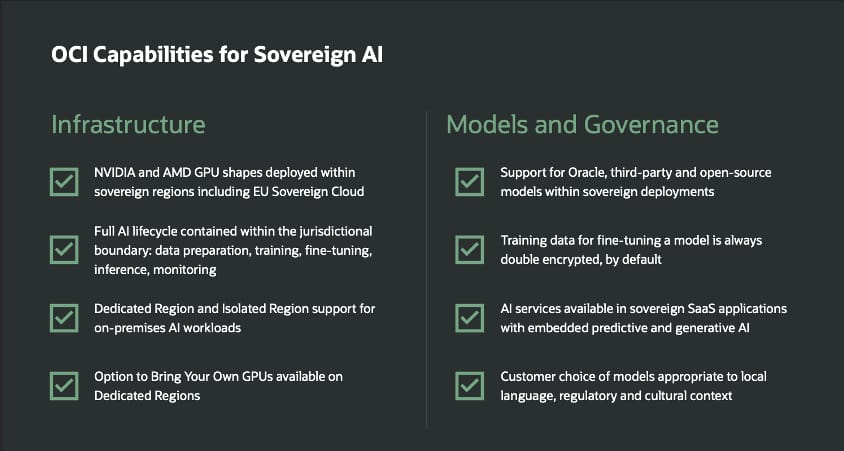
At the infrastructure layer, OCI supports AI workloads with GPU compute options, high-performance networking patterns for clusterless, cluster, and supercluster deployments, and file storage capabilities such as Lustre for AI data pipelines.
At the model and governance layer, OCI is designed to support Oracle, third-party, and open-source models within applicable sovereign deployments. That flexibility matters because different countries, industries, and organizations may require different model provenance, language coverage, cultural alignment, regulatory posture, and validation processes.
At the GenAI services layer, OCI gives customers access to services such as OCI Enterprise AI, OCI Data Science, Autonomous AI Database, and related AI capabilities where available for the selected region, realm, and deployment model.
These capabilities support a broad range of enterprise AI use cases, including reasoning models, retrieval-augmented generation, enterprise chat, multimodal AI workloads, embeddings, reranking, and large frontier-model deployments. For sovereign environments, the architectural value is straightforward: organizations can bring AI services closer to their operational, regulatory, and data governance requirements without giving up the infrastructure patterns needed for production workloads.
The result is a practical path for customers that need both AI capability and control: run AI where sensitive data lives, choose the models that fit the mission, operate within the required boundary, and still use modern cloud infrastructure and services.
OCI Gives Customers Sovereign Choice
With Oracle Cloud Infrastructure the same cloud foundation can be deployed in different operating models to meet different control requirements. That matters for sovereign AI because the right architecture may vary by country, sector, workload and risk profile.
For many AI workloads, OCI public cloud regions can provide regional placement, broad cloud services, security controls and governance. For European organizations with stronger sovereignty requirements, Oracle EU Sovereign Cloud (EUSC) provides a separate EU sovereign cloud realm operated by EU-incorporated legal entities, with EU-resident operations and support separated from Oracle’s global cloud operations. EUSC is physically and logically separated from other Oracle Cloud regions and provides more than 200 OCI services with the same pricing and financially backed service level agreements as Oracle’s public commercial regions.
For organizations that require a cloud region in their own location, OCI Dedicated Region can bring OCI services into a customer’s data centre or chosen facility. For service providers and partners, Oracle Alloy enables them to become cloud providers, combining OCI technology with their own operating model, customer relationships and local market expertise. For government and highly sensitive environments, Oracle Government Cloud and Oracle Cloud Isolated Region provide additional deployment patterns for specific requirements.
The differentiator is not simply that there are multiple deployment options. It is that customers and partners can use a common cloud foundation while choosing the operating boundary that fits the workload. For sovereign AI, that can mean placing data services, AI infrastructure, model operations and governance controls closer to the required jurisdictional, operational or organizational boundary.
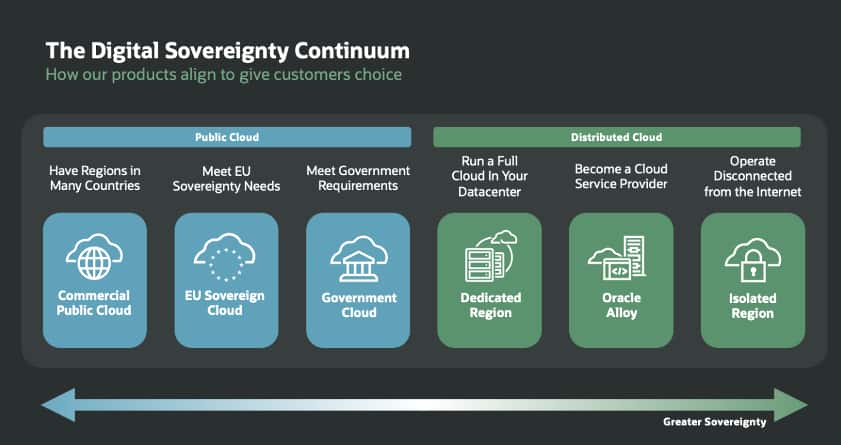
For Sovereign AI, these deployment models matter because they allow AI infrastructure, data services, and model operations to be placed closer to the customer’s required boundary.
This due-diligence approach helps leaders distinguish a sovereign AI architecture from a sovereign AI slogan.
SoftBank Corp.(“SoftBank”) as a Sovereign AI Proof Point
SoftBank Corp.(“SoftBank”) deliver Cloud PF Type A, a suite of its own proprietary cloud and AI services powered by Oracle Alloy, across SoftBank Corp.(“SoftBank”) data centers in Japan. SoftBank Corp.(“SoftBank”) announced that Cloud PF Type A launched in eastern Japan in April 2026 and is scheduled to become available in western Japan in October 2026. The platform is designed to give Japanese enterprises, public sector organizations, municipalities, and critical infrastructure providers access to more than 200 OCI AI and cloud services while keeping cloud data and operations under domestic control.
Oracle Alloy gives SoftBank Corp.(“SoftBank”) a way to operate as a cloud service provider on OCI infrastructure, delivering cloud services from its own data centers in Japan. For AI workloads, that means customers can use high-performance compute, OCI AI capabilities, GPU environments, and data services within a sovereign operating model, subject to service availability and configuration. SoftBank Corp.(“SoftBank”) is also using the platform to support generative AI services, including services based on SB Intuitions’ homegrown LLM, Sarashina, which are scheduled to begin rolling out from June 2026.
The SoftBank Corp.(“SoftBank”) example highlights how several Sovereign AI principles can come together in one operating model:
- Data sovereignty and local operations: Cloud PF Type A is delivered from SoftBank Corp.(“SoftBank”) data centers in Japan and is designed to keep cloud data and operations under domestic control. For AI workloads, local boundary matters not only for application data, but also for prompts, embeddings, inference outputs, model artifacts, logs, and operational metadata.
- Operational independence: SoftBank Corp.(“SoftBank”) operates as the local cloud service provider on OCI infrastructure through Oracle Alloy. This gives customers access to cloud and AI services through a locally operated platform, with operations aligned to Japanese customer, regulatory, and jurisdictional expectations.
- Sovereign service breadth: SoftBank Corp.(“SoftBank”) says Cloud PF Type A can deliver more than 200 OCI AI and cloud services through its locally operated platform. This matters because sovereignty should not require customers to give up access to modern cloud capabilities, including AI services, data services, and infrastructure for production workloads.
- National security and cryptographic control: SoftBank Corp.(“SoftBank”) combines OCI key management capabilities with its own proprietary key management service, adding another layer of key-management control for the Cloud PF Type A model. Its eastern and western Japan deployment model also supports redundancy, network resilience, and business continuity planning, which are important for sensitive and mission-critical environments.
- AI-ready infrastructure inside the sovereign boundary: GPU environments and generative AI workloads can run within a platform built for data sovereignty requirements. This supports training, fine-tuning, and inference patterns that need to remain closer to the customer’s required operational and jurisdictional boundary.
- Model sovereignty and cultural relevance: BYOLLM for Alloy can enable an operator to bring its own models into OCI Generative AI and package them as managed services. SoftBank Corp.(“SoftBank”) planned generative AI services based on SB Intuitions’ homegrown LLM, Sarashina, show why model choice matters: some organizations need models that reflect local language, culture, regulation, and operating context.
- Strategic autonomy: Taken together, local data control, local operations, AI-ready infrastructure, key-management control, and local model strategy help customers reduce dependency and retain greater control over the AI capabilities that matter most.
Sovereign AI is not only about where a workload runs. It is about whether data, infrastructure, operations, encryption, models, and services can be aligned to the customer’s sovereignty requirements. SoftBank Corp.(“SoftBank”) use of Oracle Alloy shows how a trusted local operator can deliver modern AI and cloud capabilities while keeping control close to the customers, users, and jurisdictions they serve.
From Compliance Question to Business Strategy
Regulation is one reason sovereign AI is gaining attention, but it is not the only reason. In Europe, the AI Act increases the importance of traceability, documentation, human oversight, robustness, cybersecurity and clear accountability across the AI lifecycle. It does not automatically require EU-only hosting for most AI uses, but it does make evidence, governance and operational clarity more important.
That has real-world business implications. If an organization uses AI to support a high-impact decision, such as assessing creditworthiness or eligibility for a service, it needs more than an accurate output. It needs to understand what data the system used, how the model was governed, how human oversight works, whether the decision can be explained or challenged, and what logs or documentation can demonstrate that the system operated appropriately. Sovereign AI architectures can help by making the operating boundary, data boundary and evidence model clearer from the start.
This is why the conversation should move beyond “Where is the cloud region?” to “What control model does this AI use case require?“
A Practical Starting Point
Organizations can start with a simple classification exercise. For each AI workload, leaders should ask:
- What data will the AI system use, and what derived data will it create?
- Where will prompts, embeddings, outputs, logs, model artifacts and telemetry reside?
- Which models are approved, and how is model provenance evaluated?
- Who can administer, monitor and support the infrastructure and model environment?
- How are encryption keys controlled?
- Which regulatory, sector or jurisdictional obligations apply?
- What evidence will prove that controls are operating as intended?
The answers should determine the deployment model, not the other way around.
Sovereign AI is not about choosing between innovation and control. It is about building AI where data, infrastructure, operations, models and governance stay aligned with the needs of the business, the expectations of regulators and the trust of the people the AI system serves.
With OCI Distributed Cloud, Oracle gives customers and partners a practical path to do that: one cloud foundation, multiple sovereign postures and the flexibility to run AI where the operating boundary needs to be.
Learn more
Ready to explore how Oracle Distributed Cloud can support your AI, sovereignty, and data governance requirements?
Learn more about Oracle Dedicated Cloud Solutions
Explore OCI distributed cloud implementation guidance