
Breaking the “Zero-Sum” Compute Game
For the modern IT Executive and CFO, the promise of Generative AI and industrial-scale simulation often feels like a high-stakes trade-off. Traditionally, the equation was simple but painful: if you wanted the raw performance of an HPC cluster with dedicated GPUs, you had to swallow a massive upfront Capex and accept a ‘shared’ environment that often compromised either performance or security.
For Private Equity firms managing a portfolio of high-growth companies, or enterprises balancing multiple Lines of Business (LOBs), this creates a ‘Zero-Sum’ game. How do you optimize an expensive, cutting-edge resource without one group’s noisy neighbor workload or security profile bleeding into another? The answer lies in shifting from ‘buying boxes’ to ‘orchestrating utility.’ By leveraging OCI’s unique off-box virtualization and flat, non-oversubscribed network, we can now creatively segment massive HPC clusters into secure, logical ‘chunks’. This allows your investment groups to innovate at the speed of bare metal—without the Capex anchor or the risk of cross-entity data exposure. We aren’t just building clusters; we are building an elastic compute economy where security and performance are finally on the same team.
Designing for Isolation: Architecture Patterns for Multi-Tenant HPC
To maximize the ROI of a massive GPU-accelerated cluster, we must move away from the “one big pool” approach. Instead, we use OCI’s native security constructs to create Sovereign Compute Enclaves. Here are the three primary options for segmenting your investment companies or LOBs:
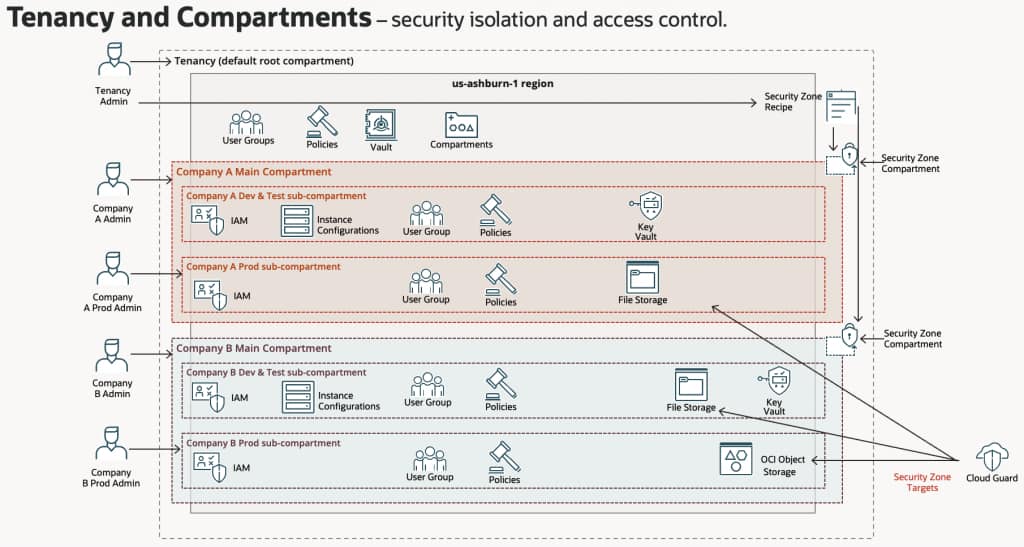
Option 1: The Logical Fortress (Compartment-Based Isolation)
This is the foundational pattern. We use a hierarchical Compartment structure to create clear boundaries for billing, management, and access.
- How it works: Each startup or LOB is assigned its own “Child Compartment” under a master HPC parent.
- The Value: Using IAM Policies, you can ensure that the “Biotech Startup A” team has zero visibility into “Engineering Group B’s” compute shapes, even though they share the same physical underlying infrastructure in the region.
- Optimization: You can set Quota Policies on each compartment to ensure one group doesn’t accidentally consume the entire GPU pool, maintaining cost performance for everyone.
Option 2: The Enforced Perimeter (Cloud Guard Security Zones)
For investment groups with high-compliance requirements (e.g., Healthcare or FinTech), we layer on Security Zones.
- How it works: You create a Security Zone for a specific startup’s compartment. This automatically enforces a “Maximum Security” posture that cannot be disabled by the user.
- The Guardrails: For example, it will block the creation of public-facing buckets or ensure that all Block Volumes are encrypted with customer-managed keys (Vault).
- The Value: This allows you to give LOBs “the keys to the car” (admin rights within their chunk) while ensuring they cannot drive it off a security cliff.
Option 3: The Hardened Fabric (Network Segmentation & Off-Box Virtualization)
This is the deepest level of isolation, focusing on the data plane.
- How it works: We utilize VCN Segregation and Network Security Groups (NSGs) to ensure that the RDMA (Remote Direct Memory Access) traffic between nodes in Group A’s cluster is physically and logically separated from Group B.
- The OCI Edge: Because of OCI’s Off-box Virtualization, the network and I/O stack are isolated from the compute node itself. This eliminates the “VM Escape” risk, providing bare-metal performance with cloud-grade multi-tenancy.
- The Value: You provide the “Utility” experience—low latency and high throughput—without the security noise of a typical multi-tenant cloud.
Reference architectures to accomplish this on OCI:
Using Sole Compartment Structure Isolation:
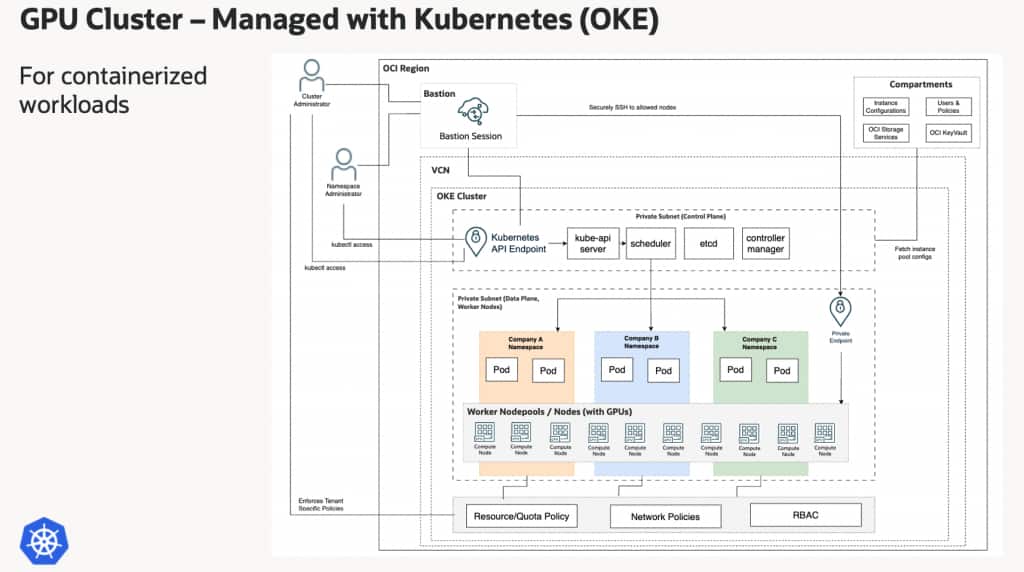
Using Kubernetes Namespaces:
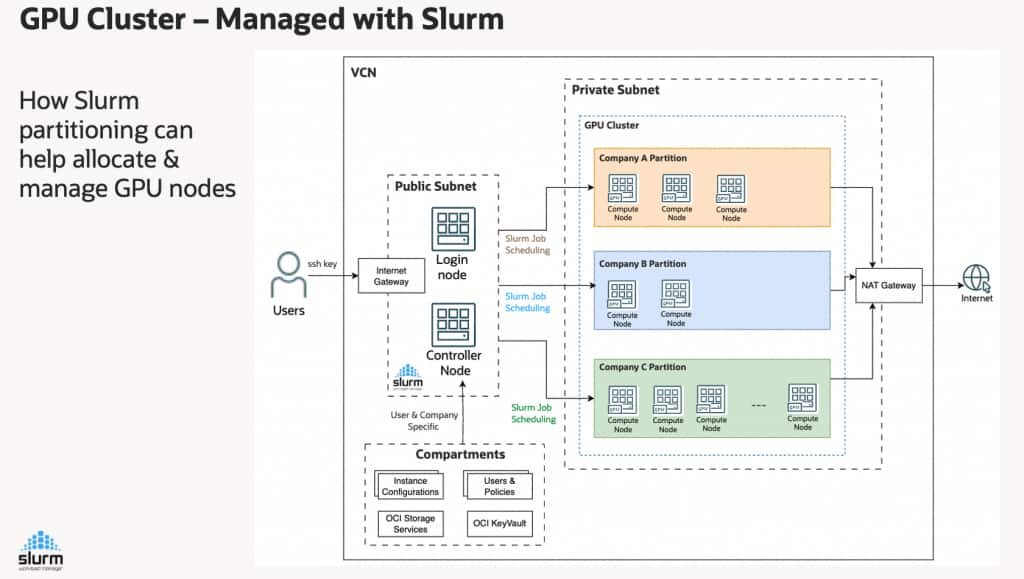
Using Slurm Partitions:
Closing Thoughts: The Strategic Payoff of Cloud-Native Supercomputing
Ultimately, treating infrastructure as a secure, elastic utility removes the financial and operational friction of modern innovation.
- For the CFO: Transitioning from rigid Capex to an optimized Opex model ensures expensive GPU and HPC resources are precisely allocated and billed to the specific group driving the value.
- For the IT Executive & CISO: Layering OCI’s compartments, Security Zones, and off-box virtualization allows you to hand over the keys to independent teams without risking cross-entity data exposure or policy violations.
By eliminating the upfront “compute tax” while maintaining absolute data isolation, private equity firms, venture capitalists, and enterprise leaders can finally protect their capital, secure their intellectual property, and let their teams focus entirely on what matters most: innovating at the absolute frontier of their industries.