

Organizations are rapidly expanding across SaaS platforms, custom-built services, partner systems, and REST-based applications, driving a critical need to govern access consistently and reduce security risk. Oracle Access Governance (AG) addresses this challenge as a cloud-native identity governance service that supports broad application coverage, including Generic REST integrations for identity-aware target systems.
This blog outlines an Agentic AI-based automation framework to accelerate and automate the generation of AG REST integration artifacts, including:
- Schema templates
- Request templates
- Response templates
- Test templates
The framework helps administrators and implementation teams accelerate the preparation of integration templates. By replacing manual processes—such as tedious API documentation reviews, repetitive analysis of request and response patterns, and manual artifact creation—it delivers a guided, highly efficient, and scalable approach to system integration.
Accelerating Generic REST Integration Readiness
Generic REST integrations play a critical role in extending Oracle Access Governance beyond applications that have prebuilt connectors. Many organizations rely on custom applications, internal services, industry-specific platforms, and third-party systems that expose identity-related capabilities through REST APIs. AG Generic REST integration enables these systems to participate in governance processes by supporting identity data onboarding, managed system integration, and account and entitlement lifecycle operations.
However, preparing a Generic REST integration still requires administrators to understand the target system’s API landscape. Teams must identify APIs that support account management, entitlement management, lookup operations, and related functions, while also analyzing the corresponding request and response structures. This information must then be translated into the schemas, request templates, response templates, and other artifacts required by Oracle Access Governance.
Agentic AI-based automation framework is designed to simplify this preparation process. Rather than starting from a blank page, implementation teams can leverage the framework to analyze API documentation, identify relevant integration patterns, and generate integration artifacts for review.
The objective is not to replace the expertise of implementation teams. Instead, it is to reduce repetitive manual effort, improve consistency across integrations, and help teams produce review-ready integration configurations more quickly and efficiently.
Architecture: AI-Assisted Generic REST Integration for Oracle Access Governance
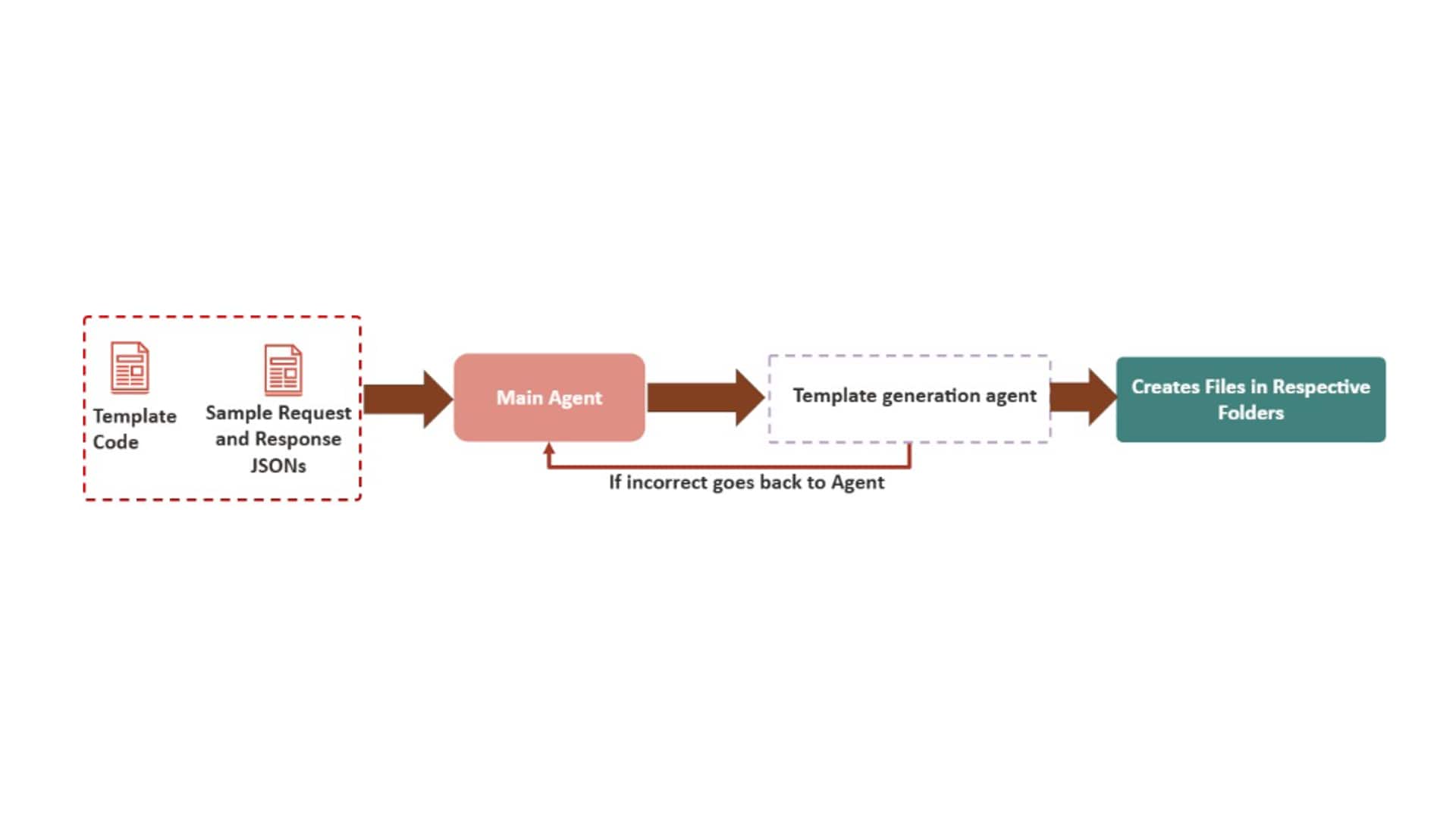
The solution uses a multi-agent framework to automate the generation of AG Generic REST integration artifacts.
- Main Agent – Orchestrates the workflow, interprets user inputs, and coordinates sub-agent activities.
- Template Generation Agent – Analyzes sample request and response payloads for operations such as Create, Update, Enable, Disable, and Delete, and generates the required Schema, Request, Response, and Test templates.
- File Management Agent – Organizes and stores the generated artifacts.
If the generated output does not meet the expected structure or format, it is routed back to the Main Agent for review and refinement, creating a feedback loop that improves the quality and consistency of the generated templates.
Providing a Guided Experience for Implementation Teams
The framework is designed to simplify Generic REST integrations for implementation teams.
An implementer provides the relevant API documentation and sample payloads, and the Agentic AI-based automation framework assists by analyzing the inputs and generating integration artifacts. The implementer remains responsible for reviewing, refining, and approving the generated output.
This human-in-the-loop approach ensures that integrations remain accurate and aligned with business requirements. While the framework accelerates preparation and reduces repetitive manual effort, implementation teams continue to validate the generated artifacts against the target system and governance requirements.
By combining AI-assisted automation with expert review, organizations can improve implementation efficiency while maintaining governance and control.
Key Benefits of the Multi-Agent Framework
The multi-agent framework assists implementation teams with activities such as:
- Analyzing API documentation provided for target applications and services.
- Generating schema, request, response, and test templates required for AG Generic REST integrations.
- Supporting account and entitlement onboarding by helping prepare integration artifacts for common governance use cases.
- Reducing repetitive manual effort involved in interpreting API specifications and mapping them to AG templates.
- Improving consistency across integrations by applying a structured approach to template generation.
- Providing a guided implementation experience, allowing teams to focus on validation, testing, and governance requirements.
Driving Efficiency and Scale
Manual connector preparation can introduce variability. Different team members may interpret the same API documentation differently, and similar systems may be modelled inconsistently. Repeated manual drafting can also increase the time required to bring new systems under governance.
Agentic AI-based automation framework helps address these challenges by providing a consistent, guided approach to template generation. By analyzing API documentation and sample payloads, the framework assists implementation teams in preparing integration artifacts while reducing the repetitive effort associated with manual interpretation and template creation.
As a result, teams can spend less time on manual drafting and more time on higher-value activities, such as validating governance outcomes, reviewing access models, collaborating with application owners, and ensuring alignment with business and compliance requirements.
For organizations managing a growing portfolio of applications, these efficiencies can have a significant impact. The framework helps improve consistency across integrations, accelerate onboarding of new systems, and enable identity teams to scale governance coverage more efficiently while maintaining the accuracy, control, and oversight required for enterprise identity governance.
Extending the Value of Generic REST
Oracle Access Governance Generic REST provides organizations with a flexible way to govern applications and services that expose identity-related capabilities through REST APIs. However, flexibility alone does not eliminate the effort required to prepare integration artifacts.
Agentic AI-based automation framework complements Generic REST by helping implementation teams transform API documentation and sample payloads into review-ready integration artifacts more efficiently.
Together, Oracle Access Governance Generic REST and AI-assisted automation will enable organizations to onboard new applications faster while maintaining governance, consistency, and human oversight.
Summary
Agentic AI-based automation framework for Oracle Access Governance represents a practical step toward AI-assisted identity governance operations.
It does not change the purpose of governance; rather, it enhances the implementation experience. By helping teams reduce manual effort, improve consistency, and accelerate the preparation of Generic REST integration artifacts, the framework simplifies the process of extending Oracle Access Governance to REST-based systems.
As organizations continue to modernize their identity programs, the ability to govern more applications with less friction becomes increasingly important. AI-assisted automation helps make that possible by enabling implementation teams to focus on higher-value activities such as validation, governance alignment, and compliance requirements.
With the Agentic AI-based automation framework, identity teams gain a guided and intelligent approach to accelerating Generic REST integrations and expanding governance coverage across a broader range of enterprise applications.
To learn more about this approach and its potential applications, contact Nitin Popli.
For more information, see the following resources: